
A Project of Many Parts

by Jerry Cayford

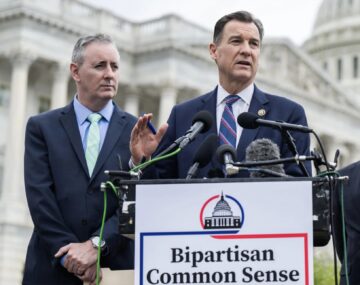
Tom Suozzi, Brian Fitzpatrick; credit: US Gov

I was going to take a break from the topic of redistricting, which has been my main focus for 2026. But then big news happened: the House Problem Solvers Caucus announced on July 1 that they have established a gerrymandering reform framework and a working group to develop legislation to end gerrymandering permanently. They explicitly list “algorithmic mapping”—what I advocate—among the reforms they would support. The Problem Solvers are a militantly bipartisan caucus, which is an important advantage for them in the election reform struggles, which I will get to below. Since not everyone may understand why this announcement is big news, I decided that a summary of the overall redistricting project would be useful: its landscape, parts, and players.

My desired endpoint in this project is national legislation mandating a single algorithm that determines all district boundaries for federal offices. (Why this is the right goal is the subject of my earlier article “Resist, Adapt, Redistrict.”) Many different groups will have to collaborate to reach that desired point. Politicians propose and pass legislation. Their staffs need academics and technical experts to produce plausible algorithms and a consensus as to which one is best. Advocacy groups mobilize support among the public and politicians. Lawyers and legal scholars refine legislation to minimize the court challenges that inevitably arise. Some of these groups will not be able to perform their functions without funding from philanthropic organizations supportive of the end goal. All of these actors influence each other; each category contains factions within it that have competing ideas; and the algorithmic redistricting that I propose is a relatively new concept to all of them.

That is a rough sketch of the terrain. Add in some dynamic factors—the gerrymander war; Supreme Court hostility to racial districting; the increased power of big data computing to game the electoral system—and you can see the forces and the resources that this project for algorithmic redistricting has to manage to end gerrymandering. Read more »

Tuesday, March 24, 2026

How Reform Fails

by Jerry Cayford

Hugo Sundström, CC BY 4.0, via Wikimedia Commons

“Failure is the foundation of success, and the means by which it is achieved,” says the Tao Te Ching. The current competition between our two parties to gerrymander the country—Texas, California, Virginia, Florida—is a stunning failure for democracy reform efforts. Gerrymandering transfers power from the people to the parties, and Americans hate it. By the time this year’s mid-term elections are over, huge numbers of us will have representatives who, we feel, don’t represent us and won unfairly. Many of us will live in states without a single official in Congress from our own party. Nevertheless, we all support this district grab, because we can’t let the other party seize power by gerrymandering more districts than we do. Where are the means to success in failure this big?

Spilt Milk

No one is feeling more defeated than the good-government activists who have worked so long to end gerrymandering and make our elections more fair. The need to respond to extreme gerrymanders has forced them to support the torching of their own work. They are “backpedaling furiously,” as one such activist bluntly puts it: “Decades of reformer work is going up in smoke.” Renewing forward movement will require understanding what happened. Alarmingly, there are signs that the reform community will learn nothing, that it will interpret this defeat as an aberration rather than a refutation of its past work and will return stubbornly to its failed strategy. A different response to failure, though, could build a foundation for success.

What the reform community appears to be overlooking is the golden opportunity this ugly war to gerrymander everything actually presents. It is the opportunity not only to formulate a better strategy, but also to use the power of public anger to solve the problem of creating fair districts once and for all. Redistricting has been mostly a wonkish, back-burner issue, briefly irritating to the public from time to time, but never before commanding the intensity of concern it does now. Right now—with huge amounts of money, political power, and public outrage all focused on gerrymandering—now is when reform can succeed. Read more »

Monday, April 15, 2024

Review: Breaking the Two-Party Doom Loop

by Jerry Cayford

It’s a book about how our political system fell into this downward spiral—a doom loop of toxic politics. It’s a story that requires thinking big—about the nature of political conflict, about broad changes in American society over many decades, and, most of all, about the failures of our political institutions. (2)
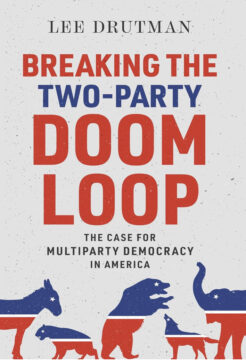
Where to begin fixing our dysfunctional society is about as contentious a question as there is. Lee Drutman’s 2020 book Breaking the Two-Party Doom Loop: The Case for Multiparty Democracy in America confronts it head-on. Chapter 1, “What the Framers Got Right and What They Got Wrong,” goes straight to the heart of the matter: what the Founding Fathers got wrong is political parties. They understood the threat of tyranny that parties (“factions”) posed, but they misunderstood the benefits and inevitability of parties. They structured our government to discourage parties, instead of to accommodate them. As Drutman explains, those structural weaknesses have finally caught up with us in today’s toxic partisanship.

Like the Founders, Drutman gets important things right and wrong. He says, “At its core, my argument can be distilled into two words: institutions matter” (4). Political parties are the institutions he defends and criticizes. What we need parties to provide are substantive choices, not coercive conformity or destabilizing toxicity. This focus on parties is one of the many, many things Drutman gets right in his well-written, informative, and important book. When he turns from diagnosis to solution, though, he gets one big thing wrong. Read more »

Monday, October 30, 2023

Less than Zero

by Jerry Cayford

(Rspeer at the English-language Wikipedia, CC BY-SA 3.0, via Wikimedia Commons)

We think we live in a democracy, though an imperfect one. Every election, our frustrations bubble up in a list of proposed reforms to make our democracy a little more perfect. Usually, changing the Electoral College heads the list, followed by gerrymandering and a motley of campaign finance, voter suppression, vote count integrity, the dominance of swing states, etc. My own frustration is the very banality of this list, its low-energy appearance of arcane, minor, and futile wishes, like dispirited longshot candidates carpooling to Iowa barbecues. Enormous differences among these reforms are masked by the generic label, “electoral reform.”

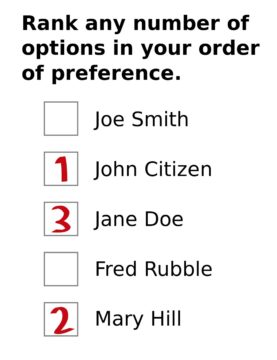
One change—Instant Runoff Voting—should stand alone, for it’s far more important than the others, or even than all of them put together. Democracy is supposed to keep government and voter interests aligned, with elections correcting the government’s course; without runoffs, though, that alignment is elusory because no electoral mechanism really tethers the government to the public interest. Where other flaws in our electoral process have in-built, practical limits on the damage they can do, elections that lack runoffs have no limit on the divergence they allow between leaders and citizens. Which may explain a lot about where we are today.

Many years ago, during the Cold War, I worked for a military policy research company. I had an epiphany there: foreign policy was heavily influenced by the fact that two-player, zero-sum games are easy to analyze. If everything that’s good for the Soviet Union is equally bad for the United States, and vice versa, and no other players matter, it’s easy to settle on a logical action in any situation. Today’s polarized, cutthroat domestic politics is eerily reminiscent of those Cold War foreign policy days. First-past-the-post elections—the kind we mostly have in the U.S., where whoever gets the most votes wins, with or without a majority—produce two parties with perfectly opposed interests and easy “for us or against us” answers. Everyone is familiar with the electoral logic that drives this result: the logic of “spoilers.” The further consequences of spoiler logic, though, are much less familiar. Read more »