
by Jeroen van Baar

Since the murder of UnitedHealthcare (UHC) CEO Brian Thompson drew everyone’s attention to the insurance company, two reports on its dealings have made my blood boil. Background info: UHC’s parent company, UnitedHealth, also owns a service provider branch called Optum and a pharmacy branch called OptumRx. The Wall Street Journal wrote in December that UnitedHealth had bonused Optum doctors to diagnose elderly patients with conditions that did not require treatment but did allow UHC to claim more money from the federal Medicare Advantage fund. Weeks later, the Federal Trade Commission alleged that OptumRx unnecessarily marked up the prices of some life-saving drugs by more than 1,000% to boost revenue, which was made possible by controlling companies throughout the drug supply chain. The profits, of course, were billed to by tax payers and consumers.
It’s particularly easy for me to get mad at all this because—perhaps you guessed it—I am a UHC customer. When I acquired U.S. health insurance last September, I was initially pleased. UnitedHealthcare sounded great: who wouldn’t want to be united, healthy, and cared for? The name of my plan—Choice Plus 80—sounded even better. And I trusted my employer, Columbia University, to select the right insurer for me. I rested easy, knowing I could not be blindsided by Kafkaesque communications and frivolous bills.
That trust is now thoroughly shattered. When I need medical attention, my insurance company might try to draw extra profit. If I just need rest, I might get a costly referral. If I need medication, I might be overcharged. And everyone I deal with in these interactions might secretly be working for The Company. Instead of cared for, I feel exploited; rather than protected, I feel exposed.
At the face of it, the American health insurance debacle is in line with other products’ recently losing their appeal. In online platforms such as Facebook and X, ‘enshittification’ has made the user experience progressively worse as tech companies start to sacrifice quality for advertiser revenue and eventually shareholder value. Aerospace giant Boeing revealed its incompetency when a door plug fell off a plane mid-flight last year, causing passengers to rush to Airbus-only filters on booking sites. And even mundane items like clothes are of much poorer quality than even ten years ago. We tend to respond to all this with a shrug of resignation. Oh well, we say, it’s a shame we can’t trust classic brands anymore, but we’ll just shop around for an alternative.
But insurance is a special case. With insurance, the trust is the product. Indeed, trust itself produces the outcome health insurance is meant to promote in the first place: health. Read more »


 Anjum Saeed. Untitled (After Rumi). 2012.
 In October last year, Charles Oppenheimer and I wrote a
 infamous lepidopteran, Cydia pomonella, or codling moth. The pom in its species names comes from the Latin root “pomum,” meaning “fruit,” particularly the apple (which is why they’re called pome fruits), wherein you’ll find this worm. It’s the archetypal worm inside the archetypal apple, the one Eve ate. (Not. The Hebrew word in Genesis, something like peri, just means “fruit.” No apple is mentioned. And please, give the mother of all living a break.)



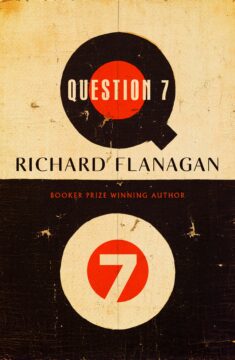 The Australian author Richard Flanagan is the 2024 winner of the prestigious Baillie Gifford Prize for Non-Fiction for his book Question 7. The book is a brilliant weaving together of memory, history, of fact and fiction, love and death around the theme of interconnectedness of events that constitute his life. Disparate connections between his father’s experience as a prisoner of war, the author H.G. Wells, and the atomic bomb all contributed towards making Flanagan the thinker and writer he is today. The book reveals to us his humanity, his love of family and of his home island of Tasmania; it is what Flanagan expects of a book when he says, ‘the words of a book are never the book, the soul is everything’, and this book has ‘soul’.
 After I moved from the UK to the US it took me only a couple of years to cede to my friends’ pleas and start driving on the right. When in Rome, and all that. But I still like to irritate Americans by maintaining that we Brits are better at this essential mechanical skill. I mean, when we drive, we
  Sughra Raza. Ephemeral Apartment Art. Boston January 4, 2025.
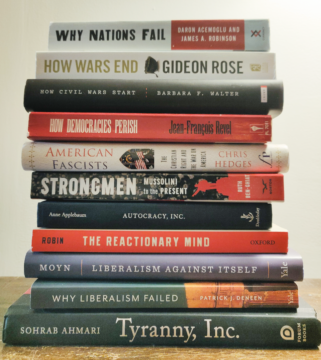 The same media that warned us against Donald Trump now warn us against tuning out. Though our side has lost, we must now ‘remain engaged’ with the minutiae of Mike Johnson’s majority