by Marie Snyder
 We’re being asked to believe six impossible things before breakfast. We have to reckon with several upheavals at once: more conflicts, discrimination, poverty, illness, and natural disasters than many of us have ever seen in our comfortable lifetimes, and without a clear path forward. It’s unsettling. It feels necessary to find courage for this disquieting time. I was recently reminded of Maya Angelou’s words, “Without courage, we cannot practice any other virtue with consistency. We can’t be kind, true, merciful, generous, or honest.” It might help to look back to stories of those who were able to maintain their integrity in the face of prior adversities as we manage this collective anxiety.
Emile Durkheim wrote about this feeling back in 1897. Suicide is a book-length report on the four scenarios that provoke people to give up on life: egoistic, altruistic, fatalistic, and anomic. His discussion of anomy may be a useful warning for today:
“Whenever serious readjustments take place in the social order, whether or not due to a sudden growth or to an unexpected catastrophe, men [referring to all people] are more inclined to self-destruction. …. Man’s characteristic privilege is that the bond he accepts is not physical but moral; that is, social. He is governed not by a material environment brutally imposed on him, but by a conscience. … But when society is disturbed by some painful crisis or by beneficent but abrupt transitions, it is momentarily incapable of exercising this influence. … Appetites, not being controlled by a public opinion become disoriented, no longer recognize the limits proper to them. … The state of de-regulation or anomy is thus further heightened by passions being less disciplined, precisely when they need more disciplining. … A thirst arises for novelties, unfamiliar pleasures, nameless sensations, all of which lose their savor once known. … What blinded him to himself was his expectation always to find further on the happiness he had so far missed. Now he is stopped in his tracks; from now on nothing remains behind or ahead of him to fix his gaze upon. … He cannot in the end escape the futility of an endless pursuit. … Time is required for the public conscience to reclassify men and things.”
Abrupt transitions make it hard to think. Some political figures recognize a crisis as an opportunity because the public isn’t thinking clearly. We go into survival mode and become more animalistic, unable to organize in order to stop questionable policies. We thirst for novelty, using distraction to cope with the upheaval. Time may be required, but what do we do if it feels like there’s a never ending urgent crisis presented, one after another? More clever commenters recognize them as planted distractions to keep us confused, but that doesn’t significantly negate their effectiveness. Read more »
 Does food express emotion? At first glance, most people might quickly answer yes. Good food fills us with joy, bad food is disgusting, and Grandma’s apple pie warms and comforts us. However, these reactions confuse causation with expression. We can see the confusion more clearly if we look at how music can cause emotion. A poorly performed song might make us feel sad but is not expressing sadness. Similarly, I might feel exhilarated listening to Samuel Barber’s serene yet sorrowful Adagio, but the work does not express exhilaration. Bad food might disgust us, but it isn’t expressing disgust, just as great food causes pleasure but doesn’t express it. Expression involves more than causing an effect; it requires communication, revelation, or the conveyance of meaning. Causation is related to expression, but they are not synonymous.
 Of all the jobs I have had over the long years of working, from being


 Anjum Saeed. Untitled (After Rumi). 2012.
 In October last year, Charles Oppenheimer and I wrote a
 infamous lepidopteran, Cydia pomonella, or codling moth. The pom in its species names comes from the Latin root “pomum,” meaning “fruit,” particularly the apple (which is why they’re called pome fruits), wherein you’ll find this worm. It’s the archetypal worm inside the archetypal apple, the one Eve ate. (Not. The Hebrew word in Genesis, something like peri, just means “fruit.” No apple is mentioned. And please, give the mother of all living a break.)


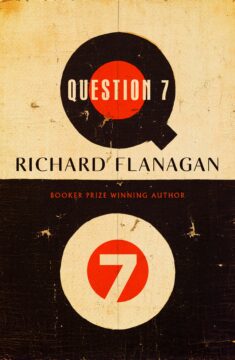 The Australian author Richard Flanagan is the 2024 winner of the prestigious Baillie Gifford Prize for Non-Fiction for his book Question 7. The book is a brilliant weaving together of memory, history, of fact and fiction, love and death around the theme of interconnectedness of events that constitute his life. Disparate connections between his father’s experience as a prisoner of war, the author H.G. Wells, and the atomic bomb all contributed towards making Flanagan the thinker and writer he is today. The book reveals to us his humanity, his love of family and of his home island of Tasmania; it is what Flanagan expects of a book when he says, ‘the words of a book are never the book, the soul is everything’, and this book has ‘soul’.