by Mathangi Krishnamurthy
This is an excerpt from my book manuscript on call center worlds in India. For five months of my research career, I worked the night shift in a transnational call center and taught workers how to speak in an American accent. What follows are my field notes, summarily rearranged into a modicum of a narrative. All names are pseudonyms in order to protect the identities of my interlocutors.
Media create unique aural and perceptual environments, everyday urban arenas through which people move, work, and become bored, violent, amorous and contemplative. (Larkin 2008: 3)
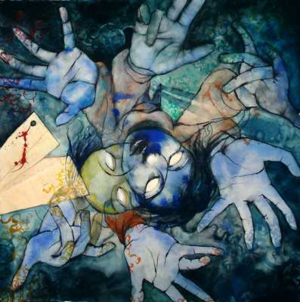
I cannot sleep. Tossing and turning and dreaming have become the order of the day. And yes, day, not night. Sleeplessness has a power over me that I would have scoffed at when in the throes of my diurnal state. In this nocturnality that is now my life, I just cannot sleep. In my now permanently half awake state, I see visions and stray in and out of states of deep dreaming. I snap myself out of one only to enter the next. The zombies of the daytime world amble along even as I deplete my reserves of energy. The milkman outside the door, the children home from school, the “fastest-finger-first” honkers of the cruel street. In one of my dreams, my father is a doppelganger. Of himself.
Every step feels like a potential fall. I tell myself that the trick is to continue the process of living even while fighting the prospect of that which allows us to become most human, sleeping. Smoke some more, drink some more, fight some more. Fight the light, draw the curtains, and dull the sound. Steal airline kits with blinkers and earplugs. Eat when standing. Quickly. Lest I forget to eat before I have to plop onto bed and enter hallucination central, and lest I lose the hand-eye co-ordination needed to last the route from morsel to mouth.
Staying awake is a technique and the call center, a living, breathing, demanding technology. One night I wake up, and I'm trembling. I have slept through my alarm, and I will miss being at work. My body has betrayed me. At this point, there is no clear disappointment or fear or anguish or disapproval. Just a shiver. And a silent anxiety building to nervous crescendo. I call the company's transport desk, already always on speed dial on my phone to see if a cab might be somewhere in my vicinity. The situation is managed, my out of control state abates, and I make it to work. Sashaying into my training session, I address the young workers in quiet confidence and tell them to manage their sleep.