by Jeroen Bouterse
 “…And now to introduce our second panelist: Martha. Martha does believe that academic philosophy is worth pursuing, and she has – of course – written a book about it. Martha, can you briefly summarize your argument?”
M: “Thank you. Yes, well, you can imagine that, though I told my publisher that my book is aimed at a broader audience, I should also like to emphasize that my argument will not easily be shortened to 140 characters. Even though I have no doubt that Rob here would find a way to do so.”
R: “Not in your case, Martha; your books are a three-tweet problem. But in all seriousness: I see what Martha is getting at here. It is the contrast between highbrow academic philosophy and ‘pop philosophy’ – a contrast I believe to be mostly a fiction. The notion that what happens in the universities is real philosophy, and that whatever the public can digest can only be a shadow of that, is misguided. It is an artifact of the fact that a few generations of great philosophers happened to work in a world where the highest intellectual authority was that of the university professor.
That Hegel’s lectures were well-attended does not mean that philosophy is, of its essence, most at home in the university. On the contrary: it is illustrative of the fact that a certain, very abstract type of thinking is suitable to the university. But it is not for school, but for life that we learn; there are other types of philosophy, and I am not ashamed that on my Twitter account I try to connect traditional philosophy to topical and pressing issues. I also write books, by the way..”
M: “That is all well and good, but I’d say that now Rob has replaced one doubtful contrast by another: his approach to philosophy concerns ‘life’, and academic philosophy, by contrast, is scholastic – which apparently means dead or lifeless.”
R: “Those were not my exact words, but I will happily embrace a similar statement in the same spirit: philosophy, in the classical sense of that notion, is not a system of more or less well-founded claims, but a way of life, defined and inspired by a reflective attitude towards life. And yes, that requires it to engage in conversation with life.” Read more »



 My answering machine whirrs. From an echoing room, the chainsaw-voice shouts into a speaker phone:
 One of the philosophical tools that seems utterly obvious to me is the so-called “use/mention distinction”. Because it strikes me as so obvious, it is always baffling to me that people seem to have such trouble with it.
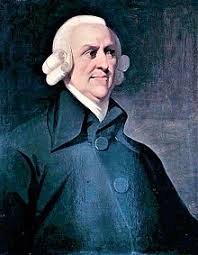 I just read Adam Smith’s The Wealth of Nations for the first time. Not every word. It’s over a thousand pages, and there are long “Digressions” (Smith’s term) on matters such as the history of the value of silver, or banking in Amsterdam, which I simply passed over. I was mainly interested in what Smith has to say about work, so I also merely skimmed some other sections that seemed to have little relevance to my research. Time and again, though, I found myself getting sucked into chapters unrelated to my concerns simply because the topics discussed are so interesting, and what Smith has to say is so thought-provoking. Reading the book is also made easier both by Smith’s admirably lucid writing and by the brief summaries of the main claims being made that he inserts throughout at the left-hand margin.




 It is fashionable to say that great wine is made in the vineyard. There is a lot of truth to that slogan but in fact wine is made by a complex assemblage with various factors influencing the final product. Last month
 From aviation to zoo-keeping, there’s a simple rule for safety in potentially hazardous pursuits. Always keep an eye on the ways that things could go badly wrong, even if they seem unlikely. The more disastrous a potential failure, the more improbable it needs to be before we can safely ignore it. Think icebergs and
 The man for whom the word “Emergency” must have been invented (“serious, unexpected, and often dangerous situation requiring immediate action”) pulled the pin out of yet another hand grenade.

 I’d been living in Tokyo about ten years, when a friend’s father decided to perform a little experiment on me. Arriving one cool autumn evening at their home in suburban Mejirodai, he waved my friend away, telling her: “I want to have a little chat with Leanne.” Sitting down on the sofa across from him, he poured me a cup of tea. In truth, I can’t recall what we chatted about, but about twenty minutes into the conversation, he suddenly clasped his hand together in delight–with what could only be described as a childlike gleam in his eyes– and said, “Don’t you hear something?”