by Mark R. DeLong
“You may be an undigested bit of beef, a blot of mustard, a crumb of cheese, a fragment of underdone potato. There’s more of gravy than of grave about you, whatever you are!” The line from Charles Dickens’ A Christmas Carol came to mind as I scrolled through my Mastodon account. There was #gravy everywhere, with social media-rendered ladles holding warm, sometimes gelatinous wit, too. Initially, I thought it was a mere annoyance. You know, even self-righteous, open-sourced, “fediverse” digital citizens can junk up social media. The #gravy was a hashtag, which is a simple means of labeling a message so that it can be grouped easily.
Using the hashtag, you can get more #gravy (https://mastodon.world/tags/gravy) than you’ll ever need.
Eventually, it became more obvious to me that Mastodon’s #gravy oozed a strategy—the odd “toots” (once called “tweets”on a now defunct social media platform in an earlier and happier time) were merely lip-smacking morsels to deceive the palates of bot barbarians. At least that was my second thought. As it happened, that was ChatGPT’s second thought as well.1The first was that Canadians were celebrating poutine, a concoction of fries, cheese curds, and gravy that the chatbot called “a beloved Canadian comfort food.” Ol’ Chat enumerated its results. At number two: “Others believe #gravy is being used as a viral prank to clutter AI training datasets. The theory: if bots or AI systems scrape common hashtags, flooding one with nonsense posts could ‘pollute’ or mislead the data.” Here, I thought, the LLM “tone” was slightly skeptical, since it labeled its explanation “the theory.” It’s unlikely that AI companies were gravely worried about it; their bots “knew” about the stratagem, after all. Read more »
Footnotes
- 1The first was that Canadians were celebrating poutine, a concoction of fries, cheese curds, and gravy that the chatbot called “a beloved Canadian comfort food.”
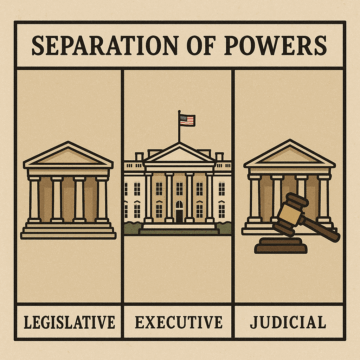 Americans learn about “checks and balances” from a young age. (Or at least they do to whatever extent civics is taught anymore.) We’re told that this doctrine is a corollary to the bedrock theory of “separation of powers.” Only through the former can the latter be preserved. As John Adams put it in a letter to Richard Henry Lee of Virginia, later a delegate to the First Continental Congress, in 1775: “It is by balancing each of these powers against the other two, that the efforts in human nature toward tyranny can alone be checked and restrained, and any degree of freedom preserved in the constitution.” As Trump’s efforts toward tyranny move ahead with ever-greater speed, those checks and balances feel very creaky these days.
 Gozo Yoshimasu. Fire Embroidery, 2017.

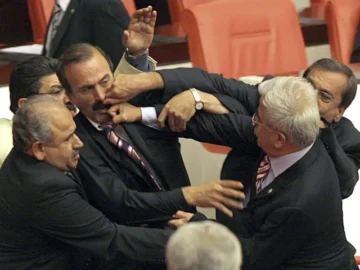
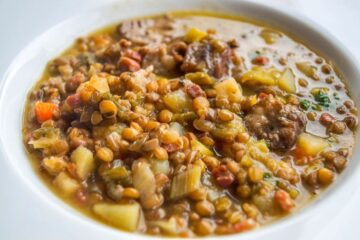 In a culture oscillating between dietary asceticism and culinary spectacle—fasts followed by feasts, detox regimens bracketed by indulgent food porn—it is easy to miss the sensuous meaningfulness of ordinary, everyday eating. We are entranced by extremes in part because they distract us from the steady, ordinary pleasures that thread through our daily lives. This cultural fixation on either controlling or glamorizing food obscures its deeper role: food is not just fuel or fantasy, but a medium through which we experience the world, anchor our identities, and rehearse our values. The act of eating, so often reduced to a health metric or a social performance, is in fact saturated with philosophical significance. It binds pleasure to perception, flavor to feeling, and the mundane to the meaningful.
 Since 1914, the Federal Trade Commission ‘s mission has been to enforce civil antitrust and unfair competition/consumer protection laws. The question is whether this mission has been supplanted—whether the FTC under Trump 2 .0 is becoming the Federal Political Truth Commission.
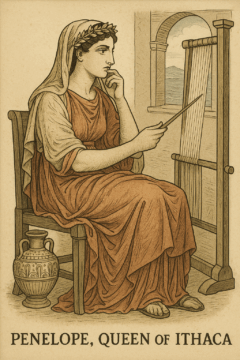

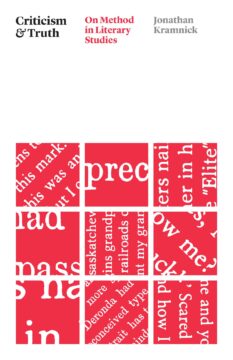 It is now close to 20 years since I completed my Ph.D. in English, and, truth be told, I’m still not exactly sure what I accomplished in doing so. There was, of course, the mundane concern about what I was thinking in spending so many of what ought to have been my most productive years preparing to work in a field not exactly busting at the seams with jobs (this was true back then, and the situation has, as we know, become even worse). But I’ve never been good with practical concerns; being addicted to uselessness, I like my problems to be more epistemic. I am still plagued with a question: Could I say that what I had written in my thesis was, in any particular sense, “true?” Had I not, in fact, made it all up, and if pressed to prove that I hadn’t, what evidence could I bring in my favour? Was what I saw actually “in” the text I was studying?