by Alexander C. Kafka
“The forest is deep. It’s easy for those unfamiliar with its ways to find themselves lost.”
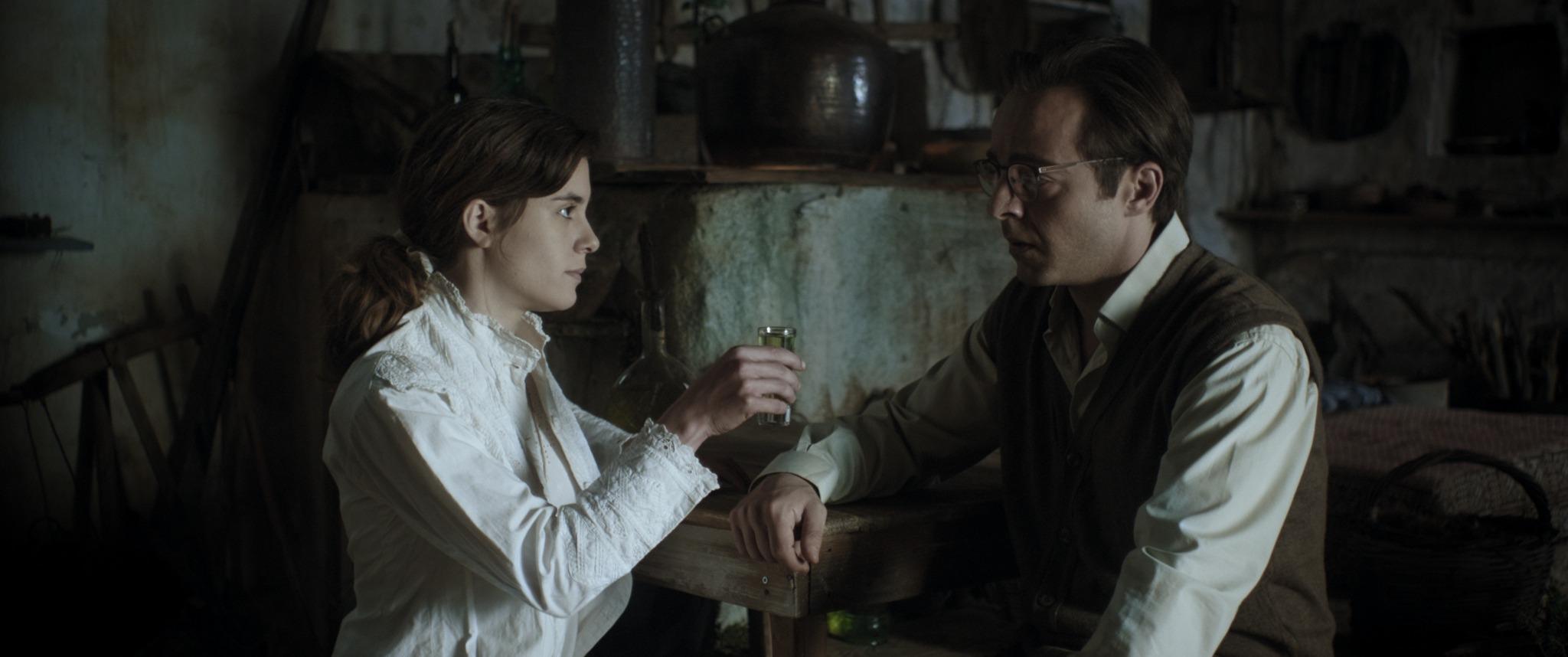
So says a beguiling young woman, Danae (Anastasia Rafaella Konidi), who lives in a tumble-down cabin in the woods. She says this in caution to Panos (Prometheus Aleifer), a doctor who has just moved to a nearby village. Panos, in a moment of cell-phone distraction, nearly ran her over and has tracked her down to see if she’s OK.
She’s not. Marring her wholesome beauty is an alarming intermittent skin condition, although it doesn’t seem to bother her very much. And her father, an old, long-bearded flesh-and-bone maniac, molests her.
Panos wants to go seek help for her. After all, as he tells a villager, “we’re not living in the Middle Ages.” But some women are hard to leave. Very.
Panos and Danae become, as the film’s title reflects, Entwined.
Danae speaks in a peculiarly old-fashioned, literary manner. Obsessed with keeping her hearth fire lit, she lives primitively and seems not of this time, nor of any specific time really. She dresses in loose white skirts and blouses, cooks simple fare, gathers branches, and listens to an eerie violin tune on an ancient, warped phonograph. She’s hospitable, tender, and has a pantheistic reverence for her surroundings.
As Danae casts her spell over Panos, so this defiantly minimalistic, low-budget Greek horror fantasy, director Minos Nikolakakis’s first feature, casts its spell over us.
Its screenplay by John de Holland, who also plays Panos’s half-brother George, is willfully gaunt, though it unmistakably underlines the idea that science can’t explain everything.
Cinematographer Thodoros Mihopoulos brings the woods very much alive — beautiful and more than a bit threatening. Composer Sotiris Debonos’s score combines scratchy strings, neo-baroque themes, and electronic atmospherics. These enhance the resonant tree creaks and bird calls mixed by editor Giorgos Georgopoulos into a hallucinogenic, lulling, primal embrace.
Every now and then we cut away to George, back in civilization and calling repeatedly to see what’s become of Panos. George’s wife assures him that Panos is probably doing just fine.
After all, what horrible force could involuntarily isolate us so completely in the modern world? Add to the 2019 film’s chilling characteristics its power as premonition.
“I need light, not prayers,” Panos irritably tells a muttering villager at a patient’s bedside. But as it turns out, the good doctor may need both.
 I often hear it said that, despite all the stories about family and cultural traditions, winemaking ideologies, and paeans to terroir, what matters is what’s in the glass. If a wine has flavor it’s good. Nothing else matters. And, of course, the whole idea of wine scores reflects the idea that there is single scale of deliciousness that defines wine quality.
 Finally, outrage. Intense, violent, peaceful, burning, painful, heart-wrenching, passionate, empowering, joyful, loving outrage. Finally. We have, for decades, lived with the violence of erasure, silencing, the carceral state, economic pain, hunger, poverty, marginalization, humiliation, colonization, juridical racism, and sexual objectification. Our outrage is collective, multi-ethnic, cross-gendered and includes people from across the economic spectrum. One match does not start a firestorm unless what it touches is primed to burn. But unlike other moments of outrage that have briefly erupted over the years in the face of death and injustice, there seems to be something different this time; our outrage burns with a kind of love not seen or felt since Selma and Stonewall. Every scream against white supremacy, each interlocked arm that refuses to yield, every step we take along roads paved in blood and sweat, each drop of milk poured over eyes burning from pepper spray, every fist raised in solidarity, each time we are afraid but keep fighting is a sign that radical love has returned with a vengeance.


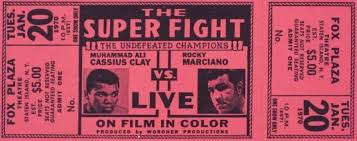


 During the 1990s, the impossibility of a black president was so ingrained in American culture that some people, including many African Americans, jokingly referred to President Bill Clinton as the first “black president.” The threshold Clinton had passed to achieve this honorary moniker? He seemed comfortable around black people. That’s all it took.
 I serve as the family cook as well as the family DJ, so no dinner party preparation is complete without a small stack of CDs waiting for guests to arrive. When the doorbell rings and my wife Alma walks to the front door to greet our earliest guests, I idle the burners on the stove and hurry to the living room stereo, where I press Play for the first CD. A song should already be in progress before the exchange of Hellos, because music, like furniture, is a form of home decoration, filling and defining silence the way a couch or chair fills and defines space. The music must be dialed low, just enough for a home to express quiet domestic welcome. I like to think that I’m long past my ancient feckless undergraduate days of booming a song through an open window.
 Perhaps imprudently, your humble blogger continues to toil in the philosophy mines for blogging material, even in this stressful time. And there will be such postage eventually, of that you can be sure! However, prudence enough remains to prevent him from posting half-baked nonsense; so in the interim, let us return once again to the podcast, and enjoy some fine music while we wait.
 We have argued in