
by Jochen Szangolies
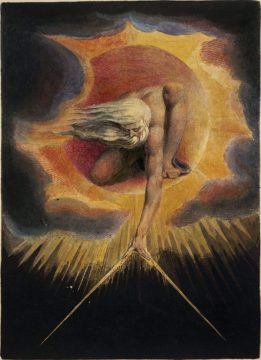
In the beginning there was nothing, which exploded.
At least, that’s how the current state of knowledge is summarized by the great Terry Pratchett in Lords and Ladies. As far as cosmogony goes, it certainly has the virtue of succinctness. It also poses—by virtue of summarily ignoring—what William James called the ‘darkest question’ in all philosophy: the question of being, of how it is that there should be anything at all—rather than nothing.
Different cultures, at different times, have found different ways to deal with this question. Broadly speaking, there are mythological, philosophical, and scientific attempts at dealing with the puzzling fact that the world, against all odds, just is, right there. Gods have been invoked, wresting the world from sheer nothingness by force of will; necessary beings, whose nonexistence would be a contradiction, have been posited; the quantum vacuum, uncertainly fluctuating around a mean value of nothing, has been appealed to.
A repeat motif, echoing throughout mythologies separated by centuries and continents, is that of the split: that whatever progenitor of the cosmos there might have been—chaos, the void, some primordial entity—was, in whatever way, split apart to give birth to the world. In the Enūma Eliš, the Babylonian creation myth, Tiamat and Apsu existed ‘co-mingled together’, in an ‘unnamed’ state, and Marduk eventually divides Tiamats body, creating heaven and earth. In the Daoist tradition, the Dao first exists, featureless yet complete, before giving birth to unity, then duality, and ultimately, ‘the myriad creatures’. And of course, according to Christian belief, the world starts out void and without form (tohu wa-bohu), before God divides light from darkness.
In such myths, the creation of the world is a process of differentiation—an initial formless unity is rendered into distinct parts. This can be thought of in informational terms: information, famously, is ‘any difference that makes a difference’—thus, if creation is an act of differentiation, it is an act of bringing information into being.
In the first entry to this series, I described human thought as governed by two distinct processes: the fast, automatic, frequent, emotional, stereotypic, unconscious, neural network-like System 1, exemplified in the polymorphous octopus, and the slow, effortful, infrequent, logical, calculating, conscious, step-by-step System 2, as portrayed by the hard-shelled lobster with its grasping claws.
Conceiving of human thought in this way is, at first blush, an affront: it suggests that our highly prized reason is, in the last consequence, not the sole sovereign of the mental realm, but that it shares its dominion with an altogether darker figure, an obscure éminence grise who, we might suspect, rules from behind the scenes. But it holds great explanatory power, and in the present installment, we will see how it may shed light on James’ darkest question, by dividing nothing into something—and something else.
But first, we need a better understanding of System 2, its origin, and its characteristics. Read more »

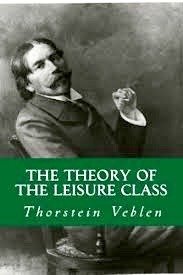 Thorstein Veblen’s The Theory of the Leisure Class is a famous, influential, and rather peculiar book. Veblen (1857 – 1929) was a progressive-minded scholar who wrote about economics, social institutions, and culture. The Theory of the Leisure Class, which appeared in 1899, was the first of ten books that he published during his lifetime. It is the original source of the expression “conspicuous consumption,” was once required reading on many graduate syllabi, and parts of it are still regularly anthologized.


 Last month
  My Jewish maternal grandparents came to America just ahead of WWII. Nearly all of my grandmother’s extended family were wiped out in the Holocaust. Much of my grandfather’s extended family had previously emigrated to Palestine.

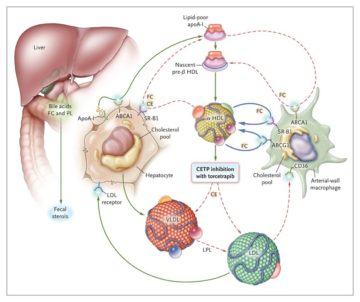 shocking. Torcetrapib, for example, failed at the very end of its phase III trial. So many resources had been expended to get that far in development. Everything spent was lost. All that remained was a big data pile worth virtually nothing, along with pilot plants that were built to supply the drug to thousands of patients across years of clinical trials.
 “The American way of life is not up for negotiation.” —George HW Bush to the assembled international diplomats at the Earth Summit in Rio de Janeiro, 1992
 Not since the Civil War and Reconstruction has the citizenry in the United States been so divided. In our current
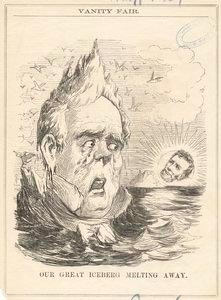 November 6, 1860. Perhaps the worst day in James Buchanan’s political life. His fears, his sympathies and antipathies, the judgment of the public upon an entire career, all converge into a horrible realty. Abraham Lincoln, of the “Black Republican Party,” has been elected President of the United States.