by Rafaël Newman

Language changes. And I’m fine with that, particularly since it wouldn’t make any difference if I weren’t. I have made my peace with the attrition of the oblique case of the interrogative pronoun—“Who to follow”1 instead of whom; with the replacement of the subjunctive by the indicative in result clauses—“Yet the exorbitant must be rendered exemplary or typical in order that her life provides a window onto the lives of the enslaved in general,”2 rather than provide, to express a hoped-for outcome; with the transformation of i-a-u ablauts (ring-rang-rung, sink-sank-sunk) into semi-deponent verbs—“For the surface agitation of the passing car as it sunk grazed something very profound,”3 where the past participle is used instead of sank, the simple past; by the extension of the subjective “suspicious” to cover the objective “suspect”—a suspicious person is now not so much the one who harbors a suspicion of foul play, as the one who is suspected of it (no examples needed here; simply round up the usual suspects).
I can intuit the unconscious force behind such deformations, all of which perform the characteristic work of linguistic development: which is to simplify by removing or replacing forms no longer required for disambiguation, or whose vestigial inflection remains stranded after the tide has borne out most of their company (as in the case of whom, in the mostly no longer inflected idiom of modern English).
What I cannot bring myself to accept, however, whether in common speech or in (astonishingly) unedited written accounts, is the creeping use of the nominative “I” in compound objects (“Susan and I”), both direct and indirect, where the oblique “me” (that is, the accusative or dative form of the word) would be reflexively supplied were the object used by the speaker in uncompounded form. Read more »

 Junya Ishigami. Serpentine Gallery Pavilion, 2019.

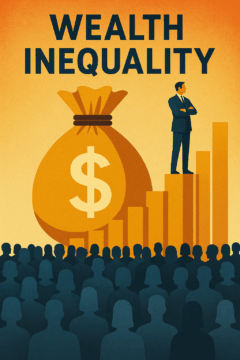 By many measures wealth inequality in the US and globally has increased significantly over the last several decades. The number of billionaires has increased at a staggering rate. Since 1987, Forbes has systematically verified and counted the global number of billionaires. In 1987, Forbes counted 140. Two decades later Forbes tallied a little over 1000. It counted 2000 billionaires in 2017. In 2024 it counted 2,781, and in March this year it counted 3,028 billionaires (a 50% increase in the number of billionaires since 2017 and almost a 9% increase since 2024).
 Recently I’ve noticed that a new wave of
 There was a prevailing idea, George Orwell wrote in a 1946 essay



 Rania Matar. Samira, Jnah, Beirut, Lebanon, 2021.