by Jonathan Kujawa
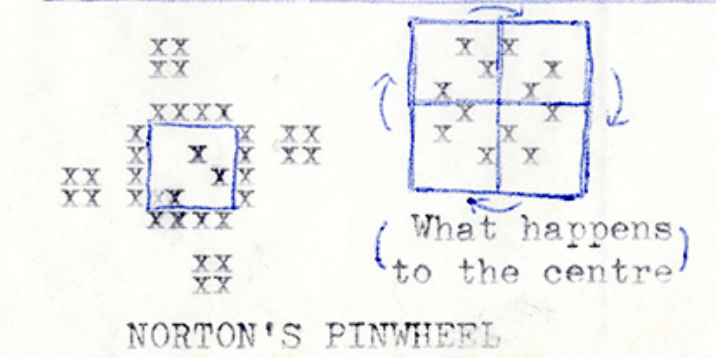
John Conway invented the Game of Life in 1970, and it remains an active area of research and play fifty-six years later.
John Conway was a deeply original mathematician who made important contributions to multiple areas of mathematics. Indeed, when Dr. Conway passed away in 2020, I wrote an entire 3QD essay about his work and, as interesting as it is, the Game of Life (or GoL) didn’t make the cut.
The rules of GoL are deceptively simple. It is a zero-player game. This means that once the game starts, it runs on its own with no further player intervention. It is played on a very, very large grid of one-by-one squares that we will call “cells”[1]. Each cell can be “alive” or “dead”. In each turn of the game, an alive cell can remain alive, or die, and a dead cell can remain dead, or spring to life. In each turn of the game, whether a cell lives or dies depends solely on the state of its eight neighbors:
- a living cell with 2 or 3 living neighbors remains alive, and otherwise it dies [2];
- a dead cell with exactly 3 living neighbors springs to life, and otherwise it remains dead [3].
That’s it.
To play the game, in the zeroth turn you, as the creator deity, decide which cells are alive and which are dead. Thereafter, the game plays itself, turn-by-turn, and you watch your universe unfold:
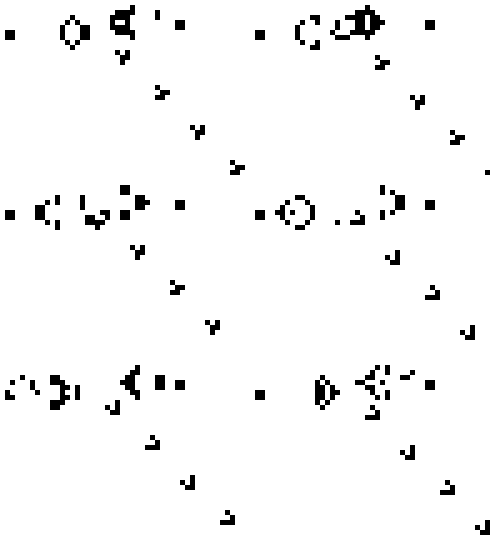
Conway discussed the origins of GoL in an interview with the Numberphile folks. He described how he was originally motivated by John von Neumann’s work on self-replicating machines. However, von Neumann’s machines had 19 different possible states. No doubt with the aphorism “Make everything as simple as possible, but not simpler” in mind, Conway spent months tinkering with the GoL rules until he was down to two states and two rules. Despite the simplicity, the game remained interesting.
By “interesting”, Conway meant unpredictable. This was Conway’s deep philosophical insight: saying GoL is unpredictable is to say that it is capable of anything, and if GoL is capable of anything, then it should be capable of everything [5]. That is, despite its simple algorithmic rules, GoL should be capable of arbitrary complexity. And indeed, in 1982, Conway proved that GoL is Turing-complete. Something is Turing-complete if it can simulate any Turing machine and, hence, can simulate any computer and perform any computation. Read more »




 Sughra Raza. Waking Up In Butaro, November 2023.
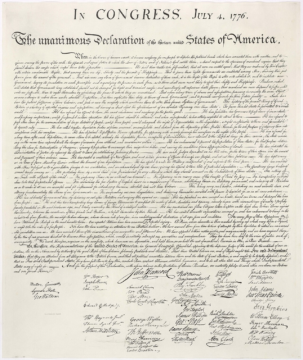 Now that Americans are celebrating the 250th anniversary of the Declaration of Independence, it is worth visiting its metaphysical foundations. Many don’t talk about “the metaphysics of the Declaration of Independence.” But the story about where this metaphysics has taken America and where it could take it can be both inspiring and surprisingly alarming.
 This Fourth of July I find myself feeling more patriotic than I have in years. That may strike many people as strange, even tone-deaf, given the political moment we are living through. I understand the reaction. Yet the feeling is genuine, and it rests on two convictions that have only grown stronger over the two decades I have lived in this country.