
by Ken MacVey
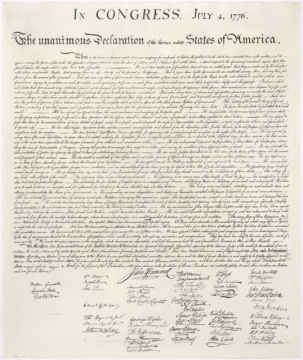 Now that Americans are celebrating the 250th anniversary of the Declaration of Independence, it is worth visiting its metaphysical foundations. Many don’t talk about “the metaphysics of the Declaration of Independence.” But the story about where this metaphysics has taken America and where it could take it can be both inspiring and surprisingly alarming.
What is meant by “metaphysics”? A Merriam-Webster dictionary definition is as good as any: “the philosophical study of the ultimate causes and nature of things.” That the Declaration of Independence is steeped in metaphysics is evident from its opening paragraphs. The first paragraph opens by invoking the authority of “the Laws of Nature” and “Nature’s God.”
The second paragraph famously continues: “We hold these truths to be self-evident that all men are created equal, that they are endowed by their Creator with certain unalienable rights, that among these are life, liberty, andt of happiness–That to secure these rights, governments are instituted among men, deriving their just powers from the consent of the governed, that whenever any form of government becomes destructive of these ends, it is the right of the people to alter or to abolish it . . .”
The Declaration then proceeds to submit “ facts . . . to a candid world” that document 27 alleged breaches and wrongs committed by King George III against the American colonies and their inhabitants.
The Declaration closes by asserting it is “appealing to the Supreme Judge of the World” for a declaration that the political connections between [the American colonies] and the State of Great Britain . . . ought to be totally dissolved” and that the colonies were now “free and independent states.”
Thomas Jefferson authored the first draft of the Declaration. Although revised with input from Benjamin Franklin, John Adams, and others, the structure and themes of Jefferson’s initial draft remained largely intact.
How Jefferson Framed the Declaration of Independence Like a Breach of Contract Lawsuit
Not often mentioned, Jefferson had already been a successful practicing lawyer well versed in English law when he wrote his draft in 1776. He was admitted to the Virginia bar in 1765 and handled 900 cases until he turned over his practice in 1774 to his friend Edmund Randolph.
Although the Declaration of Independence sounds in metaphysics, structurally, it is shaped like a breach of contract lawsuit. In fact, it is entirely possible Jefferson as a lawyer for a plaintiff in such a lawsuit could have pled in mundane legalese and generalities something like this: “Plaintiff and defendant agreed to and entered into a contract. Defendant willfully breached the terms of the contract. These breaches are material and thereby entitles the plaintiff to terminate the contract. Plaintiff hereby voids the contract and seeks judgment declaring that the contract is void and non-binding on plaintiff.”
Jefferson in drafting the Declaration of Independence dispensed with such stilted legal pleading. The rhetorical power of the Declaration echoes to this day. But what is not so apparent is that the case presented in the Declaration was strategically brilliant.
How Jefferson Used Natural Rights to Prosecute His Case Against King George III
Unlike in an ordinary contract lawsuit against an ordinary citizen, Jefferson faced the problem there were no formal legal principles, contract or otherwise, that he could draw on to prosecute a case against the King of England. Most daunting was the fact that King George III retained ultimate legal authority under what was called the “Royal Prerogative” by which he created courts and appointed judges. The other problem Jefferson faced was that King George as king held the title of “Supreme Governor of the Church of England,” thereby wielding earthly religious administrative authority supposedly bestowed by God.
So what was Jefferson to do? Jefferson summoned metaphysical principles of natural law and rights to construct an alternative “legal” and theological authority superior to King George’s claim of legal and theological authority.
Reliance on natural law was not new to Jefferson. In 1770 in a case called Howell v. Netherland Jefferson represented without charge Samuel Howell, an indentured servant. Howell was the grandson of a white grandmother and a Black grandfather. Under a 1723 Virginia statute a child of mixed-racial background was consigned to being an indentured servant to the age of 31. Jefferson challenged Howell’s status as an indentured servant. He made two arguments. He argued that under the correct interpretation of the statute, it did not apply to grandchildren. He also argued that applying the statute to Howell violated Howell’s natural rights. In his brief he wrote: “All men are born free and everyone comes into the world with a right to his own person and using it at his own will. That is what is called personal liberty, and is given him by the authority of nature, because it is necessary for his own sustenance.”
Jefferson lost. But his core theory of natural rights was not lost on him or others. Historians agree (with a dissenting view by historian Garry Wills) that John Locke and his social contract theory of government greatly influenced Jefferson and his contemporaries. In his 1679 Two Treatises of Government Locke argued that individuals in a supposed state of nature owned themselves and as a result owned the fruits of their labor. In this state of nature individuals therefore already had natural rights. Government was formed by their consent in order to better secure rights to “life, liberty, and property.” Jefferson borrowed this phrase from Locke’s treatise but substituted the word “property” with the phrase “the pursuit of happiness,” a phrase Locke had used in his “An Essay Concerning Human Understanding.”
The concept of natural rights is a subset of what has been called natural law. Black’s Law Dictionary (11th ed.) defines “natural law” as “a philosophical system of legal and moral principles purportedly deriving from a universalized conception of human nature or divine justice rather than from legislative or judicial action.” Versions of natural law have lineage traceable to the Stoics, Aristotle, Aquinas, and such writers on jurisprudence as Grotius and Pudendorf in the 1600s and in the 1700s William Blackstone in his often-cited treatise, Commentaries on the Laws of Britain. Natural rights are creatures of natural law.
The Declaration of Independence’s assertion of natural rights rests on both nature and theology. As previously mentioned, its opening paragraph invokes “Laws of Nature” and “Nature’s God.” It is generally understood by historians “Nature’s God” is a “deistic” concept of God. Jefferson, Adams, and Franklin were deists. There were varieties of deism but one key version of deism considered “God” or the “Creator” to be a law giver of natural laws who as creator assembled the machinery of the universe, got it going, and let it run on its own course under the laws of nature without further supernatural intervention. As deists, Jefferson, Adams, and Franklin did not recognize the divinity or miracles of Jesus but respected the moral authority of teachings in the New Testament. In fact, Jefferson took a razor to the New Testament where he cut out the passages on miracles and divinity but retained the portions he approved, which consisted of quotations from Jesus (now known as “the Jefferson Bible”).
Thus “Nature’s God” and the Church of England’s “God” were two distinct and vying theological concepts. By invoking the “Laws of Nature,” Jefferson was able to extend a claim of moral jurisdiction over King George despite George’s authority as the king of Great Britain. English law was morally subservient to a higher law, namely natural law. By invoking “Nature’s God” Jefferson was also able to appeal to divine authority superior to King George’s authority as the Supreme Governor of the Church of England. Nor could King George’s legal authority ever extend to overruling natural law, which governed all of humanity, not just British subjects.
In January 1776, deist Thomas Paine published his pamphlet “Common Sense,” which spread like wildfire throughout the colonies and which inflamed Americans so much they stopped talking about making demands on Great Britain and started discussing instead terminating any political relationship with Great Britain altogether. In his essay Paine took apart point by point any claim that King George’s authority over American “subjects” came from power delegated by God to British kings (which exaggerated King George’s actual position).
The Declaration of Independence was the coup de grace in executing Paine’s argument. The Declaration inverted any possible claim regarding the delegation of divine authority. King George’s alleged authority was top down: God vested governing authority to kings resulting in King George being above his “subjects.” In contrast, the Declaration’s chain of authority was bottom-up: the Creator endowed individuals with fundamental rights. By consent among themselves, these individuals delegated to the state the authority to govern over them, but on the condition that the government was to secure and protect fundamental rights to life and liberty.
As shaped by Jefferson, the Declaration of Independence was framed like a breach of contract case against King George. But the contract in question was not an actual contract but the social contract postulated by Locke and others based on natural law and rights.
The Constitution, Not Natural Law, becomes the Supreme Law of the Land
In 1789, the Constitution was ratified and declared it was “the supreme law of the land.” How did the idea of natural law and rights fare under these circumstances? In Calder v. Bull the US Supreme Court in 1798 was confronted with the question whether a civil Connecticut statute violated the Constitution’s ban on ex post facto laws. All of the justices agreed it didn’t. But Justice Chase decided to comment that “a law that takes property from A and gives it to B . . . is against all reason and justice.” Justice Chase did not believe Connecticut’s law fell into that category. Justice Iredell agreed the Connecticut law was constitiutional but rejected the idea courts could void laws for being “contrary to the principles of natural justice” because the “ideas of natural justice are regulated by no fixed standard.”
Thereafter, from time to time in the 1800s, some Supreme Court justices would invoke the authority of “natural justice” but no legal precedent explicitly held natural law was an independent basis for striking down laws and governmental actions.
Lincoln Inverts the Declaration of Independence to Contain Rebellion
Lincoln is well known for invoking the Declaration in the Lincoln-Douglas debates to make his moral case against slavery. He also invoked it as president. In his 1863 Gettysburg Address, Lincoln began: “Four score and seven years ago our fathers brought forth on this continent, a new nation, conceived in Liberty, and dedicated to the proposition that all men are created equal.”
Once again, by powerful rhetoric, the Declaration of Independence was masterfully used to flip a claim of moral authority. The Declaration of Independence was used by Jefferson to justify a rebellion and severance of ties with a nation. Lincoln invoked the authority of the Declaration to do the opposite, namely, to constrain a rebellion and its attempt to sever ties with a nation. In doing so, Lincoln helped make the Declaration of Independence foundational in defining the nation’s purpose and being.
New Philosophical Foundations are Developed for Individual Rights
The Declaration’s endorsed values of equality and liberty have taken a life of their own independent of natural law. English utilitarian philosopher Jeremy Bentham in 1796 dismissed natural inalienable human rights as “nonsense upon stilts.” To him rights were solely a product of law, which should be shaped by the principle of utility, which in turn calls for maximizing happiness of the greatest number. Yet, John Stuart Mill, mentored by Bentham and a staunch advocate of utilitarianism, endorsed almost absolutist libertarian rights in his famous essay “On Liberty.” In other words, despite their rejection of natural law and rights, utilitarians remained in the camp supporting the values of liberty and the promotion of happiness integral to the Declaration of Independence.
Contemporary philosophers, such as John Rawls, Alan Gewirth, and Ronald Dworkin have also developed non-natural law moral theories supportive of individual rights. And even followers of atheist Ayn Rand claim her ethical egoistic philosophy aligns with the Declaration of Independence’s commitment to human rights.
Natural law theory as understood in the 1600s and 1700s has thus fallen from the high perch it held when the Declaration of Independence was written. There do remain self-described natural law theorists—philosopher John Finnis is a prominent example—and natural law particularly has its following in Catholic circles. Nevertheless, the Declaration of Independence’s endorsement of liberty and equality and the premise that government is to serve and not to be served stand on their own as part of America’s vision of itself. The same cannot be so easily said about the idea of natural law.
Some Supreme Court Justices Still Invoke Natural Law
Does that mean the Declaration’s metaphysical framework of natural law and rights is dead as a judicial matter? No. In fact, the issue of natural law came up in Clarence Thomas’ nomination for the Supreme Court. In his 1991 confirmation hearing Thomas was questioned on his prior comments that seemed to endorse using natural law to adjudicate cases. Apparently, the concern was that natural law might be used as a rationale for overturning Roe v. Wade. Thomas tried to quell these fears by testifying: “I do not think you can use natural law as a basis for constitutional adjudication, except to the extent that it is the background in our Declaration. . . [and]it is certainly something that has formed our Constitution, but I don’t think that it has an appropriate role directly in constitutional adjudication.”
Despite this disclaimer, Thomas appears to remain a firm proponent of natural law. On June 23rd, the Supreme Court ruled in Pung v. Issabella County that a tax foreclosure sale of property did not violate the Fifth Amendment’s just compensation clause. But Justice Thomas decided to write a brief concurring opinion joined by Justice Neil Gorsuch. In that opinion Thomas quoted himself from a prior dissenting opinion in which he said “property is a natural, fundamental right.” He went on: “The ‘principal aim of society is to protect individuals in the enjoyment of those absolute rights, which were vested in them by immutable laws of nature.’ W. Blackstone, Commentaries on the Laws of England, 120, 135 (1765) …”
So it appears that “natural law,” at least for two Supreme Court justices, is not dead for purposes of constitutional adjudication after all.
Indeed, Gorsuch is ideally poised to wave the natural law banner. Gorsuch obtained a doctorate in philosophy at Oxford. His dissertation was supervised by natural law philosopher John Finnis. Finnis is best known for his theory of “natural goods” as a foundation of natural rights. But Finnis has also shown another side of natural law theory—namely, how it can demarcate what is “unnatural.” Finnis has controversially declared contraception is unnatural and homosexuality is akin to bestiality. This raises the question can natural law metaphysics be used to erase what were once considered rights?
How the Metaphysics of the Declaration of Independence Once Again Could be Used to Turn Matters on Their Head
A case in point is abortion.
There is a burgeoning movement to declare a fetus a person under the 14th Amendment and thereby render abortion unconstitutional for violating the fetus’ right to life. Legal scholar Josh Craddock in a National Review article titled “Our Pro-Life Constitution—The originalist case for unborn personhood” wrote this about the 14th Amendment: “The original meaning of this clause [the equal protection clause] was to secure . . . the fundamental rights of persons—including the rights to life and personal security as these rights had been expounded in Blackstone’s Commentaries on the Laws of England . . . If a state protects some persons in their rights, and it is constitutionally required to protect some persons in their rights to life and personal security, then it is constitutionally required to protect all persons—including the unborn.”
On the other hand, rightist Justice Scalia in his book Reading Law (co-written with Bryan Garner) disapproved using natural rights theory to adjudicate cases: “If a judge adheres to the . . . natural-right theory of justice (holding that justice is based not on positive law but on natural right, rendering each person his due as a human being regardless of the positive law), then the judge will likely seek to discount statutory provisions that do not coincide with the judge’s own perception of social good or natural right.”
One way to navigate Scalia’s position and maintain conservative purity is not to invoke natural rights theory directly but instead, as Thomas apparently tried to do in his Senate confirmation hearing, only claim it as historical background relevant in interpreting the Constitution. We should not be surprised to see in the not-too-distant future an attempt in the courts to ban abortion by sneaking natural law metaphysics of the Declaration of the Independence through the back door of originalism. The Declaration of Independence could then be used once again to turn things on their head: not only is there no constitutional right to abortion as once held under Roe v. Wade–there is actually a constitutional prohibition against it.
Where else could natural law theorization take us? Justice Gorsuch has given us a possible preview. Justice Gorsuch in 2009 published his book, The Future of Assisted Suicide and Euthanasia, which is based on his doctoral dissertation supervised by Finnis. In this book Gorsuch argued that government should sometimes impose “paternalistic constraints on the choices of its citizens.” He further argued that the principle of the inviolability of human life justifies rejecting what are sometimes called death with dignity laws, which have been enacted in Oregon, California, and other states, that allow for physician assisted dying of patients suffering from incurable terminal illnesses.
Justice Thomas has also given us a preview. In his concurring opinion in the Dobbs decision which overturned Roe v. Wade, he called upon the Supreme Court to overturn its rulings protecting access to contraception and establishing the right to same-sex marriage.
How all this unfolds remains to be seen. But we face the very real prospect that natural law metaphysics that once fueled the Declaration of Independence will be revived in an attempt to judicially constrain what had previously been considered individual rights.