
by Mike Bendzela
With the Strait of Hormuz in a state of constipation, we’re forced to think about things we’d rather not think about, or, rather, things that until now seemed beneath thought because they are so ubiquitous as to be effectively invisible, like air. I can’t think of an adequate analogy for our predicament, except to imagine an organism that has managed to swap out, molecule for molecule, its native substrate constitution for a freshly discovered, new and improved substrate that allows the organism to perform at levels it never before dreamed possible.
Suddenly, the organism can fly, live comfortably just about anywhere on the planet it pleases, grow more food than it needs rather than scrounging for it, extend its lifespan beyond its natural limits, and chat freely with others of its kind all around the globe. One thing these organisms discuss with one another (fruitlessly, it seems) is that this new molecular substrate has two catastrophic drawbacks: It is both highly toxic and ephemeral. The organism’s progress has an expiration date, it seems, beyond which its substrate poisons the organism and the environment, then it vanishes.
Our new substrate (by “new” I mean merely about 250 years old, approximately since the onset of the Industrial Revolution, a mere blink for a genus that has walked the globe for close to two million years) is fossil carbon, which has shouldered aside living carbon and set up house even within our very bodies and culture. Coal gives us heat, smelting of metals, and electricity generation. Oil gives us liquid fuels and chemical feedstocks. Natural gas (methane) adds to that mix the ability to synthesize nitrogenous fertilizers from mere air, which compounds are then incorporated into our very bodies. Energy expert Vaclav Smil has famously pointed out that this fossil carbon allows us to prop up modern civilization on four mighty pillars: Concrete, steel, ammonia, and plastics. Given that even wind turbines and solar photovoltaic cells depend utterly upon the products and processes of this fossil carbon substrate, it should be apparent that “green” technologies really aren’t so green after all. They’re just the latest users of fossil carbon.
The trajectory of this carbon through civilization is mind-numbingly obvious: It starts in mines and wells, it goes to construct and power modern societies (passing through maritime straits along the way), and finally it degrades into CO2 which passes into the atmosphere as heat-trapping waste. Short of waiting around tens of millions of years for that carbon to be re-sequestered into plants, re-deposited in sedimentary formations, and baked over geological time into new fossil resources, that trajectory is decidedly one-way, from deposition, to depletion, to despoilation.
I’ve come to see that we are not to blame for this state of affairs: What did we expect a ravenous, big-brained ape to do upon discovering this cornucopia in the earth’s crust? Not one of us chose to be conceived during the Fossil Fuel Age. We’re born into modern industrial society and bound to follow its ways as surely as worker bees are born into the hive and bound to follow the life cycle of the honeybee. In short: I confess that at age sixteen my second favorite obsession was getting my driver’s license.
The Hormuz crisis might be in the process of giving us a foretaste of the inevitable; short of a wholesale transformation of our species, the state of things to come looks bleak. Such a glance makes the current sorry state of politics look quaint. A gander at plastics alone is enough to raise the hair on my sorry-ass, fossil carbon-dependent head.
*
In a hilarious irony, I was converted to the use of plastics in gardening after working for four summers at an organic farm. Currently, “I don’t see no p’ints about that frog that’s any better’n any other frog,” as Mark Twain’s character Smiley might put it. In other words, organic food is fine, but non-organically grown food is just as fine. The differences in growing techniques are basically fly specks in the broad view. I’ve since eschewed any pretenses of growing vegetables organically.
At that the summer job I discovered that commercial organic farming (as opposed to gardening) owes its existence to three primary dependencies: Liquid fuels (diesel and gasoline), electricity, and plastics, just as so-called conventional farming does. For this, organic farmers may be forgiven. As any grower comes to realize, Nature hates your farm and will throw everything at it to destroy it: Inclement weather, weeds, pests of every stripe, disease, and just plain antipathy for things not grown in their proper places. Plastics shielded the little organic farm from these forces. Plastics were thus ubiquitous at the place in various forms: Irrigation lines and fittings, pots and flats, row covers and mulch, greenhouse coverings, equipment (such as backpack sprayers), plastic bags — oodles and oodles of plastic bags — to keep vegetables crisp and fresh and succulent until delivered to farmers markets.
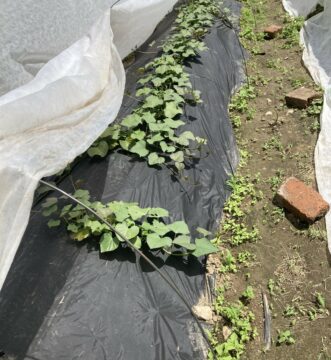
After my gig at the organic farm, I along with three partners ran a two-acre CSA (Community Supported Agriculture) at the small farm where I live. We cultivated an acre of vegetables and another acre of mixed fruit trees for about a dozen subscriber families from May through October. It was fun but a ton of work, so we lasted less than a decade. Throughout it all, I continued to learn the lesson that plastic is my friend. In the illustration above, you see sweet potato vines beginning to spread out over a mound of soil covered in polyethylene agricultural sheeting (plastic mulch). This keeps the Maine soil at tropical temperatures and suppresses weeds, the perfect environment for these Ecuadoran natives. Beneath that sheeting you can see the outline of a plastic drip hose running along the row, which allows easy irrigation during the dry months. The whole row is covered over with a spunbonded polyester row cover (the white fabric in the photo) supported by galvanized wire hoops. This keeps in warmth, excludes wind and pests, and foils the deer, woodchucks, rabbits and other herbivores inclined to chomp back the vines.
This system works so well that I use it throughout the garden. I mulch many crops with plastic and cover nearly all of them with poly fabric (corn and trellised tomatoes and cucumbers are too tall to cover). This allows me to forgo having to raise an expensive fence around the plot (so long as the deer never get an urge to peek beneath the row covers). I use plentiful plastic hosing to irrigate the rows and connect a line from the house to the garden. Without plastic I would be severely challenged in how to start all my seedlings. I don’t buy expensive plants from greenhouses, if I can avoid it: Aside from direct-seeding beans, I start everything in plastic flats and transfer the seedlings to plastic pots or cells.
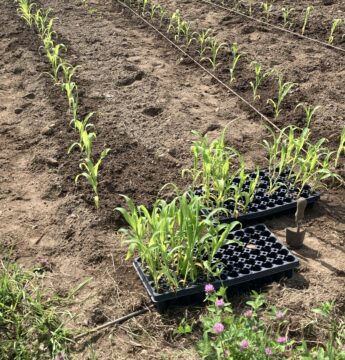
Even sweet corn can be started in plastic cell flats. This way, I can avoid direct seeding and thereby outwit the corvids that come by and yank young corn sprouts out of the ground. I can select sturdy plants that are far ahead of the weeds and space them out properly in lieu of having to hand thin many seedlings.
Hormuz makes me think: What happens if the supply of petrochemicals used to create plastics were to be cut off? Will one start one’s seedlings in egg carton cells? Will one have to erect fencing to keep pests off the plants, go back to mulching with tons of hay, hand-cultivate weeds around every planting, hand-water with buckets? The horror.
In spite of its benefits, it cannot be denied that plastic is Evil. It is largely unrecyclable. Row cover fabric can be reused a few years, as well as some pots, but they degrade over the years and must be trashed. It’s just about impossible to salvage and reuse plastic mulch. Globally, hundreds of millions of tons of plastic are thrown away every year, and only a small portion of this is “recycled.” I use scare quotes because I learned recently that plastic is never really recycled but “downcycled,” meaning the wasted plastic becomes the raw materials for lower-quality plastic products, which in turn break down and finally may be recycled no more. And at every point of this cycle, dreaded microplastics are released into the environment. These are known quaintly as novel entities. PFAS, polymers, nanomaterials. They are all contaminants. Novel entities reside in my brain now, even as I type on this plastic device.
As wells will not run out in my lifetime, novel entities are here as long as I’m around. In the meantime, I fear what the proliferation of these novel entities means, for even the closure of the Strait of Hormuz will not save us from them.
*
Modern industrial agriculture requires the use of plastics. What sort of petrochemicals dependency could be worse? How about having a husband whose health depends on plastic devices?
Don has Type 1 diabetes, has managed it for over 50 years, and has seen the technologies for managing the disease transformed in amazing ways. Instead of single-use, disposable hypodermic needles (which he found ways of reusing many times), he now has injection “pens” which allow him to dial up the correct amount of insulin and inject it: No more glass bottles of insulin to draw up from. The whole pen is disposed of after the insulin runs out of it.
Most amazingly, in order to determine his blood glucose level, he no longer has to pee on a strip of plastic, wait until it turns color, and match the color to a chart on the side of the box the strips came in. This method is pretty inadequate, as by the time the glucose shows up in your urine you have been “high” for some time. Eventually, he was able to determine his blood sugar by pricking his finger, drawing up a bead of blood, depositing the drop on a plastic strip, then inserting the strip into a meter which would digitally display his blood sugar on the spot. This was a far superior way of monitoring blood sugars. Today, he has a continuous glucose monitor (CGM); he attaches a sensor to his upper arm, which continually monitors his blood sugar and transmits the level electronically to a “reader” is his pocket, letting him know what his blood glucose is within about a five-minute window. This is far superior to waiting for glucose to show up in urine. He wears this sensor for ten days, then he disposes it and attaches a new one. These are ordered online and shipped to the house through a circuitous supply chain.
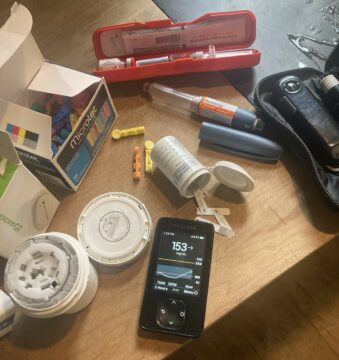
All of these devices — pens, monitors, sensors, glucagon kits, and readers — are impossible to manufacture without plastics.
Upon learning that the closure of Hormuz could restrict the transfer of petrochemical feedstocks to places in Southeast Asia and knowing that some of his medical devices are manufactured in faraway places such as Malaysia, we began casting about for ways of dealing with a possible interruption of these medical supplies. We stocked up on the old-fashioned strips, finger lancets, and batteries for his old glucose meter. We cannot do much beyond that, though, as insulin pens, CGM supplies, and glucagon kits require prescription renewals.
As of this writing, Hormuz has been closed for 115 days, Don has about a 90-day stock of supplies in the bathroom cabinet, and France has seen its hottest day in history. We can only sit here and guess whether or when we will begin feeling the heat of an interrupted petrochemicals supply chain.
Images
Photographs by the author.
Enjoying the content on 3QD? Help keep us going by donating now.