
by Anton Cebalo
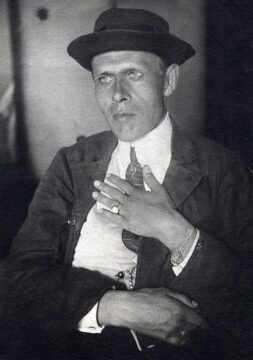
Daniil Kharms was a strange man. Born in 1905 in St. Petersburg, he was the son of Ivan Yuvachev, who was persecuted for his involvement with the revolutionary group People’s Will (Наро́дная во́ля). He adopted the surname “Kharms” while still in school as a fusion of the English words “charm” and “harm.” His literary output would follow the avant-garde, particularly absurdism—first as a founder of the collective “Union of Real Art” (ОБЭРИУ), then as a playwright, and later as a children’s writer due to Soviet censors. He gained a reputation for being eccentric. His work was non-rational and non-linear, and he lived as an oddity among his peers.
Kharms found the absurd to be the closest thing to reality: a collision between “this” and “that,” one normal and the other on the margins. Absurdism was for him effectively realism. In his work, outcome takes on an independent existence. Logic is easily suspended, violence lacks motive, and mere chance often seeks revenge on structure.
Sometimes, what’s revealed in his work is nothing at all: an empty void of nonsense. As he wrote in his diary in 1937:
I am interested only in nonsense; only in that which has no practical meaning. Life interests me only in its most absurd manifestations.
Kharms’s short stories circle this nonsense theme. In one, a freak string of deaths leads the narrative to conclude that these were “all good people but they don’t know how to hold their ground.” In another, two individuals fight and one knocks the other in the head with a large cucumber, killing him: “What big cucumbers they sell in stores nowadays!”
These stories are self-contained worlds or “happenings.” For Kharms, words create worlds and writing is an event in itself. And they could quite literally break windows. “It seems that these verses have become a thing,” he wrote in a letter, “and one can take them off the page and throw them at a window, and the window would break!”
In a time when everything—literature, art, politics, and history itself—was viewed strictly as functional toward an ideological end, Kharms’s output brought heavy repression from the Stalinist authorities. He was arrested and then deemed insane. He died of starvation in 1942. One critic, Valery Podoroga, charged his art collective with undermining the narrative of Stalinist progress. Their writing was “always destructive,” Podoroga wrote, because it removed objects from “stable forms of existence.” Kharms and his collective had insinuated that “an event only lasts as long as we keep reading.” This was simply unacceptable.
Podoroga may have unexpectedly been right almost a century later. Today, events and stories are commonly deemed relevant only as long as they’re discussed. Discourse so often dominates the actual thing being discussed, as though it were an event on its own. We’re closer to living in Kharms’s world now than when he was himself writing.
***
Enjoying the content on 3QD? Help keep us going by donating now.