by Christopher Horner
Man is that night, that empty Nothingness, which contains everything in its undivided simplicity: the wealth of many representations, images, of which none belongs to him—or which are not present. This night, the interior of nature, that exists here—pure self—in phantasmagorical representations, is night all around it, in which here shoots a bloody head—there another white ghastly apparition, suddenly here before it, and just so disappears. One catches sight of this night when one looks human beings in the eye—into a night that becomes awful; it is the night of the world which then presents itself to us. —Hegel
In psychoanalysis nothing is true except the exaggerations —Adorno
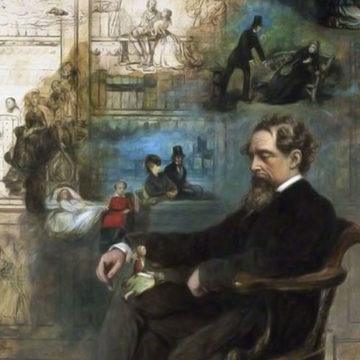
Here is the opening paragraph of Charles Dickens’ last novel. What is going on?
An ancient English Cathedral Town? How can the ancient English Cathedral town be here! The well-known massive grey square tower of its old Cathedral? How can that be here! There is no spike of rusty iron in the air, between the eye and it, from any point of the real prospect. What is the spike that intervenes, and who has set it up? Maybe it is set up by the Sultan’s orders for the impaling of a horde of Turkish robbers, one by one. It is so, for cymbals clash, and the Sultan goes by to his palace in long procession. Ten thousand scimitars flash in the sunlight, and thrice ten thousand dancing-girls strew flowers. Then, follow white elephants caparisoned in countless gorgeous colours, and infinite in number and attendants. Still the Cathedral Tower rises in the background, where it cannot be, and still no writhing figure is on the grim spike. Stay! Is the spike so low a thing as the rusty spike on the top of a post of an old bedstead that has tumbled all awry? Some vague period of drowsy laughter must be devoted to the consideration of this possibility.
This is the strange opening of Charles Dickens’ last, unfinished novel, The Mystery of Edwin Drood. We come to learn pretty quickly that we are in the ‘stream of consciousness’ of a man in the grip of an opium induced hallucination – stream of unconsciousness might fit the case better. Note the way in which we get the effect of a double exposure, and not one of a still, but a moving picture. And the book proceeds, still written in the present tense, for most of the text that he completed. Read more »

 Soon after the pandemic commenced its
  There was a time when Google replied with images of and information about a world-class jockey, an Englishman born the same year Mark Twain published
 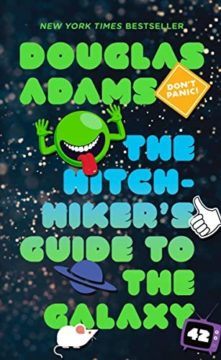 This year marks the 42nd anniversary of the American release of The Hitchhikers’ Guide to the Galaxy. Douglas Adams’ “five-book trilogy,” of which Hitchhiker’s was the first installment, led readers through a melancholy universe in which bureaucracy is the ultimate source of evil and shallow, self-serving incompetents are the galaxy’s greatest villains. The best-selling series helped shape the worldview of Generation X, capturing the nihilistic cynicism of the Thatcher/Reagan 1980s.
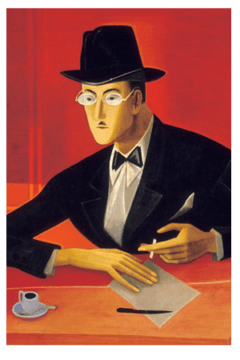 Senhor Soares goes on to explain that in his job as assistant bookkeeper in the city of Lisbon, when he finds himself “between two ledger entries,” he has visions of escaping, visiting the grand promenades of impossible parks, meeting resplendent kings, and traveling over non-existent landscapes. He doesn’t mind his monotonous job, so long as he has the occasional moment to indulge in his daydreams. And the value for him in these daydreams is that they are
 Sughra Raza. Chughtai In Shabnam’s Living Room, November, 2022.
 I moved to Berlin in 1984, but have rarely written about my experiences living in a foreign country; now that I think about it, it occurs to me that I lived here as though in exile those first few years, or rather as though I’d been banished, as though it hadn’t been my own free will to leave New York. It’s difficult to speak of the time before the Wall fell without falling into cliché—difficult to talk about the perception non-Germans had of the city, for decades, because in spite of the fascination Berlin inspired, it was steeped in the memory of industrialized murder and lingering fear and provoked a loathing that was, for some, quite visceral. Most of my earliest friends were foreigners, like myself; our fathers had served in World War II and were uncomfortable that their children had wound up in former enemy territory, but my Israeli and other Jewish friends had done the unthinkable: they’d moved to the land that had nearly extinguished them, learned to speak in the harsh consonants of the dreaded language, and betrayed their family and its unspeakable sufferings, or so their parents claimed. We were drawn to the stark reality of a walled-in, heavily guarded political enclave, long before the reunited German capital became an international magnet for start-ups and so-called creatives. We were the generation that had to justify itself for being here. It was hard not to be haunted by the city’s past, not to wonder how much of the human insanity that had taken place here was somehow imbedded in the soil—or if place is a thing entirely indifferent to us, the Earth entirely indifferent to the blood spilled on its battlegrounds.
 A Republican used to be someone like Dwight Eisenhower, a moderate who worked well with the opposing party, even meeting weekly with their leadership in the Senate and House. Eisenhower expanded social security benefits and, against the more right-wing elements of his party, appointed Earl Warren to be the Chief Justice of the Supreme Court. Warren, you’ll remember, wrote the majority opinion of Brown v Board of Education, Miranda v Arizona, and Loving v Virginia. If Dwight Eisenhower were alive today, he would be branded a RINO and a communist by his own party. I suspect he would become registered as unaffiliated.

 It’s not about dying, really—it’s about knowing you’re about to die. Not in the abstract way that we haphazardly confront our own mortality as we reach middle age and contemplate getting old. And not even in the way (I imagine) that someone with a terminal diagnosis might think about death—sooner than expected and no longer theoretical. It’s much more immediate than that.