by Michael Liss
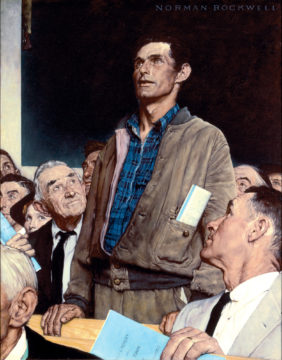
I’ve always liked this image. It’s quiet, it sneaks up on you, brings back old memories of pizza parlors, barbershop walls and drug-store soda fountains.
Norman Rockwell’s “Four Freedoms” had been inspired by FDR’s 1941 Annual Message, given at a time when Germany had swept through much of Europe, and democracy was in great peril. While the United States was not then yet at war, and isolationism was still strong, a growing number of Americans could see that our involvement might be inevitable. Roosevelt wanted to define the values that a post-war world would embrace. Drawing from the Constitution as well as from the lived experience of the Depression, FDR called for Freedom from Want, Freedom from Fear, Freedom of Worship and Freedom of Speech.
This one is Rockwell’s masterpiece. The composition was, according to him, inspired by a town meeting he had attended, where a young man took an unpopular position. Rockwell portrays him with shoulders thrown back a bit as he speaks, as if to project his unamplified voice through the hall. His hard, weathered hands hold the chair in front of him, a copy of a Town Report folded in his pocket. His face is roughened by the sun and wind, he’s flanked by two older men in white shirts and ties, and, on the face of one, there’s a small smile. No screaming, no doxing, and certainly no video captured on someone’s phone, uploaded, and seen by hundreds of thousands of partisans.
Rockwell’s painting gets to the essence of “Constitutional” free speech. However contrary this speaker’s opinion is, it is his right to voice it at a public hearing without fear of punishment. The First Amendment has very few content-based exceptions—the government can intervene only where obscenity, defamation, fraud, incitement, and speech integral to criminal conduct is involved. Read more »
 In 2022, I worked harder than before to keep my students’ tables free of smartphones. That this is a matter for negotiation at all, is because on the surface, the devices do so many things, and students often make a reasonable, possibly-good-faith case for using it for a specific purpose. I forgot my calculator; can I use my phone? No, thank you for asking, but you won’t be needing a calculator; just start with this exercise here, and don’t forget to simplify your fractions. Can I listen to music while I work? Yeah, uhm, no, I happen to be a big believer in collaborative work, I guess. Can I check my solutions online please? Ah, very good; but instead, use this printout that I bring to every one of your classes these days. I’m done, can I quickly look up my French homework? That’s a tough one, but no; it’s seven minutes to the bell anyway and I prepared a small Kahoot quiz on today’s topic. (So everyone please get your phones out.)
 Lita Albuquerque. Southern Cross, 2014, from Stellar Axis: Antarctica, Ross Ice Shelf, Antarctica, 2006.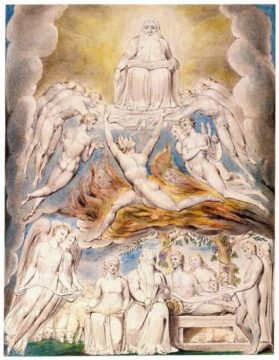
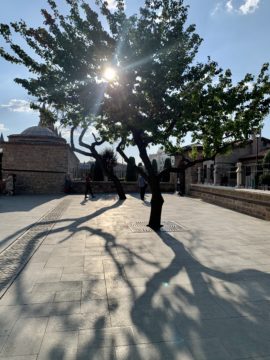 A tree in the vicinity of Rumi’s tomb has me transfixed. It isn’t the tree, actually, it is the force of attraction between tree-branch and sun-ray that seems to lift the tree off the ground and swirl it in sunshine, casting filigreed shadows on the concrete tiles across the courtyard. The tree’s heavenward reach is so magnificent that not only does it seem to clasp the sun but it spreads a tranquil yet powerful energy far beyond itself. It is easy to forget that the tree is small. I consider this my first meeting with Shams.
 I’m going to date myself in a significant way now: when I was in high school, we had to use books of trigonometric tables to look up sine and cosine values. I’m not so old that it wasn’t possible to get a calculator that could tell you the answer, but I’m assuming that the rationale at my school was that this was cheating in some way and that we needed to understand how actually to look things up. I know that sounds quaint now. I also remember when I used an actual book as a dictionary to look up how to spell words. Yes, youth of today, there were actual books that were dictionaries, and you had to find your word in there, which could be challenging if you didn’t know how to spell the word to begin with.
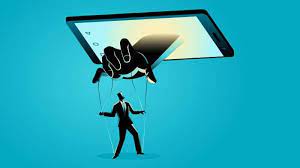 Now that the hangover from New Year’s Eve is abating for many, and we might be freshly open to some self-improvement, consider a Buddhist view of using meditation to tackle addictions. I don’t just mean for substance abuse, but also for that incessant drive to check social media just once more before starting our day or before we finally lull ourselves to sleep by the light of our devices, or the drive to buy the store out of chocolates at boxing day sales. Not that there’s anything wrong with that on its own– it’s a sale after all–but when actions are compulsive instead of intentional, then this can be a different way of approaching the problem from the typical route. I’m not a mental health professional, but this is something I’ve finally tried with earnest and found helpful, but it took a very different understanding of it all to get just this far (which is still pretty far from where I’d like to be).


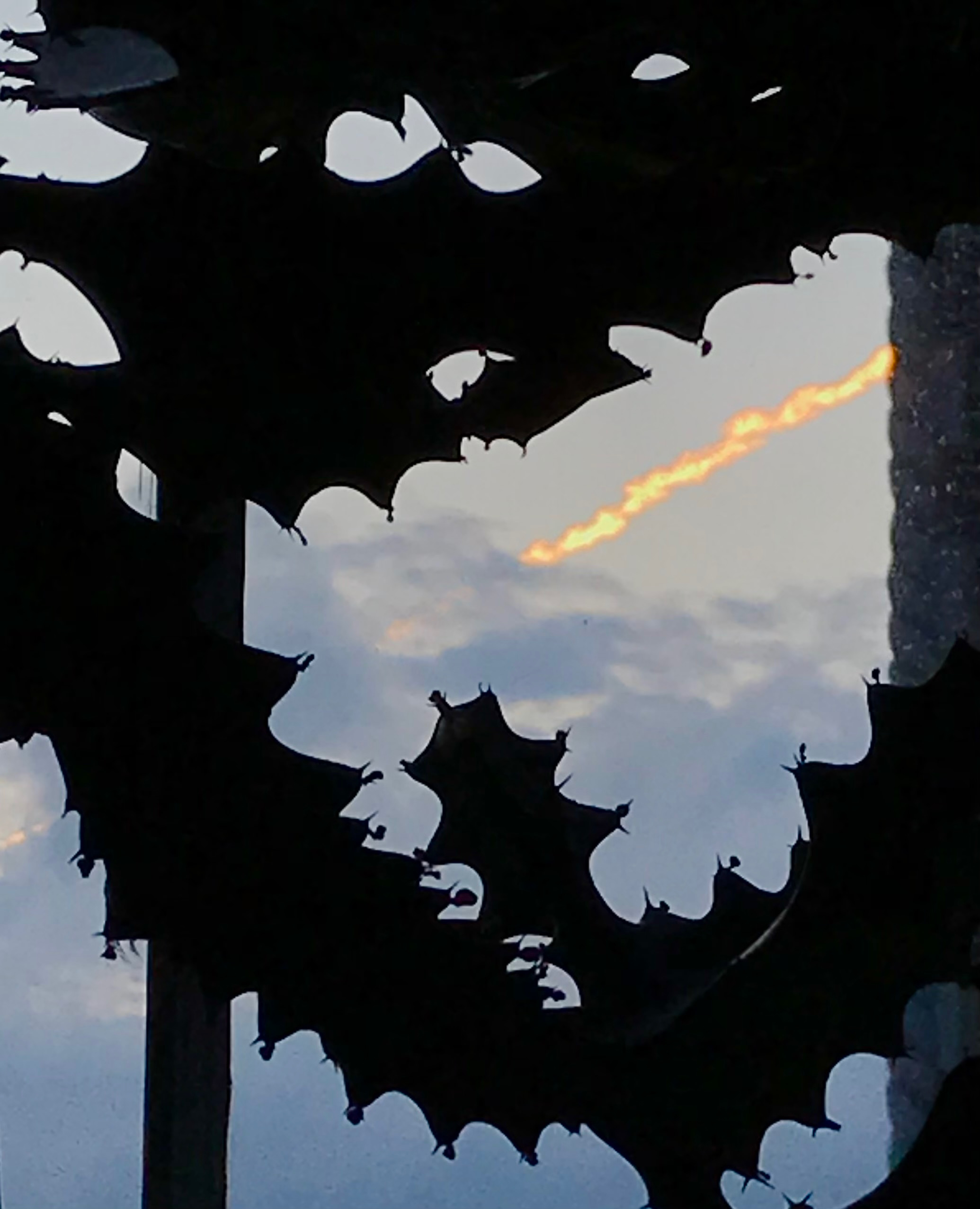 Sughra Raza. Cactus In My Window.
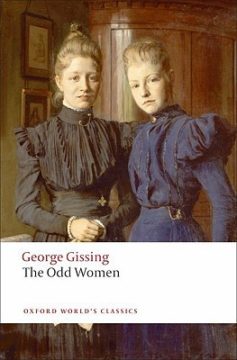 This is the kind of novel which when read makes you wonder why it isn’t better known and more widely celebrated. The late 19th century saw a wave of plays and novels dealing with ‘the New Woman’ – the educated, worryingly independent, vote-seeking, bicycling women of the late Victorian/Edwardian age. Examples include Victoria Cross’s Anna Lombard (1901), Ella Hepworth Dixon’s The Story of a Modern Woman (1894) Many of these were predictable rubbish: marriage or death solves everything. Exceptions among plays are Ibsen’s Hedda Gabler, Shaw’s Mrs Warren’s Profession, and among novels HG Wells’ Ann Veronica (1909), but it’s the Gissing that is really the winner among novels. Gissing avoids most of the cliches and stereotypes and produces a narrative that is genuinely absorbing and a set of themes and characters one remembers long after the book is put down. Gissing is an odd fish: he has real empathy for the plight of the poor and the rejected (both here and in The Nether World and his more famous New Grub Street), but has an ‘official’ conservative ideology which, when he lets it, blocks him from being able to imagine how the agency of working class or (as here) mainly lower middle class women might work for their liberation. In this he isn’t alone: many great novelists have said more through their literature than their ‘official’ beliefs ought to allow them to do (think of Dostoyevsky) In The Odd Women, he largely lets his imagination take him places his philosophy could never encompass. The book emerges as a fascinating account of the situation of the ‘superfluous’ women of the 1890s – and shows how they either succumbed to or overcame the world that seemed to have no place for them.
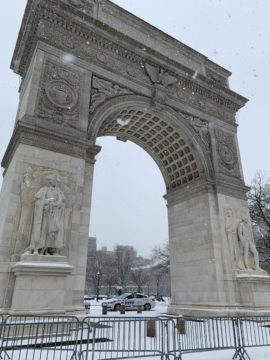 It’s halfway through the month of December and New York is filled with pine boughs and small yellow bells and horse-drawn carriages and scarves. We are seated on the edge of the fountain in Washington Square Park, though this time of year the water has been shut off. A group of five skateboarders are practicing jumps in the large basin. We just bought a pre-rolled joint from one of the stands in the park, of which there are many. But we only buy from one of them. Weed is legal in the city now, but it’s not legally sold, so it can be questionable, and you never want “questionable” when you’re prone to paranoia. We trust the woman who runs this stand, though, because we know where she buys it and she has a rainbow flag on the front of her table.