When European colonists and used West African tribesmen and their descendants as slaves, they had no intention of learning anything from them or of adopting their ways. Their intention was simply to secure a source of cheap and tractable labor. But they were struck by the musicality of their slaves. And that musicality was to have a profound influence on their descendents and, in time, on peoples around the world. Let’s take a quick look at some moments in this centuries-long process of miscegenation, mutation, and cultural transmogrification.
Ecstatic Religion
Early in the seventeenth century, at about the same time Jamestown was being settled, Richard Jobson, an English sea captain, went to Africa and subsequently wrote that “no people on the earth [are] more naturally affected to the sound of musicke than these people.” A century and a half later, the Rev. Samuel Davies heard slaves in Virginia and remarked that the “Negroes above all the Human Species that I ever knew have an Ear for Musick, and a kind of extatic Delight in Psalmody.”
Published in 1640, The Bay Psalm Book was the first full-length book published in the English-speaking colonies, thus illustrating the importance that religious song had for the colonists. Singing schools—a 3 or 4 month series of meetings in which people learned to sing hymns—were held throughout the colonies. Meanwhile, as the slaves grew in number, they held festivals grounded in African custom, such as the ‘Lection Day festivals held in New England during which the slaves elected their own governors or kings, and the legendary Congo Square meetings in New Orleans. Read more »

 Boomer-bashing is everywhere. Maybe it’s warranted, but a reality check is in order, because the bashing starts from an easy and false idea about how power has moved in American society. The recent change in House Democratic leadership is almost too perfect an example. As a “new generation” takes power in the top three offices, we quietly ignore the most interesting generational story. We griped about the old guard clinging to power, and we cheer for our new young leaders, but we don’t mention that political power skipped a generation: it passed from the pre-Baby Boom generation to the post-Baby Boom generation. The Boomers themselves were shut out of power. As usual.
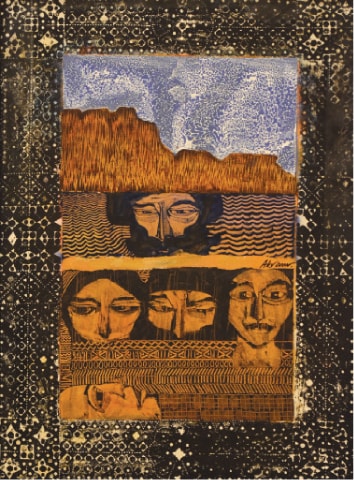 Akram Dost Baloch. From the exhibition “Identities”, 2020.
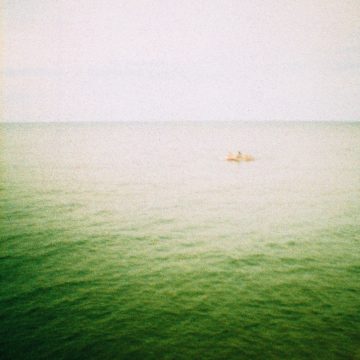 There may be no concept so alluring in all of science fiction than that of time travel. We are undoubtedly drawn to alien species and places in space—moons to colonize, asteroids to mine. But even freakish beings and far-off worlds, however remote, have always smacked a little too much of our own reality. I’m fully capable, after all, of walking from my apartment to the park. I can sit on a bench and read
 Rebecca F. Kuang
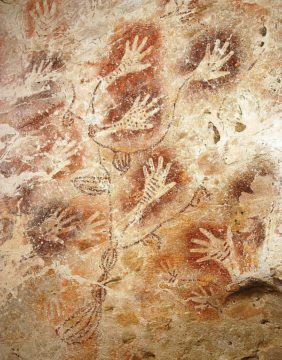 First mixing the grounds of red and yellow ocher with water so as to make a viscus, sticky gum which she puts between her cheek and whatever teeth she may have had, the woman placed her rough, calloused, weather-beaten, sun-chapped hand against the nubbly surface of the limestone cave’s wall, and then perhaps using a hollow-reed picked from the silty banks of the Rammang-rammang River she would blow that inky substance through her straw, leaving the shadow of a perfect outline. This happened around forty thousand years ago and her hand is still there. A little over two dozen of these tracings in white and red are all over the cave wall. What she looked like, where she was born, whether she had a partner or children, what gods she prayed to and what she requested will forever be unknown, but her fingers are slim and tapered and impossible to distinguish from those of any modern human. “It may seem something of a gamble to try to get close to the thought processes that guided these people,” writes archeologist Jean Clottes in What is Paleolithic Art?: Cave Paintings and the Dawn of Human Creativity. “They are so remote from us.” Today a ladder must be pushed against the surface of the cave’s exterior, which appears as if a dark mouth over the humid, muddy Indonesian rice fields of South Sulawesi Island, so as to climb inside and examine her compositions, but during the Neolithic perhaps they simply cleaved alongside the rock face with their hands and feet. Several other paintings are in the complex; among the earliest figurative compositions ever rendered, some of the sleek, aquiline, red hog deer, others of chimerical therianthropes that are part human and part animal. Beautiful, obviously, and evocative, enigmatic, enchanting, but those handprints are mysterious and moving in a different way, a tangible statement of identity, of a woman who despite the enormity of all of that which we can never understand about her, still made this piece forty millennia ago that let us know she was here, that she lived.
 How much you can divide this sentence into similarly incorrect phrases?
 I have a confession to make: I ❤️ Seymour Glass. If you don’t know who that is, count yourself lucky and walk away now—come back in a few weeks when I’ll be discussing humiliating experiences at middle-school dances or whatever. (Obviously I am joking—as always, I desperately want you to finish reading this essay.)