by Marie Snyder
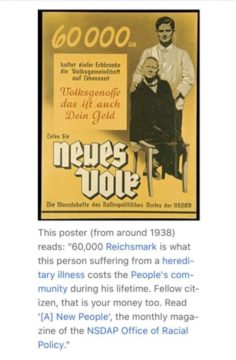 Some people are arguing that the removal of mask mandates in hospitals is a form of eugenics. Tamara Taggart, President of Down Syndrome BC, said on “This is Vancolour,”
“This is eugenics, like 100%. So now we don’t care about people. . . . All those people are expensive. I mean, it’s a harsh thing to say, but it is true. . . . My kid with a disability, he’s expensive in the grand scheme of things. A disabled person in the hospital? They’re expensive. So why else would we remove masks? Elderly people at long-term care facilities? They’re expensive!”
In an older Tyee article, currently recirculating, “My Daughter Shouldn’t be Sacrificed to ‘Get Back to Normal,'” Laesa Kim writes,
“Our family has learned more about ableism and eugenics throughout this pandemic than we should have. We have witnessed both individuals and institutions shrug as COVID more heavily affects marginalized communities. . . . Dr. Rochelle Walensky said on Good Morning America that ‘the overwhelming number of deaths of vaccinated individuals, over 75%, occurred in people who had at least four comorbidities. So really these are people who were unwell to begin with and yes, really encouraging news in the context of Omicron.’ This is eugenic. . . . Public health directions are subtly promoting the same thought: It is fine to allow a virus to spread through the population, largely unchecked and unchallenged, because the assumption is that is will only kill certain demographics of people.”
And I also used that term originally in the title of a recent post, “At What Point is Inaction a Form of Eugenics??,” showing the similarity between our dismissiveness of the disabled and elderly and children now and the experience of gay men with AIDS in the 80s.
But then I changed it. It’s not quite eugenics as we think of it now. It’s potentially genocide. Read more »
 Who doesn’t love a three-day weekend? If an extra day to relax isn’t good enough, the following week always seems to go quickly, making a Memorial Day, Labor Day, or a bank holiday in the UK, the gift that keeps on giving. Of course, most of us should consider ourselves lucky only to have to work a 5-day week. No law of the universe says a work week has to be 5 days. In fact, the concept of a 40-hour workweek is relatively new; it was only on June 25, 1938, Congress passed the Fair Labor Standards Act, which limited the workweek to 44 hours, and two years later, Congress amended that to 40 hours.
 In the 1960s, when I was a boy growing up on the west side of Montreal, whenever my father needed a hit of soul food — a smoked-meat sandwich, some pickled herring, or a ball of chopped liver with grivenes—he would head east (northeast, really, in my hometown’s skewed-grid street plan) to his old neighborhood on the Plateau. He would make for Schwartz’s, or Waldman’s, to the shops lining boulevard St.-Laurent, once known as “the Main” in memory of its service as a major artery through the Jewish part of town before the district changed hands: or rather, reverted to majority rule. On weekends my father would travel a little farther, in the direction of Mile End, to either of two places, St. Viateur Bagels and Fairmount Bagels, each located on the street from which it took its name and each, as its name candidly proposed, a baker and purveyor of bagels.

 In the movies the mathematician is always a lone genius, possibly mad, and uninterested in socializing with other people. Or they are

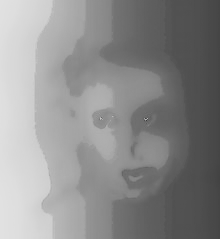
 Zaneb Beams. Untitled, 2022.



 ‘Wenn möglich, bitte wenden.’
 Everyone is talking about artificial intelligence. This is understandable: AI in its current capacity, which we so little understand ourselves, alternately threatens dystopia and promises utopia. We are mostly asking questions. Crucially, we are not asking so much whether the risks outweigh the rewards. That is because the relationship between the first potential and the second is laughably skewed. Most of us are already striving to thrive; whether increasingly superintelligent AI can help us do that is questionable. Whether AI can kill all humans is not.