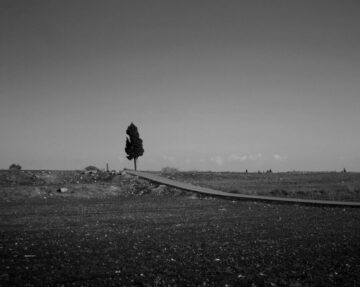
I accidentally stuck my foot into this picture of the ground in the woods near Franzensfeste, South Tyrol.

Though we are an aggregator blog (providing links to content elsewhere) on all other days, on Mondays we have only original writing by our editors and guest columnists. Each of us writes on any subject we wish, and the length of articles generally varies between 1000 and 2500 words. Our writers are free to express their own opinions and we do not censor them in any way. Sometimes we agree with them and sometimes we don’t.Below you will find links to all our past Monday columns, in alphabetical order by last name of the author. Within each columnist’s listing, the entries are mostly in reverse-chronological order (most recent first).
I accidentally stuck my foot into this picture of the ground in the woods near Franzensfeste, South Tyrol.
by Mike Bendzela
Given that it affects about 2.4% of the population, most of you probably know someone with this disorder. Some of you may even have it yourselves. Continually absenting yourself from others’ company out of chronic fear should come with the preamble, “It’s not you, it’s me,” which in this case is not just a line of bullshit. But you never get around to saying such a thing because it is tacit, as tacit as water is to a fish.
Revealing a personality disorder is like coming out of the closet a second time, but worse. For all its woes, coming out as gay initiates a new way of fitting in, a more honest way of relating to the world and others. Then you settle in and everyone forgets about it. This revelation, though, feels more like a post hoc explanation for the impaired way you relate to the world and others. That the awareness of it comes so late does not really matter, as there is nothing you could have done to make things turn out differently. It is something that has shaped every day of your life, even though you never knew there was a name for it until recently. Using the analogy of sexual orientation again: Imagine it were possible to grow up being attracted to others of your own sex, to form a long-term relationship, and then only later in mid-life to read about a condition called “homosexuality.”
Oh, so that’s a thing, then, you would think. You find that you have already adapted to it. Your life is the hand in the glove of your psychological predisposition. The variability that inheres in a world presided over by evolution by natural selection means we are all cast as certain types in the drama of life. This makes the term “disorder” in “avoidant personality disorder” seem a misnomer, even offensive, but there you have it. You did not write the Diagnostic and Statistical Manual of Mental Disorders. Read more »
by Richard Farr
This is the final part of My Drug Problem, a no doubt annoyingly elliptical three-part essay on psychedelics. Part One, A Mere Analogy, is here; Part Two, The Woman in the Cave, is here.

Interest in psychedelics has gone so mainstream that it’s embarrassing not to be able to do the usual thing, and share with you my experience of effing the eff out of the ineffable while sitting in a pool of my own ayahuasca-scented vomit in a hut in the Peruvian Amazon.
So far however, despite a strong, longstanding, and multiply motivated interest, my own psyche has never once had the opportunity to be rendered more delos by any of these substances. That’s partly because there seems to be no way for me, like most ordinary people, to get hold of them legally or illegally in a tolerably safe form. It’s partly, also, because the avenues that are slowly opening up are expensive, impractical, and/or radically inconsistent with the way that I (or most reasonable people, I will suggest) would choose to introduce ourselves to them.
*
We use the words drug, experiment, recreation and therapeutic in at least two distinct senses each.
Drugs are the blessings of medicine that free us from the clutches of disease. Ordinary but amazing Ibuprofen (C13H18O2), stalwart bug-killer amoxicillin (C16H19N3O5S), and so on. Drugs, on the other hand, are serpents in the tree, evil substances full of temptation and danger to the foolhardy; key vectors for the spread of many ills including both dependence and sanctimonious do-goodery. Heroin (C21H23NO5), methamphetamine (C10H15N), and so on. Wonders and terrors. Alpha and Omega. God and the Devil. Read more »
by Muhammad Iqbal (1877-1938)
I am standing on the banks
but I have no idea where I am.
The sun — old man of sky —
a goblet in his trembling hands
spills wine, dipping the hem
of evening in red. The day
drinks itself into oblivion,
raining rose petals on a grave at dusk.
Rāvī’s low and high rhythm urge me
to bow in silent prayer. Do not ask
how my heart feels. My world
is a precinct of the Ka’ba.
Far off, amplifying the solitude,
are minarets of Jahangir’s tomb —
history book about cruelty, still place
like silent music only trees hear?
A boat swiftly rides Rāvī’s breast,
the boatman struggles with waves,
and swift as a glance moves quickly
far away from the orb of sight; so
does the ship of man’s life born into
a sea of eternity never recognizing
defeat — out of sight
yet at no time shipwrecked.
***
Translated from the original Urdu by Rafiq Kathwari
by Mindy Clegg

It should be obvious by now that science fiction of the 20th century wasn’t in the business of predicting the future. Low earth orbit space travel does not reflect the commercial feel presented in 2001. We’re no where near having robotics and artificial intelligence as advanced as that of Blade Runner. Our current iteration of what we’re (probably incorrectly) calling artificial intelligence (AI) has not remotely reached the level of a Skynet in Terminator. But if any sci-fi franchise correctly “predicted” the current era and the struggles we currently face, that might be Star Trek, especially Deep Space 9 (DS9). In fact, 2024 ends up being a pivotal year in the Trek time-line and some of the events set in that year seem incredibly plausible in the world right now. Rather than predicting the future, these events reflected political and social issues of the day in which the show was produced. DS9, in fact, were deeply embedded in the domestic and global politics of the 1990s. The show addressed critical issues, such as ongoing decolonization movements, the fall out of the end of the Cold War, and domestic social issues like homelessness, racism, and inequality. All of these have gone to dangerous places recently, as we seem unwilling to understand the warning found in a show like DS9. Of all the Star Trek shows, few seem as critical to understanding our modern condition than this one. I’ve been reading David Seitz’s excellent book A Different Trek and it informed much of this essay.1 Read more »
by Rebecca Baumgartner

I never intentionally set out to read what one critic referred to as “landfill nonfiction,” and yet it seems harder than ever to avoid falling into such a book by accident. The term is a bit harsh, but you probably already have some idea of what kind of books I’m talking about.
These are the books with bright covers and upbeat titles that follow roughly this formula: This is Actually Pretty Obvious: A Really Overblown Claim about How We Can Fix Everything and Maybe Even Have More Fun. Many of the books I’m talking about would be shelved in the Self-Help section of your bookstore (remember those?) but the format has now expanded to include popular science, general psychology, sociology, politics, economics, and more.
One of the first things you notice about landfill nonfiction (which I’ll call “pop nonfiction” to be less mean), aside from the formulaic, casual title and the trendy aesthetic of the cover, is the abundance of “malcolms,” folksy anecdotes that an author uses to gently and obliquely introduce a topic to readers imagined to be intellectually shy and prone to bolt at the first sight of a difficult idea.
Often, the malcolm seems to have no relevance to the topic at hand, at least at first. The coy author-as-compère is waiting for the right moment to show you why this story is relevant. The more random the malcolm seems, the more satisfying will be the payoff (or so it is supposed) when the author ties it all back together. A story about a day in a busy hospital that started like any other, or the author’s boat trip with his wife, or a scene from Fiddler on the Roof, eases you into an intellectual project without shocking your system with too much thinking right off the bat. It’s nonfiction writing envisioned as PowerPoint presentation, a corporate icebreaker and team-building exercise before you get down to brass tacks. Read more »
 .
.
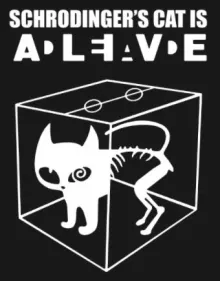
I’m in a box in two states at once,
dead and alive —what am I
Schrödinger’s cat sniffing out mice
nose to the sky?
I hear the high art of a sparrow sound,
I catch a honeysuckle’s scent
in a mire of duplicity or worse,
my neurons spell disparities in verse
which oscillates in a split skull,
slides between hemispheres
resembling convoluted nuts in
walnut shells:
heaven sometimes, sometimes hell;
(in dark they switch —or not) so,
you can never be sure
which’ll bewitch
by Jim Culleny
10/6/12
by Barbara Fischkin

At dawn on February 24, 2022, Russian President Vladimir Putin announced a “special military operation,” in Ukraine—a euphemism for war, if ever there was one. Since that morning, the fortitude of the Ukrainian people has resounded, even as the Middle East vies for our attention. For me, evidence of this grit—as fertile as Ukraine’s soil—arrives weekly, if not daily, in messages from a young woman in a western city. She writes from Ternopil, a relatively safe place. But from her I have heard that no place in Ukraine is truly safe.
I have also heard that its people are determined to stay, survive and rebuild.
My contact is not a war correspondent. She is an English language instructor, a teacher, a college administrator and the mother of two small children. In other words: A regular citizen. Her name is Oksana Fuk and we have been corresponding since hours after that terrifying dawn, almost two years ago, when Russia invaded her country.
We may have met in person years ago, when she was an internationally-recruited counselor at a camp for developmentally disabled children and adults in the upstate New York Catskill Mountains. What we are sure about is that she knows our elder son, Daniel Mulvaney, who has non-speaking autism and attended this camp for many summers.
On February 24, 2022, as I was searching for more news about the invasion—my mother was born in Ukraine—Oksana’s name popped up on my Facebook feed. I saw that she had worked at Dan’s camp.
When we first connected it was 4 p.m. on Long Island where I live. By then the invasion that morning had been front page news worldwide. It was 11 p.m. in Ternopil. Read more »
by Derek Neal
 I simply can’t seem to stop writing the same essay over and over. This is, I admit, not a great opening to a new essay. If all I do is repeat myself, why bother reading something new from me? Fair enough. You’ve heard it all before. But allow me one objection, which is that many writers write the same novel repeatedly, many filmmakers create the same movie multiple times, and these are often the best novelists and filmmakers. Now, I don’t mean to put myself in this category, but I can take solace in the fact that the greats do the same thing I seem to be fated to do.
Paul Schrader, whom I have mentioned in many of my recent essays, has made the same movie for the last 30 years. I thought it was just his recent trilogy—First Reformed, The Card Counter, and Master Gardener—but then I watched Light Sleeper from 1992, starring Willem Defoe as a drug dealer trying to change his life in New York. Does he write in a journal? He does. Does he sleep in a spare bedroom with no furniture? You bet. Does he try to change his life, only to be dragged back into the world he thought he could escape? Of course. Finally, does the move end with the Pickpocket ending, with the main character achieving something akin to a state of grace while paradoxically in prison? He sure does, and I wouldn’t want it any other way. This is Schrader’s world, it’s what he does best, and when I feel like spending a couple hours there, I know where to go.
Another writer who does this is Patrick Modiano, recipient of the Nobel Prize for Literature in 2014. It had been a few years since I’d read a Modiano novel, and a week or so ago I decided I’d like to go hang out for a bit with the phantoms that haunt Modiano’s France, stalking the dark streets with the silent specter of French collaboration during World War II hanging over them. I started reading Des Inconnues. Was there a character narrating a story in the first person about their past? There sure was. Did this character fall in with a shady group, a cast of characters who used fake names and performed clandestine activities? Absolutely. Was anything ever resolved, or would the characters exist in a dream-like state from beginning to end, unable to explain the meaning of what had happened to them? Indeed, the characters would never wake up.
The fact that writers repeat themselves is not a criticism, then, but a recognition that they are performing variations on a theme close to their heart and presenting their version of what it means to be a person living in the world. Read more »
by Jochen Szangolies
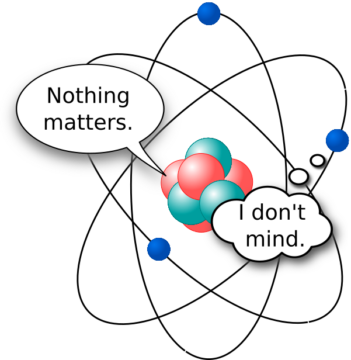
I’m inherently suspicious of overt declarations of having arrived at a certain position only through the strength of the arguments in its favor, even against one’s own prior commitments. If that were typically how things happen, then either there ought to be much more agreement than there is, or the vast majority of people are just irredeemably irrational.
There are several junctures in Philip Goff’s most recent book, Why? The Purpose of the Universe, at which we are treated to a description of the author’s intellectual journey, detailing how the force of argument necessitated course corrections. Now, changing your mind in the face of new information is generally a good thing: nobody gets it right on the first try, so everybody who’s held fast to their views probably just hasn’t examined them deeply. But still, very few people arrive at their position solely thanks to rational forces.
Luckily, most of the arguments in Goff’s book really are good ones. And what’s more, they’re presented in a way that’s accessible, without overly sacrificing detail, which he achieves by presenting them in a first pass, and then including a ‘Digging Deeper’-section devoted to clarifying various points and defending against some possible objections. That way, you can first get the gist, and perhaps return later to engage with the subject more deeply. Would that more philosophers, when writing for a non-specialist audience, showed that much consideration towards their audience!
Goff’s main contention is that the best available evidence, filtered through the understanding bestowed to us by our best current theories, does not paint a picture of a meaningless cosmos, as is usually claimed. (In the words of physicist Steven Weinberg, in his account of the creation of the universe, The First Three Minutes: “The more the universe seems comprehensible, the more it also seems pointless.”) That may have been true in the days of the mechanical cosmos of Laplace, but, Goff holds, is no longer the case.
He marshals two main arguments in support of his conclusion. Read more »
by Joseph Shieber
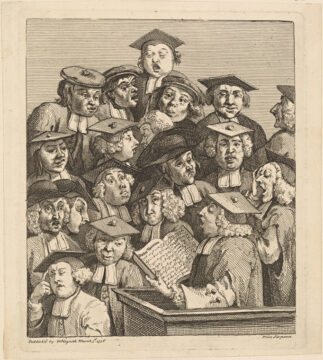
The humanities are once again in crisis, as they have been so many times before. What distinguishes this latest crisis from many of the crises preceding it, however, is the extent to which the current crisis in the humanities is exacerbated by the current political climate. Attacks on the humanities fit very well with the current right wing attack on higher education more generally; the Right moves seamlessly — one almost wants to say thoughtlessly — from attacks on one to attacks on the other.
Given this climate, it is not surprising that diagnoses of the current crisis in the humanities would focus on the politics of the humanities. Emblematic of such diagnoses is a widely discussed recent piece by Tyler Austin Harper in the Atlantic, “The Humanities Have Sown the Seeds of Their Own Destruction.” There, Harper suggests that the current crisis of the humanities is the result of political capture: the humanities disciplines are now hostage to left-wing political movements and, as a result, have become targets for critics from the center and right.
Underlying this diagnosis is Harper’s suggestion that the political capture of the humanities is the result of an attempt by representatives of those disciplines to respond to a perceived lack of practical benefit of the study of the humanities — a low return on investment (ROI) — by suggesting that the practical benefits of the humanities are not monetary, but social or political. “If the humanities have become more political over the past decade,” Harper argues, “it is largely in response to coercion from administrators and market forces that prompt disciplines to prove that they are ‘useful.’ In this sense, the growing identitarian drift of the humanities is rightly understood as a survival strategy: an attempt to stay afloat in a university landscape where departments compete for scarce resources, student attention, and prestige.” That is, the study of the humanities makes for better people and, in turn, better societies, rather than better workers. Read more »
by Brooks Riley
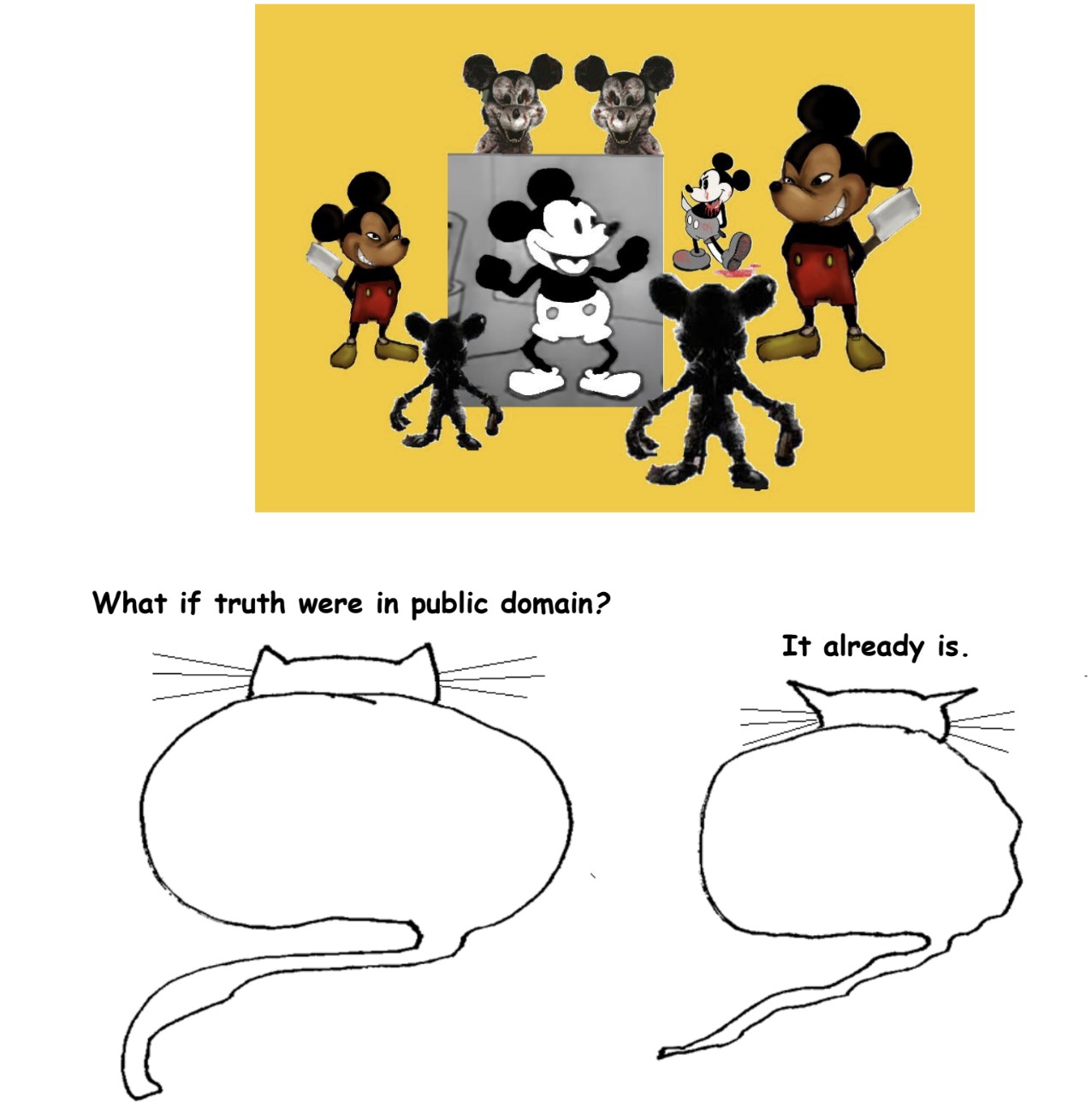
by Thomas R. Wells
Americans dominate global (social) media and one result of this is that the rest of the world is overexposed to Americans’ ideas, and also to their ideas about themselves. One such idea that is more or less endlessly repeated is that even middle-class Americans are actually poor these days.
I accept that many Americans are perfectly sincere in this belief but that doesn’t make it true, whether one defines poverty in terms of meeting basic needs, or as a relative decline between generations or between America and other nations. Yes – some Americans are poor, really poor by any reasonable standard. But not most Americans, or the average (median) American, which is the claim I see constantly.
The evidence shows that most Americans are richer than ever, and richer than most people in the rich world – that they consume more, live in larger homes, and so on. They are objectively some of the luckiest people in world history. On the one hand all this narcissistic whining about imaginary poverty is mildly annoying for the rest of the world to have to listen to. On the other hand, it reflects shared delusions about individual entitlements and America’s economic decline that are driving a toxic ‘doom politics’ of cynicism and resentment, while also neglecting the needs of actually poor Americans.
Two misunderstandings in particular seem to drive the mistake: that everything is more expensive these days, and that the rich took all the money. Read more »
by Barry Goldman
When I was a little boy my parents had a book that convulsed me with giggles. It was a collection of cartoons by Abner Dean called What Am I Doing Here? I couldn’t read, and I didn’t understand what was happening in the pictures, but the people in the cartoons were naked! You could see their tushies! It just cracked me up.
One day the book disappeared. I think my friend Neal from down the street boosted it, but in any case I forgot about it for many years. Then one afternoon when I was about 20 I came across it again in a used book store. I remember the feeling distinctly. The drawings were strangely familiar, and they were deep. Some of them made me shiver with the shiver of cosmic deepness. Readers who were once 20-year-old pot smokers will know what I mean. But the man wanted $12 or some such impossible sum, and I had to leave it in the store.
I was in another used book store 25 years later, and I came across it again. I recognized the cover and eagerly paged through the cartoons. This time they struck me as silly. “Sophomoric” was the word that came to mind. I didn’t see any reason to buy it.
Another 25 years has gone by, and there was an ad for a re-issue of What Am I Doing Here? in the New York Review of Books. It said:
With an inimitable mixture of wit, earnestness, and enigmatic surrealism, Dean uses this most ephemeral of forms to explore the deepest mysteries of human existence.
I ordered a copy. (Drumroll, please.) Nothing. Not funny, not deep, not clever. Nothing. An entirely forgettable book of entirely forgettable cartoons.
So which is true? Is it wet-your-pants funny, chillingly deep, or just silly? The question, as the Buddha used to say, “is not rightly put.” I experienced the book in all of those ways, and all of my experiences were perfectly valid. “But what is it really?” is not a proper question. I wasn’t wrong when I thought it was hysterically funny, and I’m not wrong now that I think it’s silly. The category of correctness or incorrectness doesn’t apply. Read more »
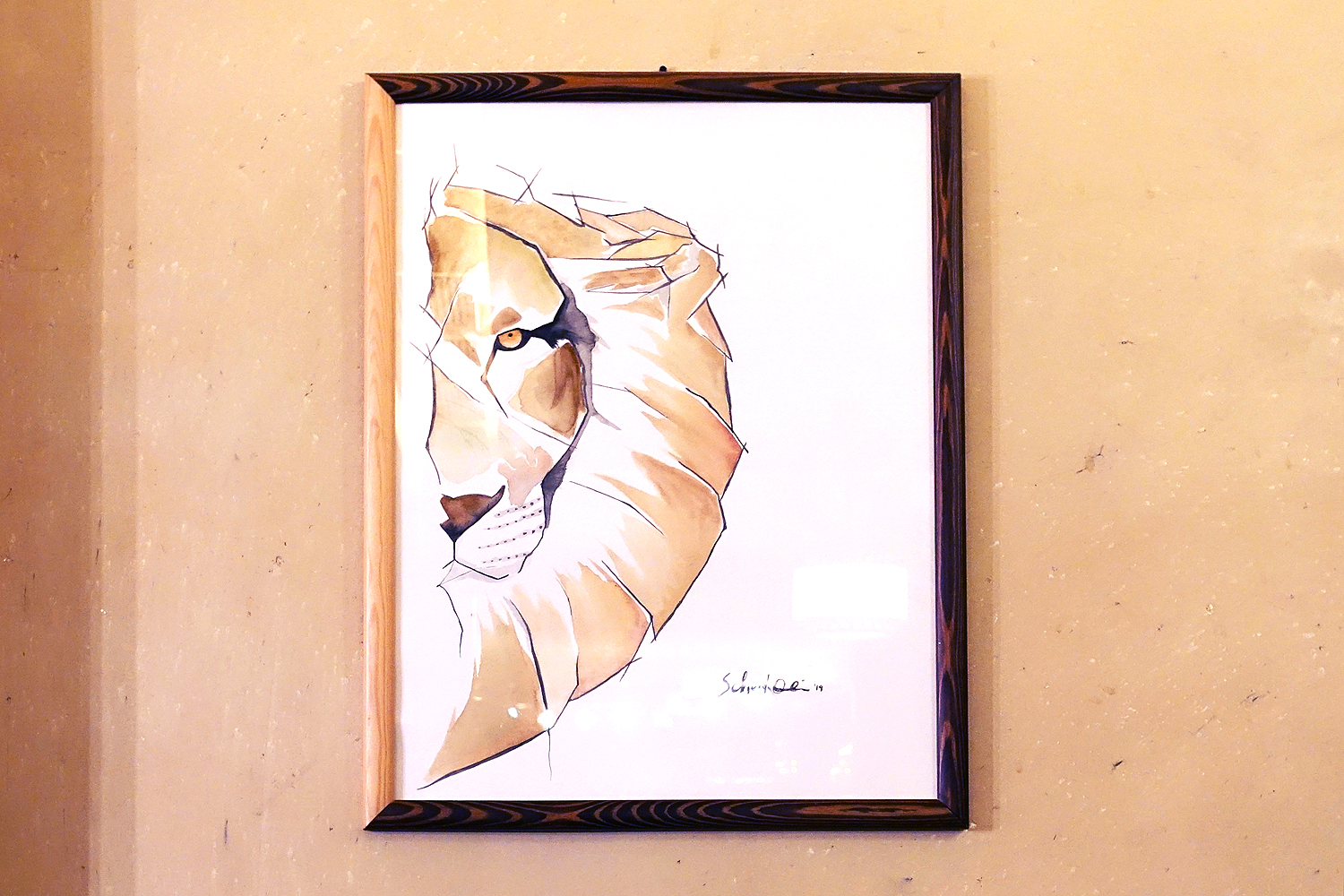
A painting at the Löwenhof Hotel in Vahrn, South Tyrol.
by Raji Jayaraman

Vijay was the smartest kid in class. It was a small class, and we weren’t especially bright, but I don’t mean that he was smart in a big-fish-small-pond sense. I mean it in absolute terms. He was a math genius. Short and slight of build there was nothing remarkable about his appearance, at least not neck-down. Neck-up, it was a different story. He had a massive head and we’re talking Boss Baby proportions. On anyone else, that head would have been fair game for mockery. But perched on Vijay’s shoulders, with a brain that size, it seemed like the only feasible design choice.
The boarding school we attended wasn’t especially prestigious. It wasn’t Mayo or Doon, where blue-blooded Indians waitlisted unborn children who, by accident of birth, were predestined to rule. No, the currency for admission wasn’t pedigree. It was money. There were three groups of students who could afford to attend our school. The first was rich kids, whose parents paid out of pocket. Some belonged to the petty nobility who, despite the half-century old abolition of titles, had managed to retain some ancestral wealth. Theirs was old money. It was solid, with no need for external trappings. Indeed, their lack of pretension was so flagrant it bordered on deceit. In middle school, for instance, we had to cancel our third and final run of “You’re A Good Man Charlie Brown” because one of the lead actors’ fathers, L.’s dad, died. As the eldest son, L. had to go home to perform his father’s final rites. Snoopy never returned to school because he was now the Raja of P.
The new money was different. They had generous monthly allowances and wore designer clothes with fancy French names I couldn’t pronounce: Es-spirit, Die-ore, Gukki. Many of these kids belonged to families who, by hook or crook, had secured state monopolies in key industries of India’s post-independence “licence-Raj”. Others were expatriates whose parents worked in Indian joint ventures, or belonged to well heeled families from neighbouring countries. Read more »
by Michael Liss
 January 1, 2024. Happy New Year! Just eleven months and five shopping days before Election 2024. Whether you find it comforting that 2024 also happens to contain an extra day might be the best marker of how Political Seasonal Affective Disorder has impacted you. Personally, I haven’t been sleeping particularly well.
The New Year is often about taking stock, and if I’m counting correctly, this is my 101st essay for 3 Quarks Daily. The majority have been about American history, American politics, and what is ostensibly American law but looks a lot like politics.
Last August, as the 49th anniversary of Richard Nixon’s resignation drew near, I started a series about the chaos of the late 1960s/early 1970s and how Presidents can lose their hold on the White House. That led me back to two men, one famous, the second memorable, who, to this day, in different ways, have had an impact on the way I think.
I will come to Henry Kissinger shortly, but I first want to spend a little time celebrating Walter Kaufmann. This is not the prolific philosopher Walter A. Kaufmann who was a pre-World-War-II expat from Germany, got his PhD at Harvard, and spent most of his career at Princeton. My Walter Kaufmann is Walter H. Kaufmann, who was also a German expat, got his PhD at the New School for Social Research, and, in 1953, published Monarchism in the Weimar Republic. My Dr. Kaufmann liked a cigar, a good story, and a better glass of wine. He also taught at my high school—German to those less linguistically challenged than I was, AP European History to voluble (in English) types like me. Dr. Kaufmann had a certain cool about him, in no small part for having gone to grade school with Werner Klemperer, son of the conductor Otto Klemperer, and, to Dr. K’s enduring dismay, the future Colonel Klink.
Like all good little suburban students, we took AP classes to take AP exams to score high enough to get college credits. Dr. K was a realist, but wanted to teach this subject on his terms. The word went out that no one got higher than a 93, his logic being that no one could know anywhere near 100% of the subject matter. So, if you were in the running for Valedictorian or Salutatorian and/or cared very much about your final class rank, to learn at the feet of Dr. K came with some obvious risks. Read more »
by David Kordahl
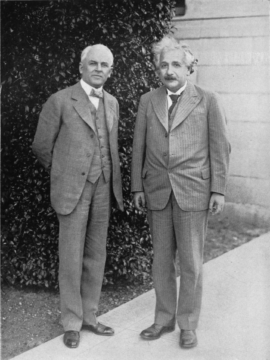 The photograph beside this text shows two men standing side by side, both scientific celebrities, both Nobel prizewinners, both of them well-known and well-loved by the American public in 1932, when the picture was taken. But public memory is fickle, and today only the man on the right is still recognizable to most people.
Albert Einstein, Time Magazine’s “Man of the Century,” the father of special and general relativity, has a place in science that remains secure, regardless of what one thinks of his life as a whole. Despite activist efforts at demystification, Einstein the scientist is unblemished by any misgivings about his personal life or political activities. Robert A. Millikan, the bow-tied man on the left, is far less secure. The posthumous charges against Millikan have been against his scientific integrity and his political sympathies, and his detractors have made headway.
In 2020, Pomona College changed the name of their Robert A. Millikan Laboratory, noting Millikan’s “history of eugenics promotion,” along with his purported sexism and racism. In 2021, the California Institute of Technology, the institution that Millikan spent decades building, followed suit, renaming Millikan Hall as Caltech Hall, and discontinuing the Millikan Medal, previously the Institute’s highest honor. Citing Caltech’s precedent, the American Association of Physics Teachers (AAPT) renamed its own Millikan Medal later that same year.
Since I spend most of my time teaching physics, and since I am myself a member of the AAPT, it was the last of these name changes that rankled me the most. These allegations bothered me because I suspected that they weren’t quite fair. Read more »
by Rafaël Newman
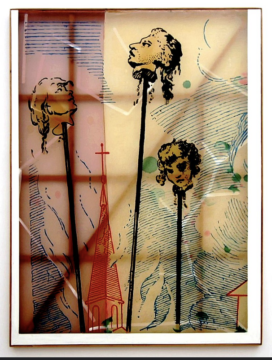
There was an old man who so loved his son,
His day was only properly begun
Once he had hugged his darling to his breast
And kissed his tender cheek. Nor could he rest
At night until the boy was put to bed;
And still he’d stand by him, and stroke his head.
Or let’s just say: he liked him well enough,
Could bear his cries, and was not over-rough
When scolding him, begrudged him not his meat,
And saw that he had leather on his feet.
No, it was worse: in truth, he hated him,
Became a father on a drunken whim
And now was bound by duty, not by joy,
To spend his dotage tending to the boy.
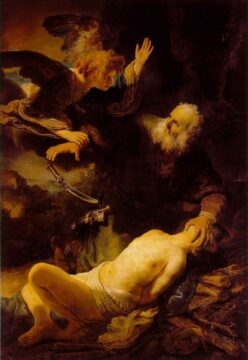
The point is—love, or loathe, or suffer him,
That man prepared to carve him limb from limb
In answer to the urging of a voice
Within his head, which offered him a choice:
Prove your compliance with a sacrifice,
Or be excluded from my paradise.
It didn’t come to that, of course. The child
Was spared—not by his father, who was wild
To do the will of his delirium,
But by the very same mysterium
That had decreed the awful liturgy,
Which very act proved it a deity:
Inscrutable, contrarian, perverse—
A fitting ruler of the universe. Read more »