by Ed Simon
Demonstrating the utility of a critical practice that’s sometimes obscured more than its venerable history would warrant, my 3 Quarks Daily column will be partially devoted to the practice of traditional close readings of poems, passages, dialogue, and even art. If you’re interested in seeing close readings on particular works of literature or pop culture, please email me at [email protected]
 There is no genuinely effective lyric poem unless there is a line which lodges itself in the brain like a bullet. Often – though not always – these lines are the first in a poem, the better to abruptly propel the reader into the lyric. William Wordsworth’s “I wandered lonely as a cloud,” Walt Whitman’s “I celebrate myself, and sing myself,” or Langston Hughes’ “I’ve known rivers.” For example, John Donne and Emily Dickinson are sterling architects of not just the memorable turn-of-phrase, but the radiant introductory line as well. Think “Batter my heart, three-person’d God” or “I heard a Fly buzz – when I died.”
While memorizing poems in their entirety was a common pedagogical exercise at all levels of education until around a century ago, today works remain pressed in the commonplace-book of-the-mind because of a deftly memorable line, a phrase which announces itself like the hook of a pop song. With some irony, contemporary poetry is sometimes maligned by more conservative critics as having a deficit of iconic lines, where the language itself submerges into an undifferentiated mush of abstract nouns and erratically enjambed lines, experimental precociousness and pretentious obscurantism.
Presumably every period of literary history is deluged with bad poetry so that there is a bias towards that which survives, giving a shining glean to previous centuries which they may not entirely deserve. After all, not every poet in the English Renaissance was the equivalent of Shakespeare; most were as if Giles Fletcher or Barnaby Googe. Still, many readers would perhaps find it difficult to name a poetic turn-of-phrase as memorable as those written by Wordsworth, Whitman, or Hughes, not to mention Donne and Dickinson. Read more »


 In
In 

 Amy Sherald. They Call me Redbone but I’d Rather Be Strawberry Shortcake, 2009.
 In November 2023, in an essay for the German national newspaper die taz, I wrote that Germany’s Jews were once again afraid for their lives. It was—and is—a shameful state of affairs, considering that the country has invested heavily in coming to terms with its fascist past and has made anti-antisemitism and the unconditional support of Israel part of its “Staatsräson,” or national interest—or, as others have come to define it, the reason for the country’s very existence. The Jews I’m referring to here, however, were not reacting to a widely deplored lack of empathy following the brutal attacks of October 7. In an open letter initiated by award-winning American journalist Ben Mauk and others, more than 100 Jewish writers, journalists, scientists, and artists living in Germany described a political climate where any form of compassion with Palestinian civilians was (and continues to be) equated with support for Hamas and criminalized. Assaults on the democratic right to dissent in peaceful demonstrations; cancellations of publications, fellowships, professorships, and awards; police brutality against the country’s immigrant population, liberal-minded Jews, and other protesting citizens—the effects have been widely documented, but what matters most now is now: the fact that the German press is still, four months later, nearly monovocal in its support of Israel and that over 28,000 civilians, two-thirds of them women and children, have died.

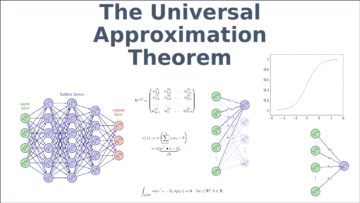 by David J. Lobina


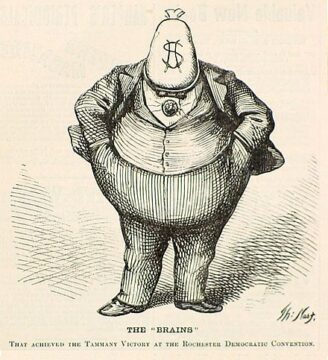 ew years, I keep getting stuck on the same question: Don’t these people have grandchildren? How can corporate decision-makers spend their days actively working to destroy the environment, pollute the water, kill off the animals, melt the glaciers, and incinerate the biosphere? Even if what they care about the most is making more money no matter how much money they already have, don’t they care at all about the world they’re leaving for their kids?