
by Joseph Carter Milholland

Lately, I have been thinking about the failures behind my most recent relationships: what led to the breakup but really what caused them not to begin at all. I have been wondering why I am always left with the feeling that the contact between the two of us never became more than surface level, and often not even that. As I wrestle with this sad fact, I have, as a form of fantasy and consolation, been thinking again and again of a scenario in which another person could know the real me.
In my imagined scenario, another person would shadow me for 24 hours – at least 24 hours, in my wilder imaginings maybe as much as a week. They would not interact with me, except for perhaps the occasional commentary or clarification as to what I was doing. They would see when I woke up, what and how I ate, how I worked, what I did with my spare time, the way I would take naps for 11 minutes and 35 seconds in the late afternoon, how I would take long walks in the evening listening to music, how I would make dinner while listening to a podcast or Youtube video, and then eat it while watching a documentary or disposable television show, how I would, during my workday, constantly refresh my podcast app and Youtube subscription to see if anything new had popped up, how I would also check the news in certain conflict zones to see if there had been an escalation, how I would read a poem each morning as soon as I woke up and often right before bed, how I would sometimes read a poem during breaks while at work but not as much as I wanted to, how I would have absolutely no set time as to when I ate, sometimes not eating anything until 5 or 6 or later, other times eating so much granola in the morning that the protein overlead would make the idea of eating unthinkable for 12 hours or more, how when I do my laundry, I take my pants out of the dryer ten minutes into a hot cycle and then hang them up semi-damp to remove the wrinkles without needing to iron them, how I make endless lists – lists of music I want to listen to, authors I want to read, books others have recommended, poems and short stories I recommend to others – and yet I am seemingly incapable of scheduling my day. They would see the sum of me, the sum of my most prized habits which I refrain from showing to anyone outside myself, the parts of me I admire or detest or am indifferent or resigned to but which are somehow opaque to others.
There is something narcissistic about this fantasy, but more significantly, it’s completely unrealistic. An observer necessarily changes the behavior of the person who is observed. If I was being watched during all my waking hours, I would fundamentally not be the same person I am when I am alone. Most importantly of all, who would consent to such a strange ritual? Read more »
 Boomer-bashing is everywhere. Maybe it’s warranted, but a reality check is in order, because the bashing starts from an easy and false idea about how power has moved in American society. The recent change in House Democratic leadership is almost too perfect an example. As a “new generation” takes power in the top three offices, we quietly ignore the most interesting generational story. We griped about the old guard clinging to power, and we cheer for our new young leaders, but we don’t mention that political power skipped a generation: it passed from the pre-Baby Boom generation to the post-Baby Boom generation. The Boomers themselves were shut out of power. As usual.
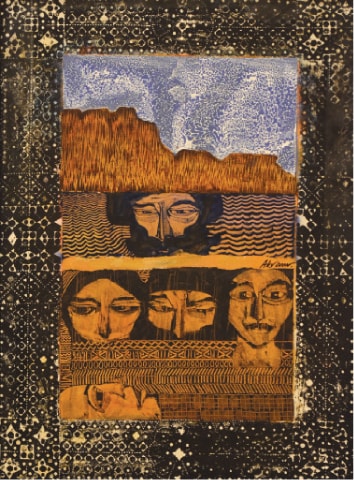 Akram Dost Baloch. From the exhibition “Identities”, 2020.
 There may be no concept so alluring in all of science fiction than that of time travel. We are undoubtedly drawn to alien species and places in space—moons to colonize, asteroids to mine. But even freakish beings and far-off worlds, however remote, have always smacked a little too much of our own reality. I’m fully capable, after all, of walking from my apartment to the park. I can sit on a bench and read
 Rebecca F. Kuang
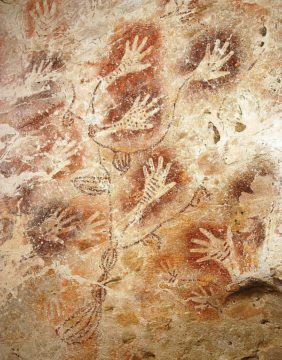 First mixing the grounds of red and yellow ocher with water so as to make a viscus, sticky gum which she puts between her cheek and whatever teeth she may have had, the woman placed her rough, calloused, weather-beaten, sun-chapped hand against the nubbly surface of the limestone cave’s wall, and then perhaps using a hollow-reed picked from the silty banks of the Rammang-rammang River she would blow that inky substance through her straw, leaving the shadow of a perfect outline. This happened around forty thousand years ago and her hand is still there. A little over two dozen of these tracings in white and red are all over the cave wall. What she looked like, where she was born, whether she had a partner or children, what gods she prayed to and what she requested will forever be unknown, but her fingers are slim and tapered and impossible to distinguish from those of any modern human. “It may seem something of a gamble to try to get close to the thought processes that guided these people,” writes archeologist Jean Clottes in What is Paleolithic Art?: Cave Paintings and the Dawn of Human Creativity. “They are so remote from us.” Today a ladder must be pushed against the surface of the cave’s exterior, which appears as if a dark mouth over the humid, muddy Indonesian rice fields of South Sulawesi Island, so as to climb inside and examine her compositions, but during the Neolithic perhaps they simply cleaved alongside the rock face with their hands and feet. Several other paintings are in the complex; among the earliest figurative compositions ever rendered, some of the sleek, aquiline, red hog deer, others of chimerical therianthropes that are part human and part animal. Beautiful, obviously, and evocative, enigmatic, enchanting, but those handprints are mysterious and moving in a different way, a tangible statement of identity, of a woman who despite the enormity of all of that which we can never understand about her, still made this piece forty millennia ago that let us know she was here, that she lived.
 How much you can divide this sentence into similarly incorrect phrases?
 I have a confession to make: I ❤️ Seymour Glass. If you don’t know who that is, count yourself lucky and walk away now—come back in a few weeks when I’ll be discussing humiliating experiences at middle-school dances or whatever. (Obviously I am joking—as always, I desperately want you to finish reading this essay.)

 I’ve mostly escaped the selfie photo culture, not out of some virtuous modesty, but because I generally look like a confused mouth-breathing moron in photos. So selfies are more of an indictment for me than something I want to post on Instagram. If I photographed like a Benicio del Toro or George Clooney, all bets would be off. And before I offend and get canceled by any mouth breathers, I am part of the mouth-breathing family due to a deviated septum. At full rest, I sound like one of those artificial lungs in hospitals.
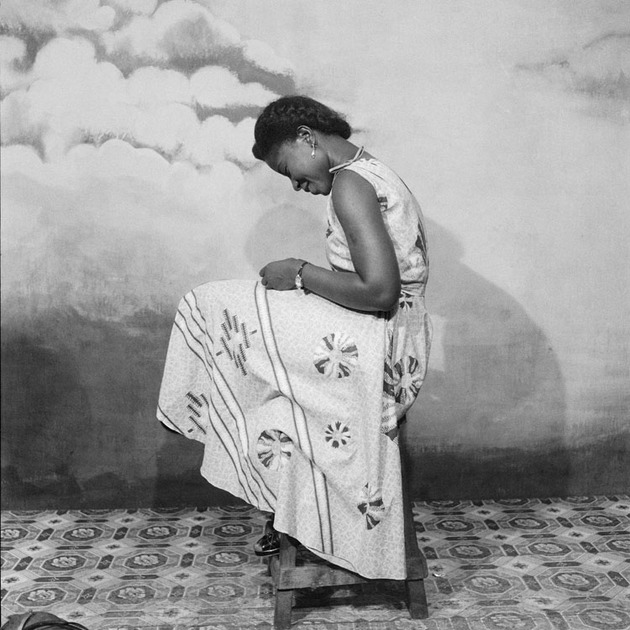 James Barnor. Portrait, Accra, ca 1954.
 Panic about runaway artificial super-intelligence spiked recently, with doomsayers like
 Not long ago, I went to the Yale University Art Gallery and saw their collection of Egyptian art. Seeing the dates on some of the pieces, it occurred to me that I had never really considered just how old Egyptian civilization is. I looked up some historical events to get perspective, and learned that I am closer in time to the assassination of Julius Caesar (44 BCE, which is 2,066 years ago) than Julius Caesar was to the construction of the Great Pyramid of Giza (circa 2500 BCE, over 2,400 years before Caesar’s death). Caesar’s death is ancient history, and the building of the Great Pyramid is also ancient history, but – for the sake of perspective here – the Great Pyramid’s construction was also ancient for Julius Caesar. That’s how old Egyptian civilization is.