
by Paul Braterman
 Throughout most of the UK (Northern Ireland is a partial exception) evolution is regarded as established science, and no politician would make belief in separate creation part of their platform, for fear of ridicule. In the US, this is far from being the case. Although evolution has become more widely accepted over time, one third of Americans still believe that God created humans in their present form. Here I discuss the enormous influence of creationism in US politics and analyse the arguments put forward in its favour, as set out for example by Charlie Kirk, the recently slain leader of Turning Point USA.
Mike Pence, Vice President during Trump’s first term in office, had argued in Congress for creationism, while creationists have been prominent in the various faith councils supporting Trump. At least three members of his present cabinet (Pete Hegseth, Scott Turner at HUD, pastor at Prestonwood Baptist Church, Doug Collins at the VA, one-time pastor at Chicopee Baptist Church) are committed creationists, as is Mike Huckabee, another former Southern Baptist pastor, now ambassador to Israel. So is Mike Johnson, Speaker of the US House of Representatives, who has done pro bono work for Answers in Genesis, now the leading creationist organization. Russell Vought, co-author of Project 2025, whose role at the Office of Management and Budget is pivotal role in the distribution of federal funds, is an elder of a church that explicitly rejects evolution, and sees Satan as “the unholy god of this age.” Vought is also acting director of the Consumer Financial Protection Bureau, and on 28 October 2025, in this capacity, rescinded the rule that, in some States, prevents medical debt from showing up on credit reports.
We can understand the link between creationism and US right-wing politics in terms of the appeal to US conservatives of loyalty, respect for authority, and sanctity. These all favour absolutist theology, which demands submission to divine authority, loyalty to the community of believers, and the preservation of pure doctrine. With this in mind, we can understand the appeal of Christian Nationalism and Trumpism to creationists. Thus as early as 2015, Answers in Genesis praised Trump, not for any specific policies, but because he spoke, just as Jesus spoke to the Pharisees, as one with authority. Read more »
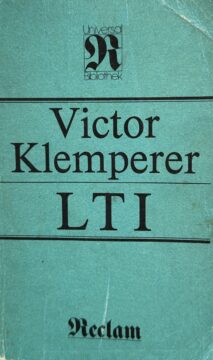 In June 1932, half a year before Adolf Hitler was sworn in as German Chancellor, Victor Klemperer watched Nazis on a newsreel marching through the Brandenburg Gate in Berlin. A professor of Romance languages at the Technical University of Dresden, whose area of specialization was the 18th century and the French Enlightenment, Klemperer (1881-1960) was unpleasantly gripped by this first encounter with what he termed “fanaticism in its specifically National Socialist form,” and by the “expression of religious ecstasy” he discerned in the eyes of a young spectator as the drum major passed by, balanced precariously on goose-stepping legs while he robotically beat time.
 When my mother was a teenager in the early 1940s, a NY-area radio station ran a weekly contest, asking listeners to vote for their favorite singer among two: Crosby or Sinatra? How people made this preference known remains unclear to me: did you need a phone in your house to make a call to the station or was sending a postcard enough? Whatever the method, the winner would be announced each Sunday afternoon. While Sinatra often took the prize, Crosby occasionally outpaced the Jersey boy who grew up two towns south of Cliffside Park, my mother’s hometown. On those occasions, she told me, she’d stamp around my grandparents’ railroad apartment, enraged at the abject stupidity of her fellow listeners. When she’d tell this story, my mother would marvel at her parents’ forbearance, the way they’d accept these outbursts without comment, though they were highly disciplined, gloomy people for whom the idea of having an “idol,” or caring about his fate on a weekly radio show was surely alien. I like this insight into them, a softer side that I myself had only witnessed a few times.
 Anushka Rostomji. Waq Waq Tree, 2023, of the Flesh and Foliage Series.
 Jersey City is a medium-size city on the West bank of the Hudson River across from Lower Manhattan. Up through the middle of the 20th century it was a port and a railroad hub but that disappeared when containerized freighter became too deep to travel that far up New York Bay. Without any freighters the railroads were no longer needed. Light industry disappeared as well. Jersey City became back-offices and bedrooms to Manhattan-based business.
 We have slid almost imperceptibly and, to be honest, gratefully, into a world that offers to think, plan, and decide on our behalf. Calendars propose our meetings; feeds anticipate our moods; large language models can summarize our desires before we’ve fully articulated them. Agency is the human capacity to initiate, to be the author of one’s actions rather than their stenographer. The age of AI is forcing us to answer a peculiar question: what forms of life still require us to begin something, rather than merely to confirm it? The best answer I’ve been able to come up with is that we preserve agency by carving out zones of what the philosopher




 When promoting her new book in September, Supreme Court Justice Amy Coney Barrett stated in an interview as quoted in Politico : “I think the Constitution is alive and well.” She went on – “I don’t know what a constitutional crisis would look like. I think that our country remains committed to the rule of law. I think we have functioning courts.”
 During covid, amid the maelstrom that was American healthcare, a miracle happened. State medical boards suspended their cross-state licensure restrictions.


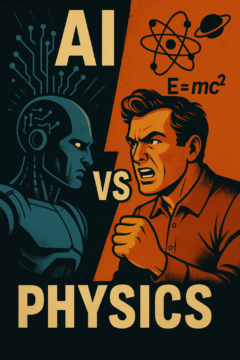 There has long been a temptation in science to imagine one system that can explain everything. For a while, that dream belonged to physics, whose practitioners, armed with a handful of equations, could describe the orbits of planets and the spin of electrons. In recent years, the torch has been seized by artificial intelligence. With enough data, we are told, the machine will learn the world. If this sounds like a passing of the crown, it has also become, in a curious way, a rivalry. Like the cinematic conflict between vampires and werewolves in the Underworld franchise, AI and physics have been cast as two immortal powers fighting for dominion over knowledge. AI enthusiasts claim that the laws of nature will simply fall out of sufficiently large data sets. Physicists counter that data without principle is merely glorified curve-fitting.