
by Azra Raza
 In June 1976, an Air France flight from Tel Aviv to Paris was hijacked by members of the Popular Front for the Liberation of Palestine along with two German radicals, diverted to Entebbe, Uganda, and received with open support from Idi Amin. There, the hijackers separated the passengers—releasing most non-Jewish travelers while holding Israelis and Jews hostage—and demanded the release of Palestinian prisoners. As the deadline approached, Israeli commandos flew secretly to Entebbe, drove toward the terminal in a motorcade disguised as Idi Amin’s own and stormed the building. In ninety minutes, all hijackers and several Ugandan soldiers were killed, 102 hostages were freed, and three died in the crossfire. The only Israeli soldier lost was the mission commander, Yoni Netanyahu.
Two years later, I traveled to Uganda myself to visit my parents, who were there while my father helped draft the nation’s new constitution for Idi Amin’s regime. I had no idea that this brief stop in Entebbe would return to haunt me decades later—when, in 2003, I was detained for over five hours at Ben Gurion Airport with my nine-year-old daughter, questioned endlessly about why I had ever set foot in Entebbe at all.
While in Uganda, my siblings and I fell instantly in love with the country—the sheer beauty of the land, the dark mystery of Bat Valley with tens of thousands of fruit bats rising in the evenings as a black cloud from the edge of the city near William Street, the riotous, ever-changing foliage that seemed to reinvent itself every few steps, and the magnificent wildlife we encountered in breathtaking abundance on our unforgettable safari. That trip remains one of the best trips of my life filled with the warmest memories of the country and the people.
Years later, as I began to understand Uganda beyond my youthful impressions, the work of Mahmood Mamdani offered me a far deeper, more sobering lens—revealing the political currents and historical wounds beneath the beauty we had so casually admired.
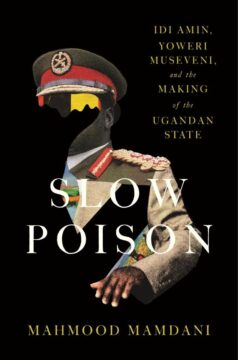
What makes Slow Poison instantly gripping is not merely Mamdani’s brilliance as a scholar, but the far rarer gift he brings to this book: the authority of one who lived the history he recounts. When an acute observer and chronicler of politics turns the lens inward—allowing us to see events as he saw them, in the heat of their unfolding—the narrative acquires a vitality no detached academic history can match. The same author who can produce impeccably sourced, rigorous scholarship becomes infinitely more interesting, readable, and persuasive when he writes from the quick of experience. Lived history breathes; it remembers smells, textures, fears, and moral confusions. It convinces not by footnotes, but by the pulse of a life that moved through the very storms it describes.
Mamdani’s anatomic dissection of manufactured narratives on both sides of historic events is indispensable precisely because he writes from within the storm rather than from its distant aftermath. He lived through the years when Asians in East Africa, insulated by their own social and economic separateness, suddenly found themselves expelled by Idi Amin. In the decades since, an entire industry has arisen to portray them purely as innocent victims of a deranged tyrant—an interpretation that, while containing elements of truth, conveniently erases their own histories of isolation, hierarchy, and complicity within colonial structures. At the same time, an equally loud chorus has spent half a century chronicling Idi Amin as the ultimate African monster, a catalogue of barbarisms embodied in one man. What Mamdani offers instead is a refusal of these easy binaries. He asks the harder questions: What produced such divisions? What resentments accumulated over generations? And how do we account for the full context without reducing anyone to caricature?
Just as revealing is Mamdani’s examination of Amin’s transformation in the Western imagination—from a “noble savage” celebrated for liberating Uganda from Milton Obote, to a jovial giant, to a cannibalistic fiend who murdered his own wives and children. The speed and ease with which these narratives harden into “history” expose how thoroughly power shapes the stories we inherit. Mamdani, who witnessed these events not as an abstract theorist but as someone whose community was entangled in every twist of the crisis, brings a clarity that only lived experience allows. His dispassionate analysis is not detached—it is honed by proximity, by memory, by a refusal to forget the complexity that propaganda, scholarship, and media alike tend to flatten. This combination of intellectual rigor and autobiographical immediacy gives Slow Poison its rare force: it teaches us how essential it is to read history not just from the archives, but from the ground on which it was lived.
If Mamdani’s account of the Amin years offers a structure one can grasp, the Museveni era—spanning nearly four decades—resists such containment. It is a long, shape-shifting landscape of reforms and reversals, hopes raised and dashed, alliances forged and broken—rendered with admirable clarity in Slow Poison, yet still eluding any tidy synthesis from me. I do not feel competent to dissect this sprawling, ever-evolving chapter of Ugandan history; its very length and volatility defy the simplicity of a reviewer’s summary.
Today, roughly 40,000 Ugandans of Asian descent call the country home—many of them descendants of families who arrived thinking Uganda would be just a brief stop on their way West. Instead, they settled into a life they had not fully planned, earning the nickname “Rockets,” a wry acknowledgment that their journey had only one direction. They had come without the provisions or even the imagination for a return trip, and so their roots deepened in a place meant only to be a waypoint.
Mahmood Mamdani, the son of one such Asian family, built his stature not through inheritance or communal privilege, but through the fierce independence of his intellect and his unwavering moral imagination. Whatever reputation he enjoys today is the result of a lifetime spent interrogating power, insisting on justice, and refusing the easy comforts of belonging. Exiled, returning, exiled again, and returning yet again—his life traces a restless arc back to Uganda, a place that pulls him home even as he continually questions what “home” means and who he becomes within it.
What is unmistakable is how profoundly this history, lived and interpreted by Mahmood Mamdani, has flowed into the next generation. It is no accident that Zohran Mamdani, now the mayor-elect of New York City, carries within him a political imagination sharpened by these entanglements of identity, power, and memory. His rise reflects not only a legacy of ideas, but a lived inheritance of how nations fracture and heal—and how courage, clarity, and solidarity can be practiced not just in scholarship, but in public life.
For Mahmood, it was the classroom where he found the story that grounded him. When he finally became a university professor, teaching at Makerere, he encountered George, a student from a small village. After one trip home, Mahmood asked after George’s family—and about a neighbor who had been pregnant.
“She must have delivered. A boy or a girl?”
“A girl.”
“What did they name her?”
“They named her after you.”
“Really? So what did they call her?”
“Professor!”
Whether at Makerere, Harvard, or Columbia, he remains the same: a teacher of rare clarity, coaxing us to see history not as a sealed archive but as a living force—shaping the present, troubling our certainties, and demanding that we read the world with nuance, courage, and unflinching honesty. Slow Poison reads like a suspense novel, yet it leaves the reader with something far more enduring: a shift in perception. It sharpened my sight, deepened my understanding, and reminded me how the familiar can suddenly turn strange when true insight arrives. Or, as Faiz writes:
Baseerat mil gayi jub se meri chashm e tun aasan ko
buhat jaani hoi surat bhi pehchaani naheen jati
بصیرت مل گئی جب سے مری چشمِ تُن آسان کو
بہت جانی ہوئی صورت بھی پہچانی نہیں جاتی
Since my weary eyes have been granted true insight,
even the most familiar faces have become unrecognizable.
Slow Poison does exactly that—it alters what we thought we knew and compels us to see anew.
***
Enjoying the content on 3QD? Help keep us going by donating now.