June

by Azadeh Amirsadri

In my current line of work as a therapist, when I see teenagers, at first they usually present with generalized anxiety disorder, or depression, or both. Parents bring a child in to tell me about all the things not going well, from bad grades and a messy room, to general disrespect and rudeness. This is usually not cause for concern from my point of view and I usually tell them I am not a behaviorist, but can help them get closer to their child and see what else is going on. Most parents, but not all, want a change in their child’s behavior. “He doesn’t turn in his work in school, she eats in her room and leaves the dishes there, etc.” When I meet with parents, I do a general intake and get a picture of how this family functions and communicates with each member to get a better snapshot of what is going on. That is if the parents are open with me. Many times, I get one version of how the family functions and come to find out rather quickly that the narrative shared with me is not exactly how things are.
 
June (not her real name) is 16 and a half years old and a junior in high school. I have been seeing her on and off, since she was 14 years old, when her father and grandmother brought her in. She has been on ADHD medication since she was in elementary school and because of her moodiness, her grandmother and father were wondering about anti-depression medication. June had a psychiatrist who was seeing her every three months for medication consultation.

When I first met her father and grandmother, the mother and her son could not tolerate to be in the same room at the same time, and the tension between them was palpable. I thought what it must be like for June to live in a house with these two people who barely spoke or looked at each other. Two parental figures, separated in the same house yet tied together for life. I realized quickly that I had to speak to them separately to see what issues they were bringing in and what goals and results they were hoping for. Both said they wanted June to communicate more with them, spend less time in her room and participate in school, both academically and socially. Her grandmother spoke about June’s mother, in rather vague terms and said she didn’t have a relationship with her. Read more »
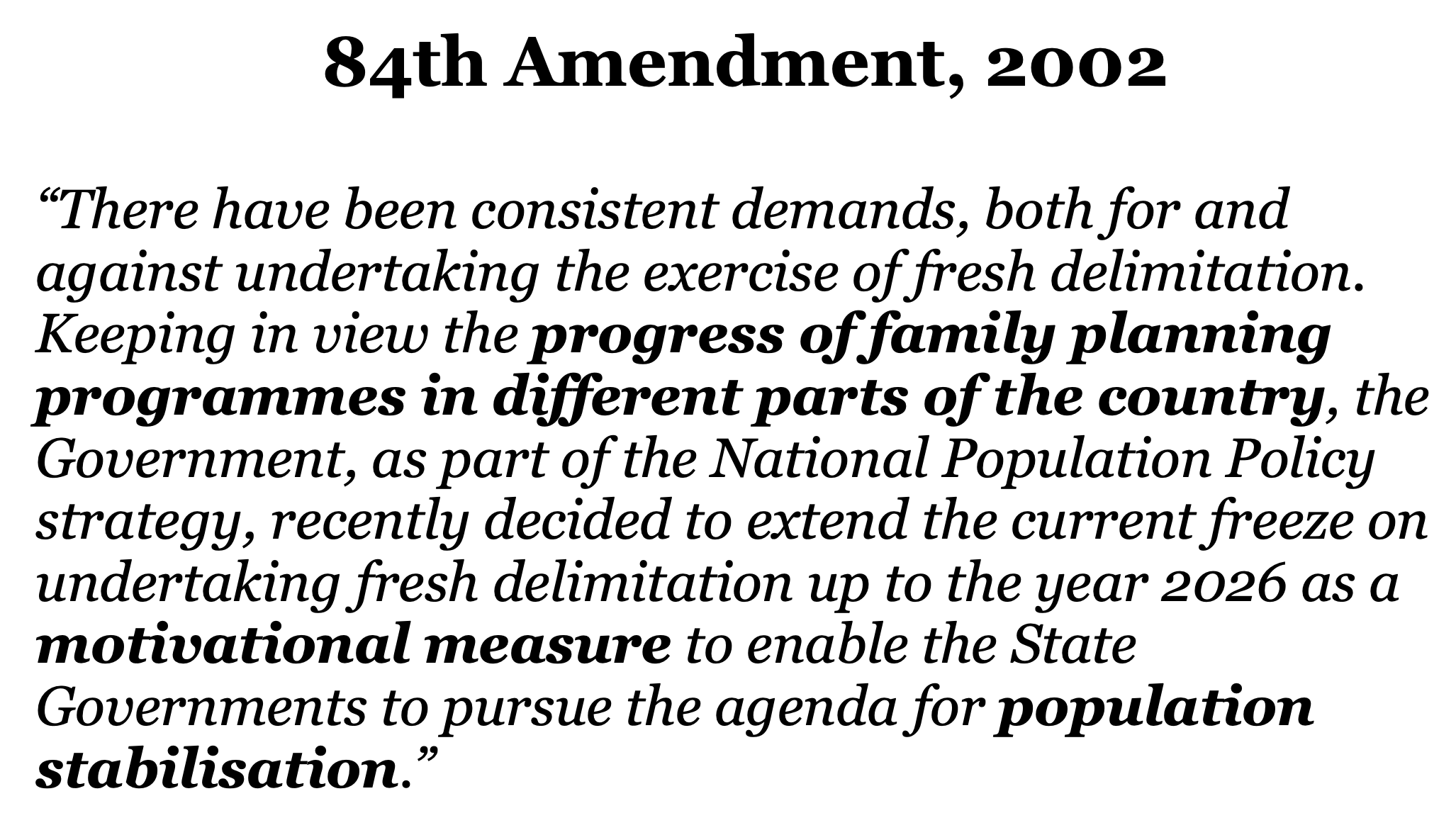

Southern Worry Territory: The Indian Spectre Of Delimitation

by Dilip D’Souza

What motivates

In South India, they’re worried. For following some stated national priorities, for performing well at them in comparison to the North, the states of the South might be punished: They stand to lose a certain quantum of political power.

India’s 1971 Census counted about 548 million Indians. Primarily based on that number, the Lok Sabha – our Lower House of Parliament – has 543 elected seats, a number that hasn’t changed since 1977. So at the time, each Member of Parliament represented about 1 million Indians. This also means that each individual state elected MPs to the Lok Sabha broadly in proportion to its population. Tamil Nadu, home to about 41 million people in 1971, has 39 seats. Uttar Pradesh, with about 88 million in 1971, has 85 seats. (When the state of Uttarakhand was hived off from UP in 2000, it got 5 of those 85 – for convenience, I’m clubbing the two here.)

And so on.

The idea was that this seat allocation would be periodically reviewed, and these numbers revised accordingly. That’s what happened in the first few decades of Indian independence. The Lok Sabha had 489 seats in India’s first election, in 1951. That increased to 494, then 520, and finally 543. All of which might make you wonder: if we had that gradual increase in our first 30 years, why have we had no change in the next 45?

Ah, but in wondering that, you’re getting into Southern worry territory.

Also part of our early years was widespread concern about our increasing population. “Family planning” was a phrase familiar to us who grew up in a still-young India. A government firm, Hindustan Latex, manufactured and sold Nirodh, the first brand of condoms sold widely in the country. The slogan Do ya teen bas (“two or three is enough”) appeared on walls and the sides of buses, was used in songs and became a pop culture meme. That slogan has mutated over the years into Hum do, hamare do (“We two and our two”) and even “We two, ours one”, suggesting that concern over a growing population has never abated. Read more »

Friday, November 21, 2025

The American South And Me: Maine . . . ?

by Mike Bendzela

The old farm in Maine under northern lights, November 2025

I do not remember whether one of our cats had killed it or whether I had run over it with the lawn mower, but I do remember peeling the poor milk snake’s corpse off the grass and walking across the yard with it dangling from my fingertips, en route to the manure pile near the barn where I intended to stow it. When I walked in front of the screen door of the little cottage in the dooryard, I was startled by a sudden “EWW! Take that thing away!” I did as she wished; and when I returned, E. D. (as she was called) was still at the door, shaking her head. Claude had joined her there, laughing. He said to me, “Was that your good buddy?”

“That’s his good buddy, all right,” E. D. repeated. I took this to mean something like its opposite, similar to how the statement, “Well, bless his heart,” an expression my uncle in Kentucky frequently used, meant something like “F— him!” It meant my “good buddy” was anything but good.

E. D. from South Carolina was the second wife of Claude from Tennessee, co-owner of the property in Maine along with his sister, Zelma Bryant, where I have lived with my other half for forty years now. The snake episode happened back in the late eighties or early nineties; it’s hard to remember when events in the distant past actually happened; but it was back when they were both still well enough to drive up from Rock Hill to visit, and when the guest cottage my partner had built for them was so new the unpainted pine clapboards and trim were still bright yellow in color.

“You don’t have to worry about the snakes in Maine,” I think I said. “They’re nothing like the ones you’ve got down south.”

“Ah don’t care. A snake’s a snake!”

And farm life is farm life, North or South. Read more »

Books As Memorabilia

by Mary Hrovat

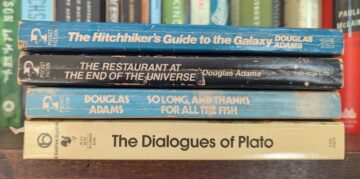
Photo of a stack of the four paperback books mentioned in the essay.

Every now and again, I go through my bookshelves to see if there’s anything that I can donate to the Friends of the Library bookstore. I like to think that books are forever, but I live in a small house. Sometimes I find things on the shelves that I not only forgot I ever had but can’t imagine why I ever bought.

Late this summer, I went through a set of bookshelves containing fiction. For some reason I decided to begin this process just before bed. I was able to identify a small stack of books that I was willing to part with. As I drifted off to sleep, I was thinking that in the morning I’d add the paperback Hitchhiker’s Guide books by Douglas Adams to the stack. Although I have fond memories of reading these books, I couldn’t remember the last time I’d opened any of them, or even removed them from the shelves. I couldn’t see a good reason to keep them.

In the morning, I pulled them down and leafed through them. I smiled as I read bits of them. The cover of one of the books was damaged by water at some point, back when my children were very young. In fact, my life was very different when I bought these books, and they conjured up that earlier time.

I remembered the way that I was introduced to the Hitchhiker’s Guide books. I used to listen to a quiz show called My Word every Saturday morning on the local NPR station. One day I turned on the radio a little early for My Word and caught the end of an episode of the radio adaptation of the Hitchhiker’s Guide books. I was baffled by what I was hearing (who is this Zaphod Beeblebrox person?), so the next week I turned the radio on in time to hear the whole episode and try to get my bearings.

Memories like that are not a good reason to hold onto books. It doesn’t seem as if the memories should depend on their presence. If that younger self exists in my mind, she’s still there. But I put them back on the shelf, next to Little Women (Adams, Alcott, Austen…). They connected me to my past in a way I didn’t want to lose. Read more »

The President of Might-Have-Been

by Steve Szilagyi

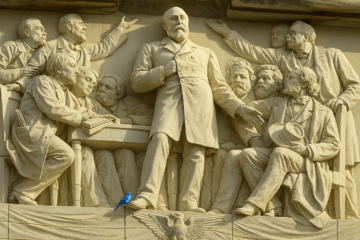
President James A. Garfield depicted in a frieze on the front of the Garfield Memorial.

Prologue
Most people visit the James A. Garfield Memorial to admire its Victorian splendor, or to pay respects to a forgotten president. I go for another reason: my great-great-grandfather carved some of its stone. If Garfield had lived out his term, the man might never have come to Cleveland, never met the woman who became my great-great-grandmother, and I—and a whole thicket of brothers, sisters, cousins, and aunts—would never have arrived on this earth. Absurd as it sounds, my existence is one more ripple in the long aftermath of a presidential assassination. Before getting to that family tale, it’s worth recalling who Garfield was, and why his loss mattered far beyond my own accidental genealogy.

James A. Garfield was the most qualified man ever to be elected president of the United States. He was a fine physical specimen: six foot, 185 pounds, born in a log cabin, and good with his fists. He had a towering intellect, led a frontier college, taught the classics, and could write in Latin with one hand, Greek with the other. People liked him, even his political enemies. He’d greet you with a bear hug on his way to the lectern or pulpit to deliver a thoughtful speech or sermon (he was an ordained minister in the Disciples of Christ church). A fervent abolitionist and Civil War hero, he served nine terms in Congress and knew how to work the levers of government.

Most attractively, when he was nominated for the presidency as a compromise candidate in a deadlocked 1880 Republican convention, he didn’t want the job. Seriously. His long seniority in the House gave him power and influence he was reluctant to sacrifice.

But once this superb human being, this fine farmer, husband, and father of five surviving children, moved into the White House in 1881, he never got the chance to fulfill his promise or address the great issues of his day—reconstruction, national infrastructure, justice for Native Americans—or set a moral direction for America’s growing wealth and international presence. Instead, he spent almost every minute of his scant 120 days in office wrestling with the squalid business of political patronage—battling the corrupt rascals of his own party who were desperate to preserve their petty prerogatives in the distribution of remunerative public offices.

He had only just scored a solid victory in this effort, humiliating his chief enemy, the villainous Senator Roscoe Conkling, and was eagerly preparing to take on the real work of the presidency when he was shot in the back by a perfect fool, and killed—after two agonizing months—by inept doctors who probed his wound with dirty fingers.

Six months as president. That was all he got. Read more »

Thursday, November 20, 2025

The Rules of The Hunt – Part II

by Thomas Fernandes

Figure 1: White-tailed deer in a tail-flagging display

Like the Thomson’s gazelle of Part I, the white-tailed deer (Odocoileus virginianus) evolved an ability to communicate with predators. Not by stotting but by flagging the white underside of their tail.

Why is this considered communication? Communication requires intention, distinguishing a cue from a signal. To a deer, a predator’s smell coming from upwind is a cue. By marking their territory, deer leave signals to others. Cues emerge from simple correlation, association of one signal (odor) with another (the presence of a predator). Over evolutionary time, cues can become signals. After detecting a predator, a deer might turn to flee. Predators constantly evaluate whether to pursue a chase, paying close attention to cues of early detection and fitness. Once predators use these cues to abort the chase, deer might evolve increasingly conspicuous displays, like flagging a highly contrasted tail, simply to advertise this cue to the predator. At this point, the fleeting readiness cue evolves into a fleeting readiness signal.

To be relevant the signal should not be only about detection but also about the ability to outrun predators. As predicted, faster deer are observed to be more likely to wag their tails and the proportion of time the tail stands erect increases with flight speed (Caro et al., 1995). While it may seem surprising that slower deer would not try to bluff their way out of a hunt, a signal is only as efficient as it is honest. If tail wagging were used every time regardless of flight capabilities, it would make the signal meaningless. After all, signals are built from correlations that are of interest to both the sender and the receiver. Break the correlation, break the signal, and everybody loses.

To better understand this behavior, a comparison with mule deer (Odocoileus hemionus) proves insightful. Read more »

Wednesday, November 19, 2025

A Play, a Line, a Power Rediscovered

by Peter Topolewski

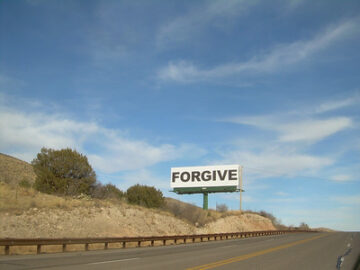
Forgive by Ross Griff

On a stage in London, and another in New York City, is a play called Punch.

It tells the story of young man from a scuffed up section of Nottingham who, at the end of a pub crawl, throws a single punch at an unsuspecting 28-year-old named James. A paramedic in training, James was at the pub with his dad following a cricket match. The punch from Jacob felled James. Days later he was dead.

The play is only tangentially about what led to Jacob throwing that punch. And it but briefly covers the 14 months he served in prison for manslaughter. It is mainly about what followed his release, especially the relationship that formed between Jacob—nineteen years old when he killed James—and James’ grieving parents Joan and David.

What do we do with suffering? the singer and novelist Nick Cave asks. Transform it to keep it from spreading? Or transmit it, allowing it to continue to do its damage? To not transform our suffering, he writes, and instead transmit our pain to others, in the form of abuse, torture, hatred, misanthropy, cynicism, blaming and victimhood, compounds the world’s suffering.

In the months after James’ death, his parents realize their grief is transforming them into something James would not like. Frightened, maybe a bit disgusted with where they are heading, searching for a way forward, they accept an invitation to explore restorative justice. Simple in concept, restorative justice could look like Mount Everest to parents suffering through the death of their son. It is a structured, mediated dialogue between people hurt by a crime and the perpetrator of that crime.

Through the machinations of restorative justice, Joan and David connect with Jacob to learn more about what happened that night, and why. Along the way they struggle with the idea of forgiving Jacob for what he’s done. Read more »

Defending the Humanities

by Mindy Clegg

Many scholars of the hard sciences have recently descended into an understandable panic over the anti-intellectual actions of the current destructive regime in the White House. The Trump administration has begun to dismantle the federal funding system that benefited academia since the Cold War. Many critics see this as an unprecedented and aggressive intervention by the state into academia in order to curtail academic freedom, a standard expectation of the modern university system. The establishment of facts about the world via testable and repeatable hypothesis helped shape western society for centuries now.

Over the course of the 20th century, scientific research incubated in academia became a key driver of many changes (good and bad) in our society. Academia became the linchpin of a network of public-private partnerships that led to these improvements, especially during the Cold War. Without university-level research it seems unlikely that we’d have our regime of vaccinations that has saved millions of lives. Nor would we have the modern computing industry. From the point of view of many academic scientists, it took only a single, massively destructive administration to send the whole network into a death spiral. How could the work of building a system of knowledge over 150 or so years come tumbling down over a handful of years? The reality is that the process of undermining the academy is not just a byproduct of the Trump era. It did not begin with this current attack on science. Rather, the center and far right have long targeted the the humanities and social (or soft) sciences.

In recent years, education has been shifting towards centering STEM fields which stands for science, technology, engineering, and mathematics. Sometimes this includes the social sciences and humanities but that’s hotly debated. The term gained traction in 1990s. Placing STEM at the center of education became a rallying cry among those wanting to keep a university education inline with a changing economy after the Cold War. Put differently, they sought to refocus sciences to better serve the needs of capital in the neoliberal economy. By that time, the computing industry was growing and computer science departments were expanding to accommodate the need. Other fields such as engineering and other technologies got a boost as well. Read more »

Tuesday, November 18, 2025

Brave Horses and Insufferable Horsey People

by Mark Harvey

Mexico, the Horse

I have a horse named Mexico that tore one of his legs to shreds last week when he got caught in a wire fence. It was a bit of a fluke because we try to keep our fences tight and well-maintained. But one morning, a herd of 50 elk ran straight through the fence, leaving a twisted mess of wire. Mexico was grazing in that pasture and innocently stepped into the wire and then fought like hell to get out. He’s a horse with the sound temper of a saint, but any horse that gets a leg trapped will fight with all the force taught them through a million years of evolution. He was a mile from any trailer, and we had to limp him slowly off the meadow.

When we got him down to the barn, we loaded him up with three grams of phenylbutazone, better known as bute in the horse world, to ease the pain and give us a fighting chance of getting him in the trailer. Even with the bute running through his veins, he had a hard time bearing weight on the injured leg, and it took a long while to load him.

This is an animal with one instinct: to please. He is an ears-always-forward horse, seems to enjoy human company as much as the company of his hoofed friends, and rarely spooks at anything. He stands patiently when being shod, occasionally bending his neck as if to check on the quality of the farrier’s work.

He was sweating profusely through the pain and trauma, and it hurt all of us to watch him try to get into the trailer, even with the help of a ramp. Somehow, when animals get injured, we take it more personally than when human beings get hurt. At least I do. I joked to my ranch foreman that if it was him who had gotten cut up in the wire, I’m not sure I’d bother taking him to the vet—even if I could get him in the trailer. Read more »

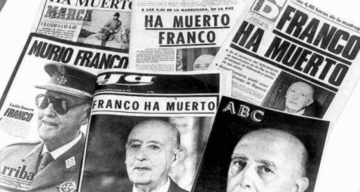
Franco is still dead, the 50th year edition, Part I: Of Legacies and Denied Justice

by David J. Lobina

Yes, still dead.

Having lived in Madrid through much of my teen years, I remember the “20-N” rather well –  November the 20th being the date Francisco Franco, the last of the far-right European dictators, died in his bed, and a date that is commemorated ever since by the far-right in Spain. The 20-N was always a tricky day in Madrid in the 1990s, my decade (but apparently it was much worse in the 80s): during the day the old guard would be out in the usual squares with their songs and salutes, but at night there were plenty of youth out “hunting”, including many who came from overseas, especially from Germany and Italy (there were also antagonist groups on the look-out for “neo-Nazis”, as skinheads were invariably called then; I was of course nowhere near any of the action).

The far-right crowd also commemorate the death of José Antonio Primo de Rivera on the 20-N, the founder of Falange Española (Spanish Phalanx), a party that was created after the model of Italian Fascism (actual fascism!), but which eventually Franco brought under the control of the Movimiento Nacional party, diluting its fascist character somewhat. Primo de Rivera died early on during the Spanish Civil War, on November the 20th, 1936 (the war started in July 1936), and under circumstances that suggest Franco did little to save him (they were in fact rivals at the time, both vying for leadership of the nationalist side in the war, as discussed in Paul Preston, A Concise History of the Spanish Civil War).

This very week happens to be the 50th anniversary of Franco’s death, and so there’ll be celebrations and remembrances of various kinds – by Franco admirers, on the one hand, and by people celebrating democracy instead, on the other. There’ll also be plenty of critical retrospectives and condemnations – again, of Franco and his regime (call it Francoism), on the one hand, and no doubt of Spanish democracy too. It is also the 50th anniversary of the restoration of the monarchy in Spain, and naturally now the so-called emeritus King of Spain (defenestrated as he was in 2014, after one too many scandals) has had the brilliant idea of publishing his memoirs about his time in power (in French only, so far), a publication where he shows genuine affection for Franco – Juan Carlos I de Borbón, for it is he!, was made King of Spain by Franco, after all. Not this post, though, which shall fall squarely on the side of a critical appraisal of Francoism, and quite the laser-focused one at that. Read more »

Perceptions

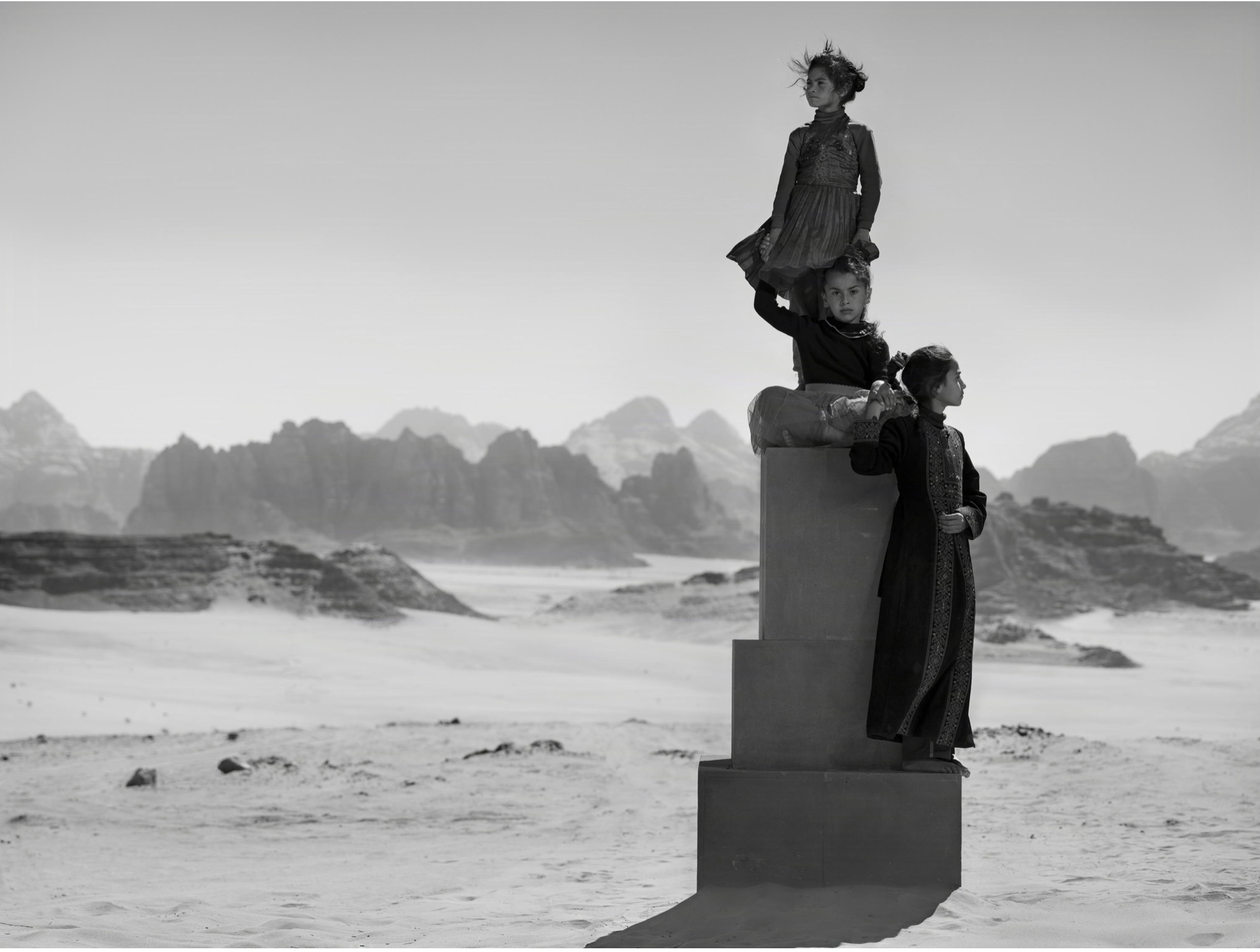
Nick Brandt. Zaina, Laila and Haroub, Jordan, 2024. From The Echo of Our Voices – The Day May Break.
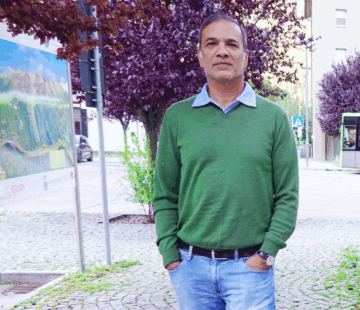
“… THE ECHO OF OUR VOICES is the fourth Chapter of The Day May Break. It was photographed in Jordan, which is considered the second most water-scarce country in the world. The photographs feature refugee families, who fled the war in Syria, now living in Jordan. Living lives of continuous displacement largely due to climate change, they are forced to move their homes up to several times a year in search of agricultural work, moving to wherever there has been sufficient rainfall to enable crops to grow.

The stacks of boxes that the families sit and stand together on aim skyward — a verticality implying more sense of strength or defiance — and provide pedestals for those that in our society are typically unseen and unheard….”

More here, here, and here.

Enjoying the content on 3QD? Help keep us going by donating now.

Monday, November 17, 2025

AI is making things very hard for 3QD

S. Abbas Raza, Founding Editor

Dear Reader, there are no algorithms at 3QD—just six human editors trying to keep a human-curated corner of the internet alive. But recent changes in Google search and other AI-driven shifts have cut our already modest advertising revenue to less than half of what it was just last year. 3QD remains mainly a labor of love, but we do need enough income to cover basic costs.

If you value what we do, please consider supporting 3QD with a contribution by clicking here. Thank you in advance!

Tributaries of the Hidden Curriculum

by TJ Price

Saying “I don’t know” is one of the great joys of my adult life. I revel in the phrase. I freely and openly admit honest ignorance, in the service of learning more, hungrily, with an avid—and, perhaps, slightly obsessive—need. It was not always this way.

For most of my early life, in fact, I was uncomfortable saying it. It was as if I would be admitting to a lack of some critical function, for which I could be judged and dismissed—or, worse, taught—accordingly. Confronted with the new or unfamiliar, I might fake familiarity, bluffing my way through or fleeing from proof of my ignorance, but the dread of challenge to my knowledge dogged my every step. This was perhaps the first flickers of so-called “imposter syndrome”—I was terrified that every moment could prove the moment when everyone discovered I was a fraud, all along. That I wasn’t as smart as they thought I was, which would then prove to me that I wasn’t as smart as I thought I was.

Idyll:

Despite this fear of inadequacy, I have secretly always wanted to be a professional student. I had dreams of vaulted ceilings and cloistered libraries. Of chalkboards and dust and long hours turning pages. The actual schools I did attend held no real value to me—I had ideals of education, from the very beginning, which eluded me and continue to elude, I think, most in this country. These ideals may have been touched by a young romanticism, but the core of them remains the same— 

Credo:

I believe education should not be a gauntlet, should not be cheerless. It should be gentle, inquisitive. It should be sets of questions to which answers are hard-won, but not in the way of contest or grade. I still, to this day, believe fully that one of the great evils in the world is that there is something that every single person is curious about, and that—often enough, for one reason or another—they just don’t get to follow that thread. Instead of being encouraging, there is a rigor involved, a stern hand-slap, a sharp return to inculcation by rote.

Hypothesis:

Education is less an instilling of foreign elements, treating knowledge as immigrant to our brain, but more a revealing—a guided perambulation via neuronal paths—lighting associations one by one as we go.  Read more »

Poem by Jim Culleny

Approaching the Cold Solstice
with J. Kepler

we’re falling deeply in
—in as deeply as we get
before we spin again along an ellipse’s rim
to a more congenial spot for blood and breath

what the astronomical survival odds
(our outer limits) are, who knows?
but time is short by late report

listening now to ersatz jazz
I shift Pandora’s voice,
I move on, linking new music to my
thinking by simply clicking
thanks to all the tricks our technos know
which is obviously permanent
and, like serious snow, is sticking

in this marvelous, magnetic, angular hour
when sun and earth seek a new relation,
and we anticipate the warm benefits
that will return in little over half a year,
as they will not be then for globe-mates
in our southern hemisphere—

Yes, there will be foxglove and hydrangea when
Kepler’s laws provide sun’s heat again.

by Jim Culleny
12/21/14

Enjoying the content on 3QD? Help keep us going by donating now.

Sunday, November 16, 2025

The Monkey’s Paw: Markets And Misaligned Proxies

by Jochen Szangolies

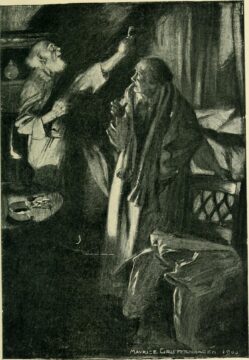
Illustration for W. W. Jacobs’ short story The Monkeys Paw, by Maurice Greiffenhagen. Image Credit: Public domain.

It was while watching the unveiling video of 1X Technologies’ home robot assistant Neo that I was hit with a revelation of a fundamental truth of our current moment in time: the world is a lot as if my ten year old sci-fi nerd self had had many of his wishes fulfilled, but by a cursed monkey’s paw. You want robots? You got it, but they’re creepy, kind of useless, probably spying on you and nevertheless will displace human workers from their jobs. You want AI? You got it, but it frequently makes stuff up, traps people in parasocial relationships while isolating them from the real world, floods the social sphere with misinformation and bad art, threatens the environment and funnels power to the people least fit to wield it.

A widespread narrative is that today, we have it better than at any previous time in human history: we live longer, are healthier and wealthier, better educated, have access to more and better nutrition, and are less likely to die from war or through homicide than ever. At the same time, however, we are faced with widespread ecosystem collapse, having just blown past the first catastrophic climate tipping point leading to near-certain die-off of coral reefs around the planet, the 1.5°C-goal may already have been eclipsed with global warming hitting a possible inflection point, depression and other mental health issues are on the rise even in the richest countries, income inequality is increasing as the richest snatch up an ever bigger piece of the pie, and wildlife populations have declined by a staggering 73% in the past 50 years. As a result, we seem to have very wildly divergent perceptions of our current reality: in one, we’re essentially living better than kings in the past; while in the other, we’re about to drive off a cliff with the wholesale destruction of our living environment.

So what gives? Who’s right—the Pinkerish peddlers of Panglossian optimism or the Monbiotesque negative Nancies decrying the despoliations of the neoliberal order? And how can there be two so vastly contradictory narratives, each of which claims a mountain of charts, data, and analysis in its favor? Read more »

Those Not Busy Being Born Are Busy Kicking The Bucket

by Bonnie McCune

To me, the most surprising fact of old age life so far has been the decline in my own condition. Physical and mental. There is no way I can reach the heights I used to, i.e., even jogging a mile or two. It’s sufficient to WALK a mile or two. I’ll never be able to jog like that again. Or perhaps I’m just being chicken because I’m afraid of falling down.

This shouldn’t have come as a shock. After all I’ve lived for years with friends and family who have gone through the process of getting old, but we’re so accustomed to gradually getting better when we practice an activity, I was taken aback when I realized this. Whether it’s learning the times-tables in third grade, or how to function at a cocktail party with its wealth of unwritten, unspoken social rules, we’re accustomed to getting familiar, comfortable, and more successful with each venture.

Not slower, confused, and achy. Not when we hit old age. Instead, one day we try to recall the name of a neighbor and come up blank. Or we start to leap out of bed, only to pause semi-paralyzed on the edge because a muscle has seized up. These are the harbingers. This is reality.

There are compensations. As we age, we can face with equanimity talk about serious illnesses because we don’t have the potential to live long any way. Given the diagnosis of a life span of one to three years for a serious illness, a friend of mine didn’t even blink. At 83, he only has so much life expectancy. He’s learning to live in the moment all the time. Great practice for meditation, by the way, where we’re urged to aim toward this mental attitude. Read more »

Friday, November 14, 2025

Remembering the South Bronx

by Laurie Sheck

1.
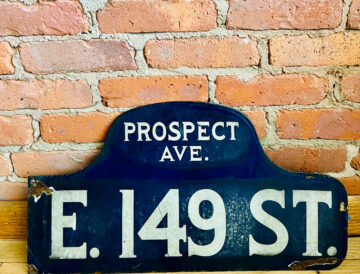
In the summer of 1977 in New York City—summer of the famous city-wide blackout, its fires and looting—my parents stole a street sign. The sign marked the location of my father’s housewares store which overnight had been turned into a hollow shell of blackened ash and charred brick. Looted and burned. 

The sign was a remembrance of a place they had loved.

The store was in the South Bronx, which at that time was the highest crime district of NYC. 149 St. and Prospect Ave. From earliest childhood, I spent many hours there dusting shelves, sticking price tags onto merchandise, and performing a variety of other minor tasks. The store and the neighborhood were a large part of my childhood world, of my introduction to what a world even is. My father and his older brother left school in the 9th and 10th grades to support their family. His brother had died young. Now, with the blackout of July 13, overnight the neighborhood was decimated. The store was gone.

2.
Even before the blackout, the South Bronx was notorious for its empty lots and abandoned buildings, its street gangs and drugs. Of course back then, as a child, I was unaware of the statistics. I didn’t know that roughly 20 percent of the buildings stood empty, abandoned by landlords unwilling or unable to maintain them. Unemployment was nearly double the rate of the city as a whole. Fewer than half of heads of households were said to be employed. The median income was $4,600, substantially below the median for the city. One study showed the median household size as 5.0, whereas the median household size for the city overall was 2.2. Families were crowded into tiny spaces. About half of the households were headed by women.

In 1977, the Women’s City Club of New York City issued an extensive report on the area, With Love and Affection: A Study of Building Abandonment. In addition to gathering numerous statistics, the report described the relentless deterioration of the neighborhood dating back to the late 1960’s. The blackout intensified what was already there: “block after block of empty buildings, some open and vandalized, some sealed, standing among rubble-strewn lots on which other buildings have already been demolished. In the midst of this desolation there is an occasional building where people are still trying to live.” It went on, “The streets and sidewalks…are littered with rubbish, with shattered glass out of the gaping doors and windows.” A New York Times article from 1975 bore the headline “To Most Americans, The South Bronx Would be Another Country.”

And yet, even as my memories resonate with much of what the WCC report described, I also remember bustling streets, restaurants, families. Read more »

Incentivising War Crimes: The High Cost of International Humanitarianism

by Thomas R. Wells

Wars have never been the concern only of their combatants. Other states pay close attention to the geo-political implications and opportunities created by armed conflict, and interfere directly or indirectly when their cynical calculations suggest that would advance their interests.  For example, various countries – the UAE, Iran, Egypt, Turkey, Saudi Arabia, Russia and Qatar – have been involving themselves in Sudan’s ghastly civil war, apparently looking to pick up geopolitical advantages – especially gaining access to Red Sea ports that would allow them to threaten international shipping via the Suez Canal, or to prevent other states from doing so. When extended to material support to favoured factions this increases the resources of the combatants, increasing the ambition of their respective war goals and so extending the war by reducing the scope for a mutually acceptable peace deal.

Such amoral realpolitik in international relations is as old as war itself, together with its unfortunate consequences for human lives. What is somewhat more recent is the rise of international moral concern for the lives of civilians threatened by war, expressed through the increased influence of civil society. At least since the Greeks’ 1820s war of independence, states have also been interfering in other people’s wars out of humanitarian concerns to reduce civilian suffering.

The problem is that although each individual humanitarian intervention may be sincerely morally motivated – and even sometimes succeed in its goal of reducing suffering – the practise of morally motivated interference would seem actually to increase the amount of civilian suffering due to war. It makes civil wars more likely to start and harder to end, while incentivising crimes against civilians. Read more »