
by Mary Hrovat
Every now and again, I go through my bookshelves to see if there’s anything that I can donate to the Friends of the Library bookstore. I like to think that books are forever, but I live in a small house. Sometimes I find things on the shelves that I not only forgot I ever had but can’t imagine why I ever bought.
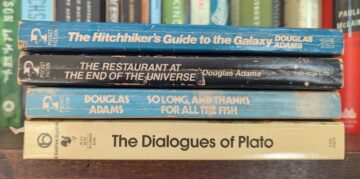
Late this summer, I went through a set of bookshelves containing fiction. For some reason I decided to begin this process just before bed. I was able to identify a small stack of books that I was willing to part with. As I drifted off to sleep, I was thinking that in the morning I’d add the paperback Hitchhiker’s Guide books by Douglas Adams to the stack. Although I have fond memories of reading these books, I couldn’t remember the last time I’d opened any of them, or even removed them from the shelves. I couldn’t see a good reason to keep them.
In the morning, I pulled them down and leafed through them. I smiled as I read bits of them. The cover of one of the books was damaged by water at some point, back when my children were very young. In fact, my life was very different when I bought these books, and they conjured up that earlier time.
I remembered the way that I was introduced to the Hitchhiker’s Guide books. I used to listen to a quiz show called My Word every Saturday morning on the local NPR station. One day I turned on the radio a little early for My Word and caught the end of an episode of the radio adaptation of the Hitchhiker’s Guide books. I was baffled by what I was hearing (who is this Zaphod Beeblebrox person?), so the next week I turned the radio on in time to hear the whole episode and try to get my bearings.
Memories like that are not a good reason to hold onto books. It doesn’t seem as if the memories should depend on their presence. If that younger self exists in my mind, she’s still there. But I put them back on the shelf, next to Little Women (Adams, Alcott, Austen…). They connected me to my past in a way I didn’t want to lose.
∞
Below the fiction on those shelves, there’s a little philosophy. I thought I might find some forgotten things in there that could be donated. The first book I looked at was about Aristotle’s work. I bought the book from a bookstore that was going out of business, and it was steeply discounted. Sometimes I buy books on the principle that educated people should own something by this or that thinker. But Aristotle isn’t central to any of my interests, and if I need to consult his writings, I can find them online or at the university library. Letting that book go wasn’t difficult.
Next to it was a book of Plato’s dialogues, and I thought I could certainly let that one go too, for similar reasons. At some point I did actually read some of the dialogues, probably for a class, and the cover art had a comforting familiarity to me. Still, Plato’s work is also not central to my life, and I’m sure I can access the dialogues by other means if I need to consult them.
But when I paged through the book, I found a receipt from when I bought it in 1988. It’s a very small receipt, from the days when receipts were basically a piece of the narrow paper tape that goes in a printing calculator. It shows that I bought two trade paperbacks for $3.95 each at the Newcomb Hall Bookstore on the University of Virginia campus on January 15, 1988. I don’t remember buying these books, and I immediately wondered what the other book was. Then I marveled at the idea of buying two paperbacks for $8, not to mention the idea of a world where college bookstores sold books.
At that time, I was in my last semester of classes at Indiana University, finishing up a bachelor’s degree in astrophysics. I was dating someone who lived in Charlottesville, and I visited him for at least part of the holiday break. I’m not sure why I bought the book that particular day; I don’t think I had a class that semester that would have required it. It seemed strange that I was still in Charlottesville that far into January; perhaps classes hadn’t started in Bloomington. I was both informed and baffled by the receipt. Again, a past world was evoked. The dialogues of Plato still sit on my shelves.
∞
One of the strange things about getting older is that the past does and doesn’t go away. I hold so many memories; I feel as if I’m in touch with the past. At the same time, I’m increasingly aware of how irrevocably the past has vanished. Every time I’ve left a job or a place, I thought of it as still going on without me. It has seemed that I might drop back in some day for a visit. As I grow older, as people close to me die, as the world changes, I’ve come to see that many of the doors that closed behind me have closed for good.
I tend to think of memorabilia as the photo albums and boxes of old letters and greeting cards and other ephemera that I store in the closet. It hadn’t struck me until recently that some of my books can also be described as memorabilia. If I look closely at any bookshelf, I find memories in the books. The memories are sometimes incomplete, reminding me that the past is simultaneously absent and present.
My kitchen is the one room that holds no books, but the past is there, generally unnoticed but occasionally poignant. Every day I use a plastic cutting board that my mother gave me when I got married at 18, and the plates and silverware that my ex-husband and I chose for our home. It sometimes strikes me as peculiar that these humble objects have come so far with me, through so many moves and changes, when they world they came from has closed up behind them and cannot be re-entered.
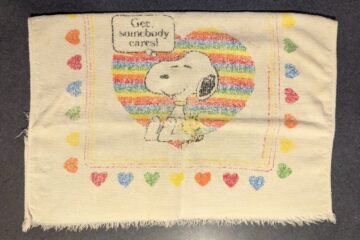 I also have memorabilia in the kitchen. I have a set of casserole dishes that I seldom use; they date back to my first marriage. They’re Corningware with a goofy flower pattern, and they remind me so vividly of their time that I love catching sight of them in the cupboard. I have plastic tumblers given to me by my father’s mother, a dish towel from my mother’s mother. At some point I stopped using the towel because I didn’t want it to become any more worn than it already was. It’s patterned with hearts in a rainbow theme, and it shows Snoopy sitting next to his little bird friend Woodstock, both of them smiling. A thought bubble next to Snoopy reads, “Gee, somebody cares!” People, like the past, can be both absent and present.
∞
You can find more of my work at MaryHrovat.com.
Enjoying the content on 3QD? Help keep us going by donating now.