by Paul Braterman
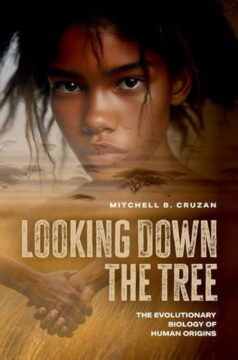 Looking Down the Tree, The Evolutionary Biology of Human Origins, Mitchell B. Cruzan, Oxford University Press, 2025
This book has an ambitious and praiseworthy agenda, to discuss a wide range of specifically human characteristics, in the context of the selection pressures operating on our ancestors once the forests of East Africa were replaced by savanna. The more open terrain favoured bipedalism, and bipedalism led on to a cascade of further changes. These, we are told, included loss of fur, bulbous breasts, female orgasm, monogamy, large penis size, cooperation, and exclusive homosexuality. Anatomical side-effects of bipedalism gave us hands capable of fine movements, which in turn favoured the development of large brains, and hence prolonged infancy and the development of cooperative social structures. This evolution took place under circumstances very different from those under which almost all of us live today, and we need to understand the constraints imposed by our evolutionary pathway if we are to understand ourselves as we are now. The book is well produced, and fully illustrated with drawings and diagrams.
The approach is laudably multidisciplinary. As the author puts it, his aim is
“To facilitate an understanding of the origin of human traits, I draw upon evidence and inferences from fossils, genomics, phylogenetics, coalescence theory, analyses of calcium isotopes, and the anatomy and physiology of our ancestors and other animals.”
Cruzan follows the account of humans having emerged in East Africa, with more than one out-of-Africa migration, but anatomically modern humans outside Africa having most of their genetic material from a group that left there around 70,000 years ago. As a narrative device, he follows a fictional woman (Launua) from childhood to her eventual death, pointing out the specific challenges she is presented with, and the evolved abilities with which she overcomes them. Much of the argument is controversial, but this is not necessarily a bad thing, and the style makes the material accessible to a wide audience. I would warn the reader, however, that there are questions about his heavy use of selection at the clan level, and the assumption that the individual clans would have been highly inbred. There is some evidence that by 34,000 years ago, admittedly halfway between the time under discussion in the present, anatomically modern humans had formed networks that avoided inbreeding. More details (paywall) here.
There are, unfortunately, drawbacks. Read more »
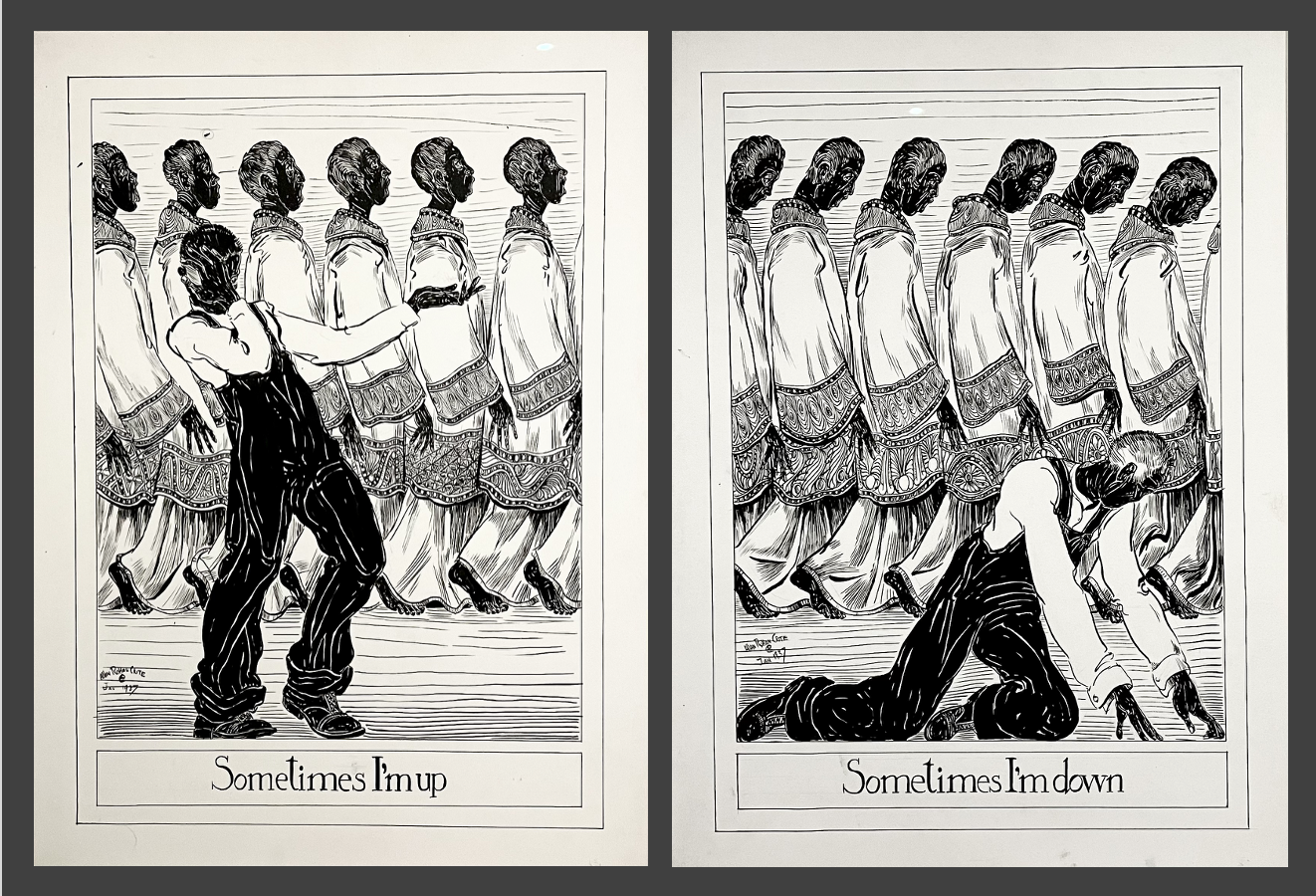 Allan Rohan Crite. Sometimes I’m Up, Sometimes I’m Down. Illustration for Three Spirituals from Earth to Heaven (Cambridge, Mass., 1948),” 1937.
 Dear Reader,


 We sometimes say that someone is living in the past, but it seems to me that the past lives in us. It lives in our houses; it lies all around us. As I write this, I’m sitting on the couch under two blankets crocheted by my grandmother, who was born around the turn of the 20th century. The laptop sits on a folded blanket that came from Mexico via a friend years ago. And that’s just the surface layer. My closets and file cabinets are also full of the past.