
Raphael’s School of Education

by Scott Samuelson

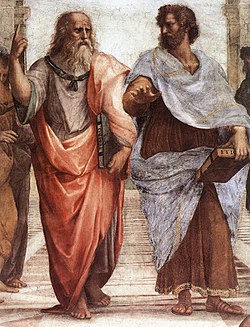
Raphael, School of Athens (1509-11). Detail of Plato and Aristotle. Click here to see the whole image.

Once I’ve hung a picture on the wall, I pretty much never look at it again. It goes right from the forefront of my mind to the background of my room. It’s only when a guest comments on it that I bother to see it again.

A similar thing can be said for iconic works of art. We see them so often that we don’t bother to look at them anymore. A good example is Raphael’s School of Athens, especially its central scene of Plato and Aristotle in conversation. It’s used to illustrate pretty much every article concerning philosophy in the popular media. When we see it, we think “philosophy” or maybe “classics” and move on.

Art historians aren’t much better. They love the game of guessing who each figure in the School of Athens is modeled on or is supposed to represent. Instead of seeing “philosophy,” their great advance is to see “Michelangelo” and “Heraclitus.” As fun and minorly informative as the guessing game can be, it still sees the painting as a cheap allegory.

I started taking a fresh look at the School of Athens when I had to teach it as part of a study abroad course to Rome. The more I looked at it, the more I started to see it as a compelling and comprehensive philosophy of education. To my surprise, I’ve found that it illustrates the complexity of what I aspire to as a teacher. Read more »
Monday, June 8, 2015

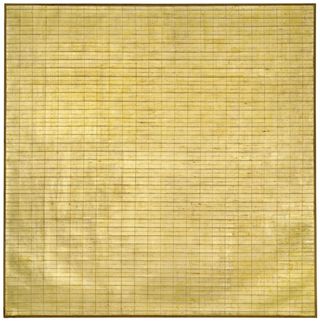
A Modern Mystic: Agnes Martin, Tate Britain, Until 11th October, 2015

by Sue Hubbard

“Beauty is the mystery of life, it is not just in the eye. It is in the mind. It is our positive response to life.” —Agnes Martin

010Over the last few years Tate Modern has paid homage to a number of important women artists including, amongst others, Eva Hesse, Frida Kahlo, Louise Bourgeois, Yayoi Kusama, Marlene Dumas and Sonia Delaunay. That the psychodrama of Frida Kahlo and Louise Bourgeois, the theatre of Kusama and the eroticism of Marlene Dumas should have had wide public appeal is not surprising. All provide the means for the viewer to identify with the artist, to ‘feel her pain' and be drawn into her emotional maelstrom and visual world. But the current exhibition of work by Agnes Martin is an altogether more difficult affair. It makes demands on the spectator who, if willing to engage, will be rewarded by moments of Zen-like stillness and clarity.

To sit among Martin's white paintings, The Islands I-XII, 1979, is akin to being alone with Rothko's Seagram paintings. Though while Rothko is chthonic, the colours womb-like and elemental as he wrestles with the dark night of the soul, the subtle tonalities of Martin's pale paintings are, in contrast, Apollonian. She is Ariel to Rothko's Caliban. Full of light and air, her paintings quieten the busy mind, provide space, tranquillity and silence. Yet each of these silences is subtly varied, broken by differing accents and rhythms. The tonal shifts, the small variations and delineations of the sections of the canvas demand attention and mindfulness. These works offer not so much an experience of the sublime – that form of masculine awe and ecstasy – as a dilution into nothingness, an arrival at T. S. Eliot's “still point in a turning world.” Here we find stasis, where everything, as in meditation, has been stripped away, so that we are left with nothing more than the rhythm of the world, with what simply IS.

Read more »