
by Scott Samuelson
Once I’ve hung a picture on the wall, I pretty much never look at it again. It goes right from the forefront of my mind to the background of my room. It’s only when a guest comments on it that I bother to see it again.
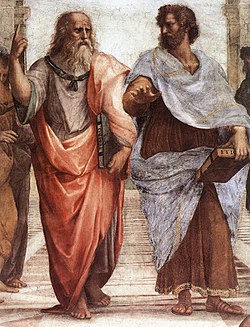
A similar thing can be said for iconic works of art. We see them so often that we don’t bother to look at them anymore. A good example is Raphael’s School of Athens, especially its central scene of Plato and Aristotle in conversation. It’s used to illustrate pretty much every article concerning philosophy in the popular media. When we see it, we think “philosophy” or maybe “classics” and move on.
Art historians aren’t much better. They love the game of guessing who each figure in the School of Athens is modeled on or is supposed to represent. Instead of seeing “philosophy,” their great advance is to see “Michelangelo” and “Heraclitus.” As fun and minorly informative as the guessing game can be, it still sees the painting as a cheap allegory.
I started taking a fresh look at the School of Athens when I had to teach it as part of a study abroad course to Rome. The more I looked at it, the more I started to see it as a compelling and comprehensive philosophy of education. To my surprise, I’ve found that it illustrates the complexity of what I aspire to as a teacher. Read more »