
Raphael’s School of Education

by Scott Samuelson

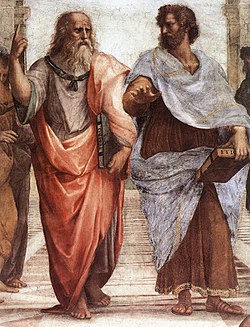
Raphael, School of Athens (1509-11). Detail of Plato and Aristotle. Click here to see the whole image.

Once I’ve hung a picture on the wall, I pretty much never look at it again. It goes right from the forefront of my mind to the background of my room. It’s only when a guest comments on it that I bother to see it again.

A similar thing can be said for iconic works of art. We see them so often that we don’t bother to look at them anymore. A good example is Raphael’s School of Athens, especially its central scene of Plato and Aristotle in conversation. It’s used to illustrate pretty much every article concerning philosophy in the popular media. When we see it, we think “philosophy” or maybe “classics” and move on.

Art historians aren’t much better. They love the game of guessing who each figure in the School of Athens is modeled on or is supposed to represent. Instead of seeing “philosophy,” their great advance is to see “Michelangelo” and “Heraclitus.” As fun and minorly informative as the guessing game can be, it still sees the painting as a cheap allegory.

I started taking a fresh look at the School of Athens when I had to teach it as part of a study abroad course to Rome. The more I looked at it, the more I started to see it as a compelling and comprehensive philosophy of education. To my surprise, I’ve found that it illustrates the complexity of what I aspire to as a teacher. Read more »
Monday, November 12, 2012

Pre-Raphaelites: Victorian Avant-Garde. Tate Britian till 13th Jan 2013

by Sue Hubbard

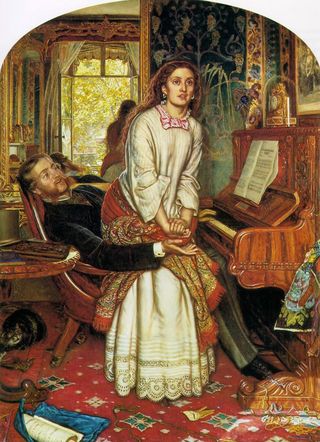
William_holman_hunt_4_the_awakening_conscienceCollected by Andrew Lloyd Webber, and the inspiration for a number of rumpy-pumpy TV costume dramas, it’s hard to think beyond the flowing hair, the luxurious silk dresses and the rich nostalgia of the Pre-Raphaelites to see them as anything other than the acceptable face of establishment art. Having missed the opening of the current show at Tate Britain, I paid a visit to the exhibition during the week and was hardly able to move for the throng. The Pre-Raphaelites, it seems, have lost none of their popular allure. But their works were not always a subject for tea towels and art shop merchandise but constituted an inventive avant-garde that not only tells us a good deal about the Victorian fear of modernity and industrialisation, but about the social order, attitudes to sexuality and the role of women in the mid-19thcentury.

Founded in 1848 the Pre-Raphaelite Brotherhood was a reaction to a recognisably modern world of dramatic technological and social change. In many ways there are parallels with our own times: the newly globalised communications, the rapid industrialisation and turbulent financial markets and the hitherto unprecedented growth in the expansion of cities that threatened old agrarian ways of life and the natural world. London, like now, was the centre of a world economic system. Traditional patterns were changing; the social order was in flux, feudal belief systems were crumbling. There was the rise of a new middle class, who were making their money from trade, as well as a decline in old religious certainties. This was the era that spawned Darwin and Nietzsche.

Read more »