—because despite being enlightened, civilized, advanced, and free, we are trapped—
by Paul North
In the 1930s a Hungarian psychiatrist, Leopold Szondi, began to think that families predetermine the lives of their members, before he was deported to Bergen-Belsen because his family was Jewish. Through a special negotiation he and other intellectuals were released and sent into exile. Szondi settled in Switzerland, where he worked the rest of his long life on tests and treatments for Genotropism, the name he gave to this curse on families. Members of a family share, he thought, a narrow set of psychological tendencies that are transmitted across generations. Who you choose as a life partner, what kind of career you end up practicing, even how much money you make are all determined up to a point by a ‘familial unconscious.'
The familial unconscious contains drives and needs specific to the family and gives them their desires, their limits, their fate. Now, although Szondi wanted to release individuals from the family's unconscious predeterminations, and he invented a therapy to do so, the principle that underpinned his therapy was itself a fateful idea. Instead of staying limited by family traits, he wanted you to learn that: “Wahl macht Schicksal” — “Choice makes fate.” With this principle, Szondi hoped to break through the walls of his patients' familial unconscious. What if he succeeded? Well, through this principle he also locked patients into a new idea of destiny. Fate may not pre-determine you, but it does determine you. The way it determines you now is not necessarily better, only different. Now your fate happens to you choice by choice.
Let us imagine that there is a history for the idea of fate. It is a fiction or a semi-fiction, but that doesn't matter. It will help us to see a pattern. The first stage of the history is ancient, even archaic. We see Greek and Roman worry about fate all over epic poetry and stoic philosophy. In monotheisms, however, and especially in Christianity, fate takes a back seat to a different kind of story, where what happens at the end of time cannot be pre-judged by humans. At the end of all things, whether it comes as a last judgment or a gift of grace, a human-looking God will be there, making all the final decisions.
The philosophical essayist Odo Marquard, who first sketched out this historical tale about fate—the fate of fate, he called it—was right: the weightiest things in life, which used to be completely out of our hands (threads were held by “the fates,” judgments were made by God) at some point were put directly into our hands. After the great monotheisms (this is fiction too: we know they have not ended), everything, Marquard wrote in 1981, comes to be seen as made by human beings, including the highest things, like God, history, and truth. He notes that the expansive new human power of making did not actually put an end to the fate idea. Just because we began to think of ourselves as in charge, as making all things, including our own history, our ideas and ideals, this did not mean that we were free—on the contrary.
Read more »




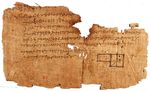 Math works pretty well. We can count apples and oranges; we can scribble equations and then launch a rocket that lands gently upright. When an argument is indisputable, we colloquially say “do the math,” and we speak of events that will happen with “mathematical certainty.” Math works so well that you're forced to wonder: why, and what does it mean about our world? I won't fully answer these questions, but I'll offer a few perspectives.