by Syed Tasnim Raza
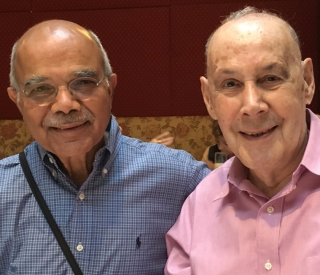
It was late October 1971. My brother-in-law, Dr. Tariq Khan and I were interviewing together for residency training positions in Surgery. We finished our interview at the Downstate Medical Center in Brooklyn at 7:30 PM one night and then drove to Syracuse in heavy rain. We arrived at a friend's house at 2 AM and after sleeping a couple of hours we drove to our next interview at the Buffalo General Hospital in Buffalo, New York. There was heavy fog with very poor visibility, but we had to be at the Buffalo General before 9, so we sped west in the fog and made it there just in time.
The person to interview us first that morning was the acting director of the residency program in Buffalo, Dr. Richard H. Adler, a general Thoracic Surgeon. He had an angelic face and a lovely soft smile, and his presence immediately made us comfortable. The first question he asked us was why our eyes were bloodshot. We explained the all-night driving session after our interview finished later than expected in Brooklyn. He seemed impressed. After reviewing our application and reference letters he sent us to meet two other young faculty members, Dr. Jack Cudmore and Dr. Roger Dayer. And then we were given a tour of the hospital by Dr. Robert Milch, then the senior resident in surgery. After lunch, we met Dr. Adler again, for the closing interview, where he offered both of us the first-year residency position in surgery. This was a pyramidal program, so that there would be 15 first year residents, but these would be reduced to only six in the second year. Both Tariq and I were so excited we accepted the offer on the spot. We would join the program in July 1972. Thus, began my relationship with Dr. Adler, who would become my teacher, mentor and friend for the next 45 years.
Even though there were many Thoracic surgeons in Buffalo during the years Dr. Adler was active, he was the thoracic surgeon and did over 80% of all thoracic surgery at the Buffalo General Hospital. He was Professor of Surgery and eventually Director of the Thoracic Surgery Residency program until his retirement in 1990. He was one of the best thoracic surgeons both in the operating room, and also in his fund of knowledge about thoracic disease, which he always kept updated and current. Dr. Adler was trained at the University of Michigan in Ann Arbor under Dr. Herbert Sloan, one of the eminent thoracic surgeons of his time, who also was the Editor of the Annals of Thoracic Surgery. After his training, Dr. Adler came home to Buffalo and joined the Surgical faculty at the Buffalo General Hospital under Dr. John Payne, the Chairman of Surgery. During the next decade, Dr. Adler spent a year of further training in England in one of the foremost thoracic surgery clinics. While in London, Dr. Adler was exposed to Norman Barrett, one of the premier thoracic surgeons, who described the mucosal changes in the lower esophagus due to chronic reflux of acid from the stomach, now commonly known as Barrett's esophagus. On his return to Buffalo, Dr. Adler started methodically collecting patients with hiatal hernia and acid reflux and did mucosal biopsies of the lower esophagus. When Dr. Adler presented the results of his studies at a Thoracic Surgical meeting, Norman Barrett was in the audience. He discussed the paper and congratulated Dr. Adler for presenting the largest series of well documented cases of Barrett's esophagitis reported until then. Dr. Adler had similarly large series of case-studies, where he performed talc pleurodesis for malignant pleural effusion or patients with post-pneumonectomy space and others.
His attention to detail and very methodical follow-up of any given thoracic disease was remarkable. I always enjoyed assisting him at the smallest procedure, because he made it into an art form.

 b
b