by Christopher Hall
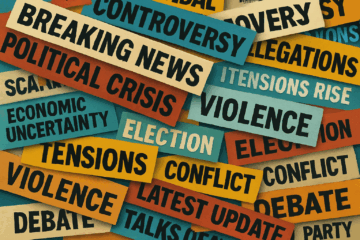
When J. L. Austin published his book How to do Things With Words, his intent was to demonstrate that language must be understood to go beyond any mere reference function. We do not use language merely to point to things in the world, but also to enact things within the world. “I christen thee the Titanic” is a linguistic act. The non-referential quality of language ought to be of some concern to us at the moment. Trump, bullshitter supreme, has never cared about the referential aspect of his language, and whether that bears any correspondence with reality. What strikes me most about Trump’s 2nd term is that he seems to be deploying this empty language with intent; MAGA has become self-aware, perhaps even sentient. The key to the Trump presidency is not misinformation, but the ultimate distrust of information itself. He wants, and is getting, a people who can be convinced to distrust all signals, and thus hear only noise. Everything Trump says is designed to enact something on the listener; what Trump is actually talking about is often irrelevant.
There is a clumsy will-to-power here, but Trump’s fundamental authoritarian impulse doesn’t, for the moment, seem to be pulling in the typical direction. Of course, it’s entirely possible that he wants people to believe that Haitians are eating pets in Springfield, or that there’s a white genocide occurring in South Africa. But there’s also a very real sense that he simply doesn’t care. Orwell envisioned political language as being rendered “dead,” particularly (but not exclusively by any means) in authoritarian states. And yes, Trump’s limited vocabulary, his absurd repetitions and locutions, and his general bumptious cadence, might all be symptoms of general necrosis. But, at least in this sphere, Trump doesn’t have to coerce anybody. It’s enough to present nonsense and proclaim that people can think what they want.
The politician as bullshitter is nothing new. But as I think about Trump and the new authoritarianism’s affect on the public sphere, I am beginning to believe the key to 21st century is not what Orwell saw as a deadening of language. Yes, meaning is on the decline, but it is coming about not as result of repressive restriction, but rather through perverse exuberance. Language isn’t dying; it is experiencing cancerous growth. If it true that authoritarian states like China and Russia continue to enforce silence, they increasingly do not to rely on this alone as a means of control; overwhelming noise will do the trick just as well. Do we understand enough about control by noise to understand this trajectory in our political future? Read more »
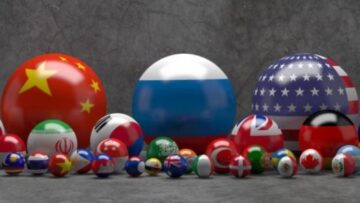 In 2007, at the Munich Security Conference, Vladimir Putin announced that the current world order had changed. The unipolar world order, with one centre of power, force and decision-making, was unacceptable to the leader in the Kremlin. Yet, more than that, Putin’s speech prepared the replacement of the unipolar world order, a replacement, he would later come back to, over and over again: multipolarity.



 One argument for the existence of a creator /designer of the universe that is popular in public and academic circles is the fine-tuning argument. It is argued that if one or more of nature’s physical constants as mathematically accounted for in subatomic physics had varied just by an infinitesimal amount, life would not exist in the universe. Some claim, for example, with an infinitesimal difference in certain physical constants the Big Bang would have collapsed upon itself before life could form or elements like carbon essential for life would never have formed. The specific settings that make life possible seem to be set to almost incomprehensible infinitesimal precision. It would be incredibly lucky to have these settings be the result of pure chance. The best explanation for life is not physics alone but the existence of a creator/designer who intentionally fine-tuned physical laws and fundamental constants of physics to make life physically possible in the universe. In other words, the best explanation for the existence of life in general and ourselves in particular, is not chance but a theistic version of a designer of the universe.
 Sughra Raza. Scattered Color. Italy, 2012.