
by Christopher Hall
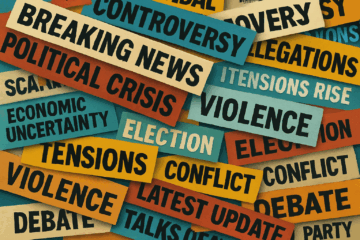
When J. L. Austin published his book How to do Things With Words, his intent was to demonstrate that language must be understood to go beyond any mere reference function. We do not use language merely to point to things in the world, but also to enact things within the world. “I christen thee the Titanic” is a linguistic act. The non-referential quality of language ought to be of some concern to us at the moment. Trump, bullshitter supreme, has never cared about the referential aspect of his language, and whether that bears any correspondence with reality. What strikes me most about Trump’s 2nd term is that he seems to be deploying this empty language with intent; MAGA has become self-aware, perhaps even sentient. The key to the Trump presidency is not misinformation, but the ultimate distrust of information itself. He wants, and is getting, a people who can be convinced to distrust all signals, and thus hear only noise. Everything Trump says is designed to enact something on the listener; what Trump is actually talking about is often irrelevant.
There is a clumsy will-to-power here, but Trump’s fundamental authoritarian impulse doesn’t, for the moment, seem to be pulling in the typical direction. Of course, it’s entirely possible that he wants people to believe that Haitians are eating pets in Springfield, or that there’s a white genocide occurring in South Africa. But there’s also a very real sense that he simply doesn’t care. Orwell envisioned political language as being rendered “dead,” particularly (but not exclusively by any means) in authoritarian states. And yes, Trump’s limited vocabulary, his absurd repetitions and locutions, and his general bumptious cadence, might all be symptoms of general necrosis. But, at least in this sphere, Trump doesn’t have to coerce anybody. It’s enough to present nonsense and proclaim that people can think what they want.
The politician as bullshitter is nothing new. But as I think about Trump and the new authoritarianism’s affect on the public sphere, I am beginning to believe the key to 21st century is not what Orwell saw as a deadening of language. Yes, meaning is on the decline, but it is coming about not as result of repressive restriction, but rather through perverse exuberance. Language isn’t dying; it is experiencing cancerous growth. If it true that authoritarian states like China and Russia continue to enforce silence, they increasingly do not to rely on this alone as a means of control; overwhelming noise will do the trick just as well. Do we understand enough about control by noise to understand this trajectory in our political future?
Let’s put this another way: Winston Smith would have a rather different job in a regime controlled by noise. He would no longer be required to edit the past so that Oceania has always been at war with Eastasia. He could, instead, be a member of the commentariat. There would never be the necessity for one truth, a single signal, to emanate from the state itself; it would be enough that thousands of signals are emanating from everywhere all at once. Oceania is at war with Eastasia. No, it is not a war, it is a special military operation. But that doesn’t matter, as the real question is why we suddenly stopped being at war with Eurasia. We should be at war with Eurasia, and then go to war with Eastasia. We are in fact still at war with Eurasia. We shouldn’t be in any war in the first place. Winston Smith takes one, or some, or all of these positions, posts them where he will in one, some or all of the public forums he can find. And he was never coerced to do so; he may be a disinformation agent, or he may be an enthusiastic civilian – it doesn’t matter. The state goes on being at war with who it wants. In Orwell’s Oceania, every utterance conveyed the single speech act: You Will Obey. In our Oceania, even that message is impossible. The speech act is contained within the volume of the cacophony.
I’ve been inspired to consider this question, not only by Trump himself, but also by the endless responses to him in which Trump is OWNED but such-and-such commentator or congressperson, or his administration is DESTROYED by any one of the idiotic things he does and says on a daily basis. In the current moment, the collapse of the bromance between Musk and Trump is busily feeding on the available oxygen. But owning Trump doesn’t matter unless one is prominent enough to cause a reaction from him – and even then, I’d argue, it still doesn’t matter. He is not destroyed – he remains. And despite feeling this might be one tick too far on the cynicism meter, all of the reaction from addled progressives, pearl-clutching liberals and Never-Trump conservatives seems to me, at this late stage, not so much speaking truth to power but merely adding fungus to the rot. (Which, as goes without saying, might be precisely what I am doing right now). Classic authoritarians believe in a Truth that resides within a particular political ideology and/or their status as the embodiment and savior of the true nation. Trump certainly makes gestures towards himself as the latter, but it seems like a purposeful parody of the ravings of the leader of a tinpot junta. (Trump’s followers have a keen habit of both completely investing in what Trump has to say and luxuriating in the nonsense of it.) Either way, the question remains: what is the point in speaking truth to someone who doesn’t believe in the concept of truth?
It may be that noisy authoritarianism is simply an intermediary stage before the silent kind – France was pretty noisy before the Terror, after all. And as Trump’s war with Harvard and the press, and the measures he’s taken to obliterate anyone who isn’t white and straight from American history make clear, he is hardly above attempting to silence dissent or throwing people in the Memory Hole. And democracies should be noisy, shouldn’t they? It is impossible, of course, to imagine Trump without the internet and social media, and it certainly the case that the issue of noise I’m describing here goes beyond a political phenomenon. But we are “used to,” if I can say so, state coercion wanting us to say one thing instead of another, not one wanting us to say everything possible.
Whatever the scale of repression, no political force can repress every single sort of unwanted signal. In the Soviet system, suppressed works could find themselves circulating in manuscript form, a system which became known as samizdat, and one of the earliest works to be disseminated in this manner was Doctor Zhivago. Thus a community formed of people dedicated to retrieve some kind of signal from the dominating silence, and they risked life and limb to do so.
If there were to be practitioners of the equivalent of samizdat in democratic system, they would not have to risk nearly so much, perhaps only a bit of time and sanity. It would involve, to my mind, a resistance to the saturated frames of discourse we habitually find ourselves in. Information comes at us in ways that overwhelm each management strategy we have, and the habits we thus form – doomscrolling and the accompany brain rot – are the ticks of an addict. Perhaps the first step is a kind of affirmation that signals still exist in a noisy society, even if they are difficult to find. At that point we must find that it is incumbent on us to practice a kind of mental curatorship, to find and keep safe the various nodes of meaning we come across. That should be our countering speech act against a dominant one where meaning is constantly being overmatched by nonsense. The referential and the active part of language thus meet again – we are doing something by trying to listen to, and say, something meaningful. There is always the risk that you’re just contributing to the noise, but the alternative is a quietism which, if for no better reason that the salvation of our souls, we simply cannot afford.
***
Enjoying the content on 3QD? Help keep us going by donating now.