
Replacing Death

by Kyle Munkittrick

By Thomas Cole – National Gallery of Art, Public Domain, WikiCommons

Nearly every argument against longevity is a version of, “But death is good sometimes.” Death creates finitude, thereby creating meaning and forcing change. Take Frances Fukuyama’s recent piece “Against Life Extension” in Persuasion. Fukuyama argues slower generational turnover delays social and political dynamism. He does this at 72, recapitulating an argument from over 20 years ago, without a hint of irony. What is odd is that Fukuyama, like others who oppose life extension because it robs us of finitude, doesn’t explore any other source of finitude beyond one: death.

Here is Fukuyama’s claim:

The slowing of generational turnover is thus very likely to slow the rate of social evolution and adaptation, in line with the old joke that the field of economics advances one funeral at a time. […] You will have an overlapping of generations and increasing social conflict as younger people begin to think differently and demand change, while older ones resist. The problem will not be conflict per se, but a gradual slowing of the rate of social change.

Fukuyama opens by pointing out out that life expectancy has gotten longer and that’s good. His first implicit claim, that as people live longer society itself gets older, is, I suspect, so self-evident in government and in our movies, that he doesn’t feel the need to note it. But by not pointing out that our society is already older, he doesn’t have to address the fact that it’s not entirely obvious our society is also already less dynamic. It is almost a truism that we live in a world of accelerating change, not just in tech, but politics and social movements. If we accept the claim that we’re already older, our society should already be getting slower, right? Read more »
Monday, July 26, 2010

Moral Questions in the Ancient Art of Human Enhancement (Now With Venn Diagrams)

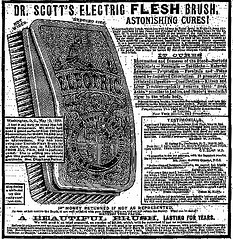
Electric flesh brushI've been named an “Affiliate Scholar” at the Institute for Ethics and Emerging Technologies, so I thought I'd think about where I fit in the Humanist/Transhumanist matrix. Then I thought I'd draw a Venn diagram or two.

Somewhere along the line we've developed the habit of announcing that, thanks to new technology, we're forever on the verge of revolutionizing what it means to be human. Maybe it came in with the Industrial Revolution and our parallel discovery of modern medical science. Whatever the source, consider this 1933 quote from British engineer Allan Young, in his book Forward From Chaos. As Jo-Anne Pemberton noted in her book Global Metaphors, Young heralded the dawn of what he called the 'Electric-Machine-Power Age' as follows:

“The advent of radio art has provided a revolutionary change in the method and rate of thought dissemination. The human voice is now able to encircle the globe in the twinkling of an eye … It is thus possible for me to project my thoughts instantly into the mind of someone living on the opposite side of the planet …”

“The evolution of the radio machine … seems to be one of the very biggest happenings in our civilization … I stresss the importance of the great acceleration we are now witnessing in the whole process of translating thought into action …”

To which the modern mind can only add, “Really? From radio?” If he were alive today, Allan Young would probably be a Transhumanist like most of my friends at the IEET. In 1933, as in the decades before and since, people have been announcing that technology is about to radically alter the scope, power, and nature of human existence.

And the funny thing is, then it actually does. Humanity was transformed by radio – and by what Young called “the aeroplane.” By the time these transformations became ubiquitious, however, they had also become ordinary – even boring. The truth is that we've been transforming our minds and our bodies for generations. Take life extension, a favorite topic for Transhumanists: Life expectancy increased from 18 years in the Bronze Age to 25 years in Colonial America (although infant mortality affected the numbers significantly), and it approaches 80 years in that country today. Medicine and public health lowered infant mortality in London from nearly 75% before the Industrial Revolution to 31% afterward[i]. But these advances have been unequal. Life expectancy in the poverty-stricken Calton area of Glasgow, for example, is 8 years less than in the Lenzie neighborhood less than ten miles away.[ii]

Somebody already engineered the human lifespan – but they did it with the (often unequal) distribution of resources like food, shelter, disease and accident prevention, and medical care.

Read more »