by Eric J. Weiner
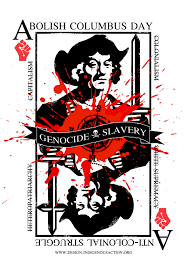 Today in the United States is Indigenous Peoples’ Day, a time to bear witness and remember the savagery of Christopher Columbus and other European explorers when they first encountered indigenous peoples throughout the Americas. It’s also a day to recognize and celebrate the courage, knowledges, and cultures of indigenous peoples throughout the world. It coincides with Columbus Day, a national holiday that triggers a day of protests and celebratory parades, rekindles debates about removing statues of Christopher Columbus from parks, squares and circles throughout the United States, and provokes critical discussions about the kind of stories we should be teaching the Nation’s children about his earliest encounters with indigenous communities.
The controversies surrounding Columbus Day should be seen as part of a larger struggle for the integrity of history education, historical research, national identity, and collective memory. Historians and American history teachers are the official guardians of the Nation’s collective historical memory; they are the defenders of historical facts and truths regardless of how ugly, embarrassing, or in contradiction they might be to the Nation’s distorted ideological view of itself. They are the essential workers of any free society and must be allowed to remain beyond the influence of state and corporate power. If Trumpists get their way, the struggle over the integrity of the “official” American history curriculum as well as how it is taught will get harder, more urgent, and dangerous.
 Although American history curriculum has always been a site of ideological struggle, historians, history teachers, and curriculum designers have done a good job over the past several decades to revise many historical inaccuracies, distortions, and lies that helped whitewash the historical record in the service of white, male, imperialistic, and neoliberal interests. But with Trump’s latest decree to create a “1776 Commission” charged to design a “pro-American” curriculum of American history coupled with his promise to defund schools that use the 1619 Project as well as other curricular platforms that bring attention to historical facts and truths that counter the “official” curriculum, the Nation’s collective historical memory is under siege with public schools at the center of the assault. Whether Trump and the GOP actually care about how American history is represented and taught in schools or whether they are just cynically using the issue to create a political wedge between people who may otherwise be allied to vote against Trump in November is irrelevant. Read more »
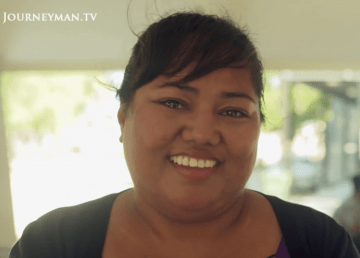 Tabea Bakeua lives in Kiribati, a North Pacific atoll nation. Her country is likely to be the first to disappear completely under the rising seas within a few decades. Asked by foreign documentary filmmakers if she “believes” in climate change, Bakeua considers and tells them, “I have seen climate change, the consequences of climate change. But I don’t believe it as a religious person. There’s a thing in the Bible, where they say that god sends this person to tell all the people that there will be no more floods. So I am still believing in that.” She smiles, self-consciously, as she continues. “And the reason why I am still believing in that is because I’m afraid. And I don’t know how to get all my fifty or sixty family members away from here.” She’s still smiling as tears fill her eyes. “That’s why I’m afraid. But I’m putting it behind me because I just don’t know what to do.” She turns, apologetically, to wipe away her tears. [from “
 We live in The Year Of Overlapping Catastrophes. Oh 2020, we know ye all too well. The pandemic, our very own plague. Economic depression. A quasi-fascistic con man at the head of government. The discovery that perhaps forty percent of our fellow Americans are truth-hating dupes and low-information racists. (Brits too. Decline of the Anglophone empire?)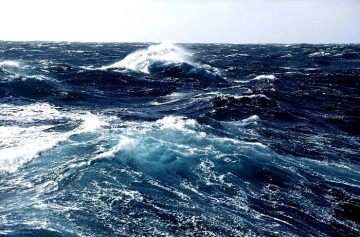
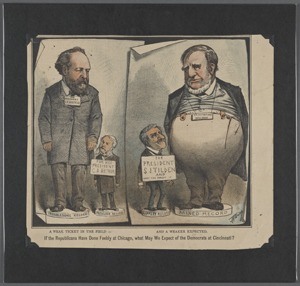 There are times where we are simply unable to surpass our elders.
 A system update recently downloaded to my cellphone included artificial intelligence capable of facial recognition. I know this because, when I subsequently opened the “Gallery” function to send a photograph, I discovered that the refurbished app had taken it upon itself to create a new “album” (alongside “Camera”, “Downloads” and “Screenshots”) called “Stories”, within which I found assemblages of my own pictures, culled from all of those other albums and assorted thematically, evidently because they depicted identical, or similar, figures.
 FRONT PORCH

 Is there anything more clichéd than some spoiled, petulant celebrity publicly threatening to move to Canada if the candidate they most despise wins an election? These tantrums have at least four problems:
 Last time, in

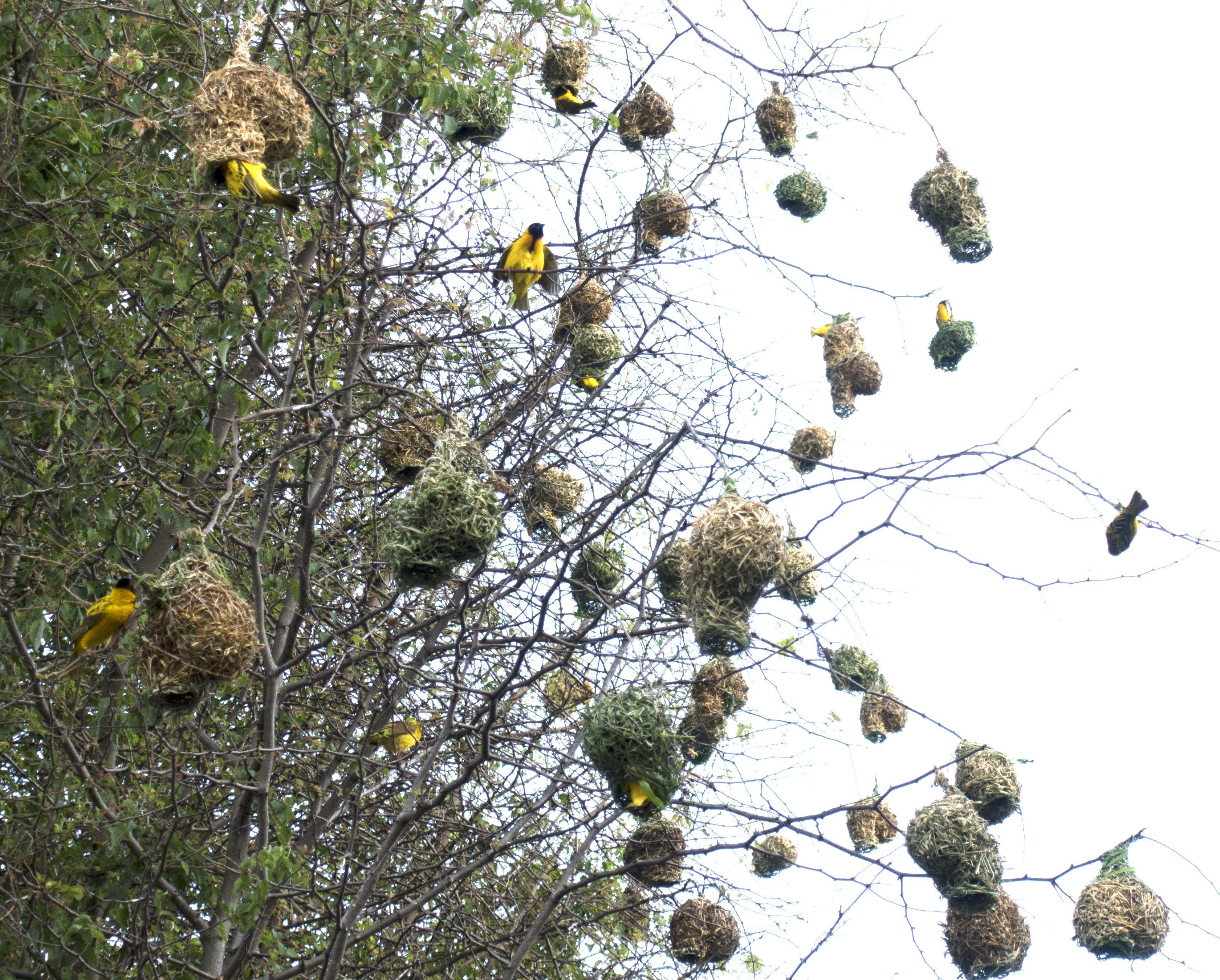 Sughra Raza. Lesser Weaver Nests, Akagera National Park, Rwanda. 2018.