
by Raji Jayaraman
Audio version
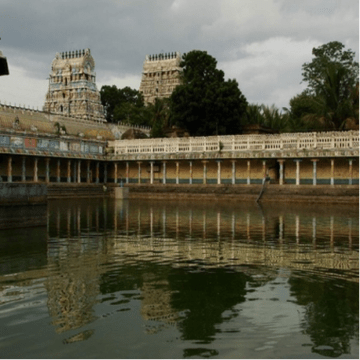
When you say you have an ancestral temple, it sounds fancy. To be fair, some are. My mother’s ancestral temple, the Vaitheeswaran Koil, is a vast complex with five towers and hall after cavernous hall housing both worshippers and elephants. The temple is dedicated to Shiva in his incarnation as a healer. Perched on the banks of the Cauvery river, a dip in any one of its eighteen water tanks is said to cure all ailments. Dedicated to Mars, it is one of only nine ancient Tamil temples devoted to the planets. (Before you get excited about the prescience of the nine, I feel obliged to inform you that two of them are the sun and the moon, and another two are “Rahu” and “Ketu” who reside somewhere between the sun and moon, causing eclipses.) It has gold plated pillars; emerald encrusted deities; and inscriptions dating back to at least the Chola period in the twelfth century. All very impressive.
I would bask in the reflected glory except that I don’t stem from a matrilineal religious tradition, so my ancestral temple is said to be my father’s. Our parents’ biannual visits to India always included a temple tour with a mandatory visit to the ancestral temple. The itinerary never included Vaitheeswaran Koil, and looking back, I can see why. My ancestral temple was in a village called Tholacheri, and I use the term “village” loosely. Tholacheri contained four or five mud-walled, thatched roof structures surrounding three sides of a viscous pond. On the fourth side lay the temple compound.
The compound’s architectural ensemble comprised the temple itself, consisting of a small anteroom and alcove; a hut that served as the priest’s residence; and four or five giant-sized painted terracotta statues of Ayyanar deities. These statues were armed with machetes. They had bulbous eyes, protruding tongues, and outsized fangs. As an adult they looked almost comical but as children they struck the fear of God in us, which I suppose was the whole point. Read more »

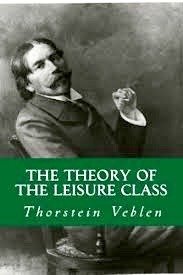 Thorstein Veblen’s The Theory of the Leisure Class is a famous, influential, and rather peculiar book. Veblen (1857 – 1929) was a progressive-minded scholar who wrote about economics, social institutions, and culture. The Theory of the Leisure Class, which appeared in 1899, was the first of ten books that he published during his lifetime. It is the original source of the expression “conspicuous consumption,” was once required reading on many graduate syllabi, and parts of it are still regularly anthologized.




 Last month
  My Jewish maternal grandparents came to America just ahead of WWII. Nearly all of my grandmother’s extended family were wiped out in the Holocaust. Much of my grandfather’s extended family had previously emigrated to Palestine.

 shocking. Torcetrapib, for example, failed at the very end of its phase III trial. So many resources had been expended to get that far in development. Everything spent was lost. All that remained was a big data pile worth virtually nothing, along with pilot plants that were built to supply the drug to thousands of patients across years of clinical trials.
 “The American way of life is not up for negotiation.” —George HW Bush to the assembled international diplomats at the Earth Summit in Rio de Janeiro, 1992