by Emrys Westacott
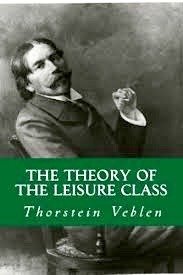 Thorstein Veblen’s The Theory of the Leisure Class is a famous, influential, and rather peculiar book. Veblen (1857 – 1929) was a progressive-minded scholar who wrote about economics, social institutions, and culture. The Theory of the Leisure Class, which appeared in 1899, was the first of ten books that he published during his lifetime. It is the original source of the expression “conspicuous consumption,” was once required reading on many graduate syllabi, and parts of it are still regularly anthologized.
The central argument of the can be briefly summarized. In the earliest human communities, pretty much everyone contributed to securing the means of life. In this situation there was no steep or rigid social hierarchy. Cooperative traits were socially valuable and therefore generally respected, and individual property was not important. At some point, however, certain members of the group created a situation in which they didn’t need to beaver away at mundane tasks like tending crops or making clothes. These individuals would typically be the biggest, strongest, boldest, most competitive types–for example, men who were good at hunting, which made them also good at fighting against other hostile groups. Social hierarchies emerged. Women and the less able-bodied men drudged away to produce the means of life; men who possessed the necessary traits engaged only in activities such as hunting and fighting. These men became the “leisure class.”
The leisure class came to include others who did no genuinely productive work, for instance, priests and administrators. This elite came to look down on productive work, which was performed by the majority who had to do it out of necessity. Not having to do such work thus came to be a distinguishing mark of a person’s higher social standing. In smaller societies it was fairly easy to flaunt this privilege in the form of “conspicuous leisure”, but in larger, more complex societies, one exhibited one’s status by showing off one’s wealth through conspicuous consumption. Read more »





 Last month
  My Jewish maternal grandparents came to America just ahead of WWII. Nearly all of my grandmother’s extended family were wiped out in the Holocaust. Much of my grandfather’s extended family had previously emigrated to Palestine.

 shocking. Torcetrapib, for example, failed at the very end of its phase III trial. So many resources had been expended to get that far in development. Everything spent was lost. All that remained was a big data pile worth virtually nothing, along with pilot plants that were built to supply the drug to thousands of patients across years of clinical trials.
 “The American way of life is not up for negotiation.” —George HW Bush to the assembled international diplomats at the Earth Summit in Rio de Janeiro, 1992
 Not since the Civil War and Reconstruction has the citizenry in the United States been so divided. In our current
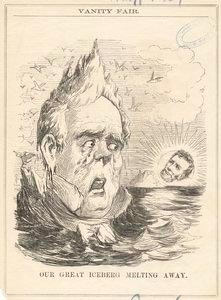 November 6, 1860. Perhaps the worst day in James Buchanan’s political life. His fears, his sympathies and antipathies, the judgment of the public upon an entire career, all converge into a horrible realty. Abraham Lincoln, of the “Black Republican Party,” has been elected President of the United States.