by Tim Sommers

Even as we want to do the right thing, we may wonder if there is really, in some objective sense, a right thing to do. Throughout most of the twentieth-century most Anglo-American philosophers thought not. They were mostly some sort of subjectivist or other. Since they focused on language, the way that they tended to talk about it was in terms of the meaning of ethical statements. Ethical statements, unlike factual claims, are subjective expressions of our emotions or inclinations and can’t really be true or false, right or wrong, in any objective sense.
Emotivists, for example, argued that when I say something is good or bad, I am just expressing my like or dislike. This is sometimes referred to as the “Yay! Boo!” theory. Others argued that ethical statements are more like descriptions of our subjective states or imperatives commanding or exhorting others to act in the way we prefer they would.
Some philosophers took a subtler approach. J.L. Mackie’s “error-theory,” for example, accepted that people mostly believe that ethical statements can be correct or incorrect and that people do mean to do more than express themselves when making ethical claims. Unfortunately, Mackie says, there is nothing that makes it so. When I say something is bad, I may imply that there is an external standard according to which it is bad, some source of objectivity beyond my emotions or idiosyncratic beliefs, that makes this so. But all moral talk, including this style of “objective” moral talk, fails to be meaningful because nothing could make it objectively so. Hence, moral language needs to be reinterpreted in some subjectivist way.
Of course, philosophers outside the tradition of analytic philosophy have also been skeptical of the objectivity of morality. One of Nietzsche’s “terrible truths” is that most of our thinking about right and wrong is just a hangover from Christianity and it will eventually (soon!) dissipate. We are in no sense moral equals, he said. Democracy is a farce. The strong should rule the weak.
(Plus, there is no god. Life is meaningless. We have no free will. We suffer more than we experience joy. He was a real riot at parties, I bet.)
I wonder what it would be like if most people really believed that claims about what is right or wrong, good or bad, or just or unjust, were just subjective expressions of our own emotions and desires. What would our shared public discourse, and our shared public life, look like if most people believed that?
I fear that we are like the cartoon character who has gone over a cliff, but is not yet falling, only because we haven’t looked down yet. Read more »

 A good weather colloquialism can be quite suggestive. Take



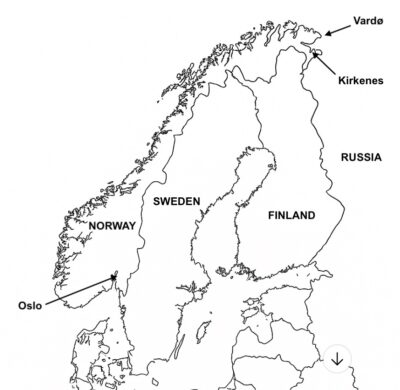 It’s different in the Arctic. Norwegians who live here make their lives amid long cold winters, seasons of all daylight and then all-day darkness, and with a neighbor to the east now an implacable foe.