by Paul Braterman
One month ago today, Ken Ham of Answers in Genesis appointed Martyn Iles, formerly director of the Australian Question Lobby, to the position of Chief Ministry Officer, ministry of course being Answers in Genesis’ core activity. Here’s why that matters.
 Martyn Iles, a lawyer by training, was the managing director of the Australian Christian Lobby (ACL) from 2018 until he was abruptly sacked by the ACL Board in February 2023. Accounts of his dismissal differ. Iles described it as a result of difference in strategy; the Board wanted to move in a more political direction, making him in his own words “not the right person for that vision. I have always been a preacher first and politician second (or third…)”. The Board’s chair, however, denied that there had been any such change.
Answers in Genesis (AiG) is the world’s largest Young Earth Creationist organisation. AiG has a full-time working staff of 1200 and, according to its 2021 tax declaration, assets of almost $82 million. It owns the Creation Museum and the Ark Encounter in Kentucky as well as other major assets, and its massive outreach programme includes formal publications, Answers magazine, and an extremely active website.
AiG is the property of Ken Ham, like Iles a product of Australian’s extreme Christian fundamentalist community. It was set up in 1994 after complex and litigious manoeuvres involving Ham and his previous associates, Creation Ministries International based mainly in Australia, and the Institute for Creation Research (ICR). ICR itself had been set up by Henry Morris, co-author of The Genesis Flood, when disputes arose among an earlier generation of Young Earth creationists. Read more »



 Allison Elizabeth Taylor. Only Castles Burning, 2017.
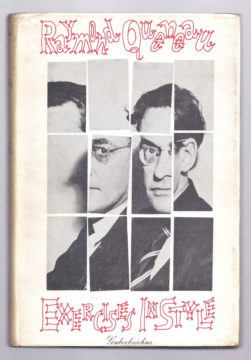 Raymond Queneau was a French novelist, poet, mathematician, and co-founder of the Oulipo group about




 Human minds run on stories, in which things happen at a human level scale and for human meaningful reasons. But the actual world runs on causal processes, largely indifferent to humans’ feelings about them. The great breakthrough in human enlightenment was to develop techniques – empirical science – to allow us to grasp the real complexity of the world and to understand it in terms of

 One of the amusing things about academic conferences – for a European – is to meet with American scholars. Five minutes into an amicable conversation with an American scholar and they will inevitably confide in a European one of two complaints: either how all their fellow American colleagues are ‘philistines’ (a favourite term) or (but sometimes and) how taxing it is to be always called out as an ‘erudite’ by said fellow countrymen. As Arthur Schnitzler demonstrated in his 1897 play Reigen (better known through Max Ophühls film version La Ronde from 1950), social circles are quickly closed in a confined space; and so, soon enough, by the end of day two of the conference, by pure mathematical calculation, as Justin Timberlake sings, ‘what goes around, comes around’, all the Americans in the room turn out to be both philistines and erudite.
 Sa’dia Rehman. Allegiance To The Flag on Picture Day, 2018.