
by Charlie Huenemann
Today is July 4th, a day when Americans reflect on the value of freedom and the costs and sacrifices required for it. So it is an appropriate day to reflect on America’s deepest political aspirations.
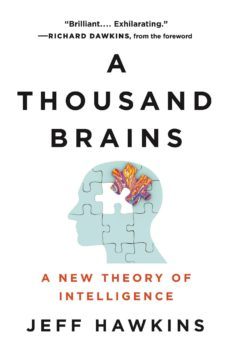 Nah. Let’s talk about our brains. The neocortex is where all our fancy thinking takes place. The neocortex wraps around the core of our brain, and if you could carefully unwrap it and lay it flat it would be about the size of a dinner napkin, and about 3 millimeters thick. The neocortex consists of 150,000 cortical columns, which we might think of as separate processing units involving hundreds of thousands of neurons. According to research at Jeff Hawkins’ company Numenta (and as explained in his fascinating recent book, A Thousand Brains), these cortical columns are capable of modeling patches of our experience (he calls them “reference frames”) and setting our expectations of what we should experience next, at any given moment. [Note: the remarks that follow are inspired by Hawkins’ book, but shouldn’t be taken as a faithful representation of it.]
The neocortex’s complexity is considerable, but not infinite, and what’s most surprising is that such a relatively small network—you can fold it up and put it in your head—is capable of understanding calculus and making up jaunty little tunes and comparing Kierkegaard to Heidegger, not to mention doing all three in a single afternoon.
It’s hard to believe that the wide world of human thought can come from such a comparatively small albeit complicated structure, and my guess is that it doesn’t. It’s not that I believe in a soul or immaterial mind or anything like that, but I think that probably there is a lot less going on in our thinking than we think there is. Our thinking and our experience is extremely gappy, and we spackle over the gaps with a paste of fictions, supplied mainly through language and culture. Read more »
 I assume that if your eye was drawn to this essay, then you are also troubled by feelings of rage. But I don’t want to be presumptuous—there are other reasons to read an essay that promises to tell you what to do with your anger. Maybe you think I have an agenda. Perhaps you have formed an idea of what my rage is about, and you disagree with that figment, and you are hate-reading these words right now, waiting for me to reveal the source of my own rage so that you can write a nasty comment at the end of this post or troll me on social media or try to cancel me or dox me or incite violence against me or come to my house and sneak onto my porch and stare balefully into my front windows or throw an egg at my car or trample deliberately on the ox-eye sunflowers that are bursting around my mailbox or put a bomb in my mailbox or disagree with me strenuously in your heart. There is a wide range of potential negative responses, and I don’t have time to list them all. The point here is that one must contend with them, and that is another reason to feel rage.




 The first full moon I saw after the procedure looked as if it might burst, like a balloon with too much helium. It was just above the horizon, fat and dark yellow —moving slowly upward to the firmament where it would later appear smaller and take on a whiter shade of pale. I could distinguish its tranquil seas, the old familiar terrain coinciding with a long abandoned memory.
 Even before the bandage came off, the implant’s ID card seemed to confirm it: I am a camera—with a new Zeiss lens made in Jena. Jena is back in my life.


 In the middle 1990’s along with journal-editing I did another job in Berkeley which was even more arduous, but also in some ways quite exciting and instructive. I was invited by the campus academic senate to serve for 3 years in a high-powered committee that decided on all appointments, promotions, salaries and merit payment increases for all Berkeley faculty (then roughly about 2,000 in size). This committee is called the Budget Committee in Berkeley; technically it advises the Chancellor, but the latter took our advice in 99% of cases—in the less than 1% cases when the Chancellor did not follow our advice, the rule was that the Chancellor was obliged to meet us in a special session of the committee and explain why he/she would not follow our advice (most often this involved some legal issues) and we had a chance to rebut their arguments.
 In his book
 Sughra Raza. This Moment … late June 2022.