by David Greer
To see a World in a Grain of Sand
And a Heaven in a Wild Flower,
Hold Infinity in the palm of your hand
And Eternity in an hour. —William Blake, from “Auguries of Innocence”
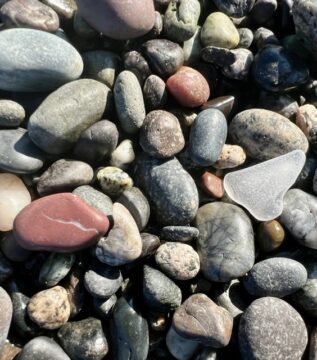 I count among my simple pleasures a walk to a pocket beach not far from my home. Tucked between a couple of small headlands, barely 100 yards long, it overlooks Juan de Fuca Strait, separating Vancouver Island from Washington’s Olympic Peninsula to the south. It’s a quiet spot, empty of the summer crowds that flock to beaches elsewhere in the city, and for that reason a treasured refuge for readers and romantics in search of solitude with a tranquil view of snowy peaks. There’s always the possibility of sighting a pod of the killer whales that frequent these waters.
Casual strollers and swimmers prefer the city’s sandy beaches. The shape of pocket beaches like the one I frequent invites tidal scouring that washes sand away, leaving only pebbles, some of which may one day be ground to sand as well, though likely not in our lifetimes or those of our grandchildren. Geological change moves slowly, except when it doesn’t.
Rapid geological change is rare and, given the propensity of humans to occupy even the remoter parts of the planet, invites casualties. One of the most dramatic such changes in recent times occurred in 1980, when Mount St. Helens, in western Washington state, blew its top one fine spring day, filling the skies with half a billion tons of rock and ash and instantly and dramatically reshaping the surrounding landscape, including by radically relocating the course of a major river. One of the consequences of the event was the establishment of the Mount St. Helens Creation Center, one of a number of “creation science” museums dedicated to the proposition that all creatures great and small, as well as the planet they inhabit, were created in a matter of days a few thousand years ago and not through the course of a few billion years of gradual evolution. What better evidence than a landscape reborn in moments? Read more »