
by Jochen Szangolies
There has been no shortage of articles on this year’s physics Nobel, which, just in case you’ve been living under a rock, was awarded to Alain Aspect, John Clauser, and Anton Zeilinger “for experiments with entangled photons, establishing the violation of Bell inequalities and pioneering quantum information science”. Why, then, add more to the pile?
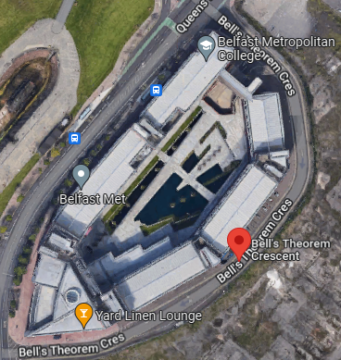
A justification is given be John Bell himself in his 1966 review article On the Problem of Hidden Variables in Quantum Mechanics: “[l]ike all authors of noncommissioned reviews [the writer] thinks that he can restate the position with such clarity and simplicity that all previous discussions will be eclipsed”. While I like to think that I’m generally more modest in my ambitions than Bell semi-seriously positions himself here, I feel that there is a lacuna in most of the recent coverage that ought to be addressed. That omission is that while there is much talk about what the prize-winning research implies—from the possibility of groundbreaking new quantum technologies to the refutation of dearly held assumptions about physical reality—there is considerably less talk about what it, and Bell’s theorem specifically, actually is, and why it has had enough impact beyond the scientific world to warrant the unique (to the best of my knowledge) distinction of having a street named after it.
In part, this is certainly owed to the constraints of writing for an audience with a diverse background, and the fear of alienating one’s readers by delving too deeply into what might seem like overly technical matters. Luckily (or not), I have no such scruples. However, I—perhaps foolishly—believe that there is a way to get the essential content of Bell’s theorem across without breaking out its full machinery. Indeed, the bare statement of his result is quite simple. At its core, what Bell did was to derive an inequality—a bound on the magnitude of a certain quantity—such that, when it holds, we can write down a joint probability distribution for the possible values of the inputs of the inequality, where these ‘inputs’ are given by measurement results.
Now let’s unpack what this means. Read more »
 There are certain words that seem to take on a life of their own, words that spread imperceptibly, like a virus, replicating below the level of consciousness, latent in our environment and culture, until suddenly the word is everywhere, and we are afflicted with it. We may even use these words ourselves: we struggle to find the right phrase, the true word to capture our intention, and these words come to us unbidden, floating into our minds from somewhere out there, and we speak the word without understanding what we really mean, but we see understanding and acknowledgement in the face of our interlocutor, and we know we have hit upon the correct utterance that will mark us as one who belongs.
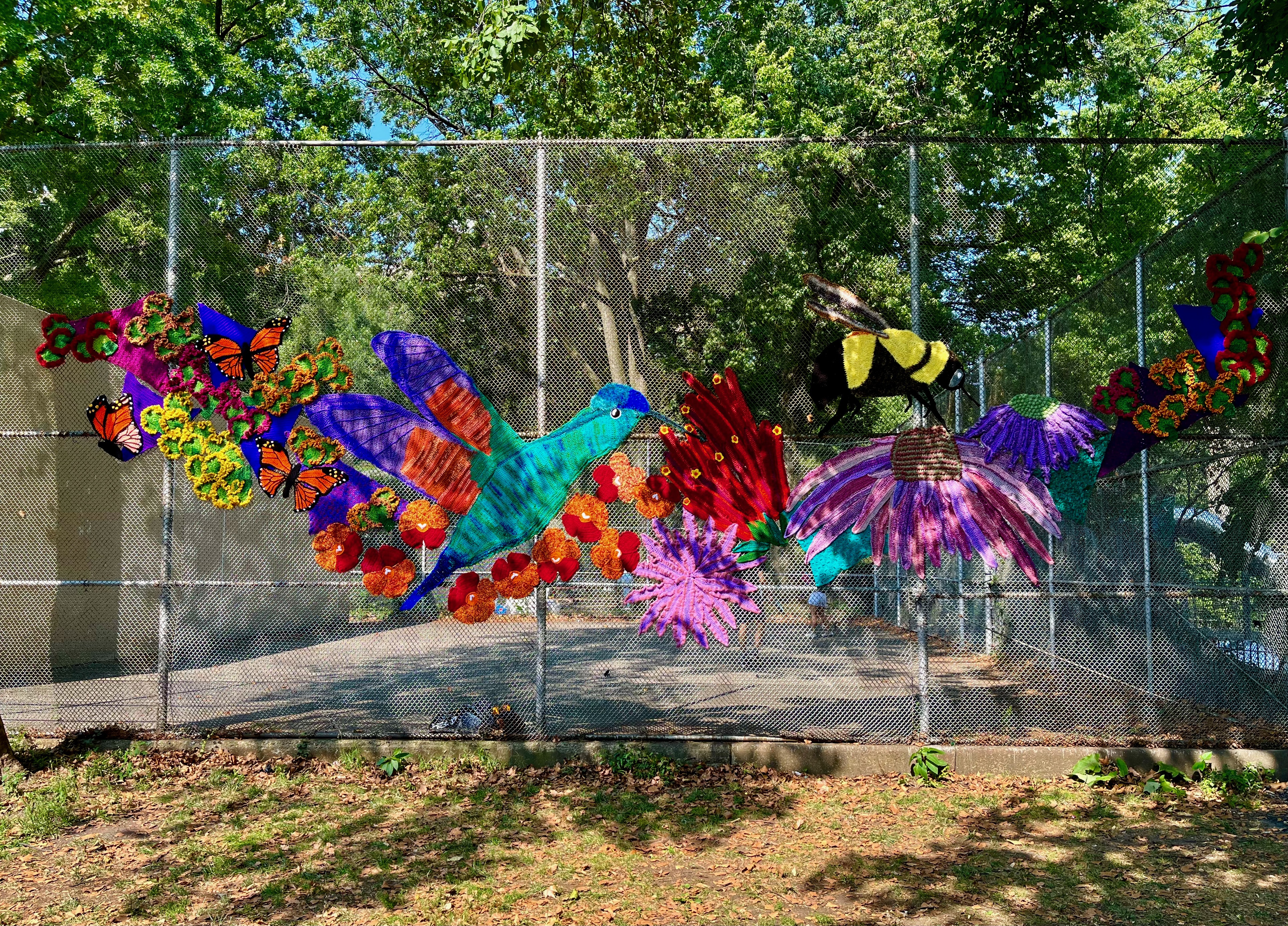 Naomi Lawrence. Tierra Frágil, 2022.
 Come die with me.
 by Leanne Ogasawara


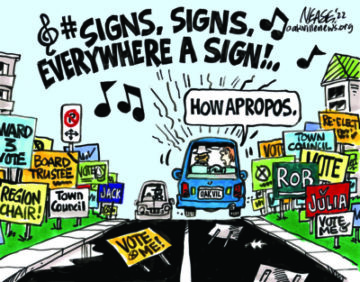 trustee. It’s a relatively minor position and non-partisan, so there’s no budget or staff. There’s also no speeches or debates, just lawn signs and fliers. Campaigning is like an expensive two-month long job interview that requires a daily walking and stairs regimen that goes on for hours. Recently, some well-meaning friends who are trying to help me win (by heeding the noise of the loudest voices) cautioned me to limit any writing or posting about Covid. It turns people off and will cost me votes. I agreed, but then had second thoughts the following day, and tweeted this:
 Before leaving Santa Fe I spent (yet another) morning at a coffeehouse. It’s an urban sort of behavior, and a Bachian one too – you might know about Zimmerman’s in Leipzig, the coffeehouse where Bach brought ensembles large and small to perform once a week. It seems to have been a chance to make some non-liturgical music, a relief from Bach’s otherwise very churchy employment.
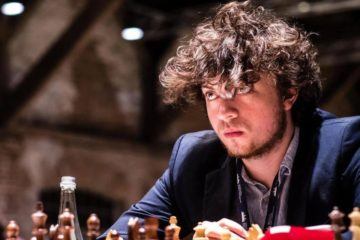 At a recent tournament sponsored by the St. Louis Chess Club, 19-year old Hans Niemann rocked the chess world by defeating grandmaster Magnus Carlson, the world’s top player. Their match was not an anticipated showdown between a senior titan and a recognized rising phenom. The upset came out of nowhere.