by Mike O’Brien

If this article seems less lucid, or artful, or otherwise good in the way that some of my columns are good, you must excuse my failings and instead direct your disappointment towards the ingenuity of modern immunology. I am still, as far as I know, untouched by Covid-19; however, in anticipation of an inevitable despoilment of my precious bodily fluids, I have received a sixth vaccination and can confidently, emphatically say that it is not a placebo. I am heartened by the argument that my scalp-to-toes suffering is a sign that I possess a robust and responsive immune system. Good for me. I am less heartened by the argument that if the vaccine’s viral simulacrum throws me into a sack and beats me with bricks, the real thing will visit even worse horrors upon me. I try not to think about it too much. I wear my mask and get my shots and hope that the virus doesn’t mutate into something worse.
As I discussed in my previous article, I was summoned for jury duty selection in September. It was a breathtakingly botched affair (especially the part where dozens of fellow potential jurors were crammed into an unventilated conference room in the basement of Montreal’s imposing brutalist monument of a courthouse, and this just as Covid rates were spiking upwards again). About an hour into the day, the few hundred citizens compelled to appear in a cavernous courtroom were informed by the judge of four important facts: first, that they would be forbidden from working during the trial; second, that they would receive a stipend amounting to less than the provincial minimum wage; third, that the trial was expected to last a considerable length of time; and fourth, that it was to start the following morning. Read more »
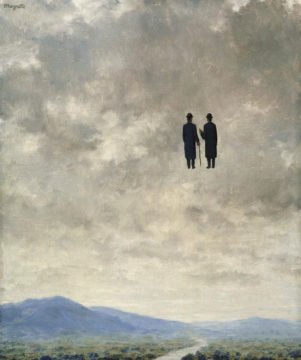 Lightness comes in three F’s: finesse, flippancy and fantasy. The French are famous for the first. See how the delicate, sweet singer songwriter Alain Souchon transforms the heavyweight aphorism of André Malraux – the real-life French Indiana Jones who ended his career as minister for culture – from the desperate heroism of ‘I learnt that a life is worth nothing, but nothing is more valuable than life’ into the ethereal, refined song that even if you do not understand the words, you cannot help but feel the
 In 1970, Pier Paolo Passolini directed a film titled Notes Towards an African Orestes, which presents footage about his attempt to make a movie based on the Oresteia set in Africa. The movie was never made. In the same way, this article will be about a series of essays, or perhaps a book, that may never be written.
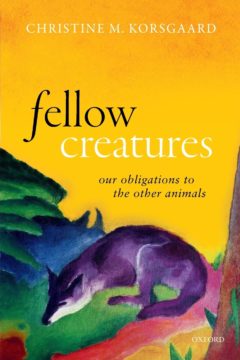 Without really looking into them, I have always felt sceptical of Kantian approaches to animal ethics. I never really trust them to play well with creatures who are different from us. Only recently, I cared to pick up a book to see what such an approach would actually look like in practice: Christine Korsgaard’s Fellow creatures (2018). An exciting and challenging reading experience, that not only made a very good case for Kantianism (of course), but also forced me to come to terms with some rather strange implications of my own views.
 The force of recent attempts to increase minority visibility in the performing arts, principally in the US, by matching the identity of the performer with that of the role—in effect a form of affirmative action—has been diminished by a series of tabloid “scandals”: the casting of Jared Leto as a trans woman in Dallas Buyers Club
 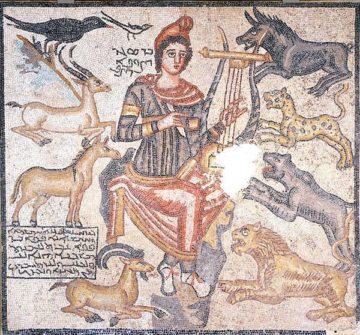 1.
1. Jeannette Ehlers. Black Bullets, 2012.
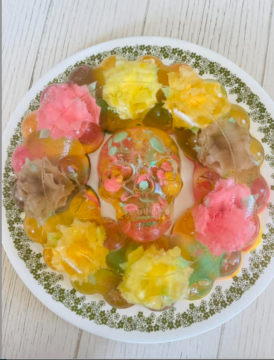 How plastic – really plastic – gelatin presents as a food. Not only in the “easily molded” sense of a pliable art material but also its transparency. Walnuts and celery, the “nuts and bolts” of gelatin desserts, defy gravity, floating amidst the cheerful jewel-like plastic-looking splendor of the 1950’s, when gelatin was the king of desserts. Gelatin’s mid-century elegance belies its orgiastic sweetness, especially the lime flavor, which is downright otherworldly. If you stir it up hot, half diluted, gelatin lives up to its derelict reputation with regard to the sickbed and sugar, being thick and warm, twice as intoxicatingly sweet, and surely terrible for an invalid’s teeth, if not metabolism. In my novel, Dog on Fire, I hypothesize that lime-flavored gelatin is the perfect murder weapon.
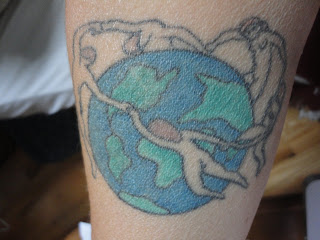 Barring that reality, and knowing this would be an ongoing, lifelong issue, I got a tattoo on my Visa-paying forearm to remind myself that my actions affect the entire world. I borrowed Matisse’s
 I am sitting on the couch of our discontent. The Robot Overlords™ are circling. Shall we fight them, as would a sassy little girl and her aging, unshaven action star caretaker in the Hollywood rendition of our feel good dystopian future? Shall we clamp our hands over our ears, shut our eyes, and yell “Nah! Nah! Nah! Nah! Nah!”? Shall we bow down and let the late stage digital revolution wash over us, quietly and obediently resigning ourselves to all that comes next, whether or not includes us?
 I first became aware of Miriam Lipschutz Yevick through my interest in human perception and thought. I believed that her 1975 paper,