by Carol A Westbrook
Oh, where were you in Chicago?
You know I didn’t see you there
I didn’t see them crack your head
Or breathe the tear gas air
Oh, where were you in Chicago
When the fight was being fought?
Oh, where were you in Chicago?
‘Cause I was in DetroitWhere were you in Chicago? —Written and performed by Phil Ochs.
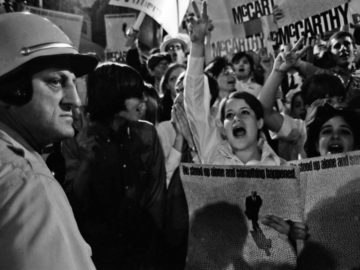 When I heard that Chicago will host the 2024 Democratic National Convention next August, (August 19-22,) it brought back a flood of memories. Memories, not only of the convention itself, but of the 60’s. “The 60’s” did not exactly span the decade but began in 1963 , when John F Kennedy was shot, and ended in 1975, when the war in Vietnam ended. During this relatively short period, our country went through a large number of societal changes, including political changes, changes in gender stereotypes, in racial interactions, in acceptable speech, in sexual mores. This was the time when we Baby Boomers came of age, when the 76 million Americans born between 1946 and 1954, began to flex their muscles and recognize how much they could accomplish, and what a loud voice they had when acting as a group. For example, they influenced clothing styles and music. They had tremendous purchasing power, as most of the clothing for sale after the 60’s was more appropriate for a-19–year-old than for a 40 or 50- year old American!
I am a Boomer, and I turned 18 in 1968. High school graduation was behind me, and I was looking forward to college in October at University of Chicago. The summer was fun.
I had a part-time job in an office, so the hours were short and I had plenty of time to go to the beach or to socialize in the long, hot summer evenings of the Midwest. My boyfriend, Greg, enjoyed driving, so he took me around the city a lot. I had a good friend who was volunteering for McGovern’ campaign. We Boomers supported McGovern because he was anti-war– which seemed to be the most important quality a candidate needed to get this the votes of our large block. Although quite frankly I was always more interested in feminist issues. Read more »
 Nanni Moretti has always been a melancholic in denial. Perhaps more than any other film-director raised on the French New Wave – born in 1953, shooting his first short in 1973 – Moretti has been turning around the question that François Truffaut posed as a key to the seventh art: is cinema more important than life? But where for Truffaut, or Rossellini, as for many amongst their long and glorious lineage (from Spielberg to Tran Anh Hung) the dilemma has been between a painful reality full of obstacles on one side and a ‘harmonious’ path where ‘there are no traffic jams’ (to speak like Truffaut in his 1973 Day for Night), on the other – in other words, where cinema is the path of escape towards a world where dreams (or nightmares) come true – for Moretti, it is the dilemma itself which is the essence of cinema.

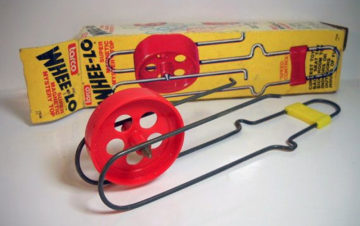 I never heard Henry Bull, my father-in-law, claim he invented the Whee-Lo, but his proud sons have on occasion. He manufactured and distributed the toy, and made it into a nationwide sensation in 1953, just before the hula hoop and Frisbee. A curved double metal track that held a spinning plastic wheel, the gyroscopic magnetic Whee-Lo is still available for purchase, most frequently at airport gift shops. By flicking your wrist, you propel the wheel and its spinning progress down the track and back. Mesmerizing, it’s a sort of fifties’ analog Game Boy. First called the Magnetic Walking Wheel, it came packaged with six colorful cardboard discs known as “Whee-lets” that created optical illusions as the wheel spun. According to Fortune, Henry’s company, Maggie Magnetics, sold two million units its first year.