
by S. Abbas Raza
 “Martti Ahtisaari, ex-Finland president and Nobel peace laureate, dies aged 86” runs the headline of his obituary in The Guardian today. But he was much more than that. First of all, he was the father of one of my closest friends, Marko Ahtisaari, who was with me in graduate school in the philosophy department at Columbia in the 1990s and was instrumental in my starting 3 Quarks Daily almost 20 years ago.
I first met Martti in the immediate aftermath of the September 11, 2001 attacks in NYC. I had written a couple of paragraphs about what it felt like to be a New Yorker on the day after 9/11, and must have sent what I’d written to Marko who forwarded it to Martti, who then asked if he could read what I had written at some important emergency political meeting in Europe (I forget what it was, exactly), and then he did. A couple of weeks later he came to New York to (among other things) meet with Kofi Annan who was Secretary-General of the United Nations at the time. Martti invited me to have breakfast with him, which I did with my sister Sughra, and he turned out to be an exceptionally lovely and modest man.
I met Martti on many occasions after that and was always deeply impressed by his cheerful optimism. He was always full of ideas on how to solve political as well as other problems and was obviously a man of great intelligence but what I loved about him most was his (often self-deprecating) sense of humor, such as the time he told me about the message of congratulations he received when he was first elected President of Finland from a Pakistani friend who had been his roommate in Karachi at the beginning of Martti’s diplomatic career. After congratulating him, the message went on to say, “You weren’t that smart. How did you do it?” This was a typical Martti story. By the way, by a complete coincidence, the man who sent him that message is now buried in a grave next to my mother’s grave in a cemetery in Karachi.
Let me quickly relate one last memory of him which made a lasting impression on me: My wife, Margit, and I were once staying with Martti and his wife, Eeva, in their apartment in Helsinki and the four of us had dinner together. Afterwards, Margit got up and started picking up the dirty plates but she was immediately stopped by Eeva who said, “No, please sit down, that has always been Martti’s job.” And then this wonderful, funny, powerful man, who had recently stepped down as President of Finland and who was still deeply involved in international peace efforts that would eventually win him a Nobel Peace Prize, picked up and washed all our dishes.
NOTE: Several of the editors of 3QD knew Martti Ahtisaari and we all wish to extend our deepest sympathies to Eeva and Marko: Your grief is also our grief.
Other Obituaries: New York Times, Washington Post, Bloomberg, Official Memorial Page


 I once wrote a political column for
 Sughra Raza. Pale Sunday Morning, April 2021.
 bankruptcy were billing at $2,165 an hour ($595 for paralegals). Since then we learned:
 Lightness comes in three F’s: finesse, flippancy and fantasy. The French are famous for the first. See how the delicate, sweet singer songwriter Alain Souchon transforms the heavyweight aphorism of André Malraux – the real-life French Indiana Jones who ended his career as minister for culture – from the desperate heroism of ‘I learnt that a life is worth nothing, but nothing is more valuable than life’ into the ethereal, refined song that even if you do not understand the words, you cannot help but feel the

 In 1970, Pier Paolo Passolini directed a film titled Notes Towards an African Orestes, which presents footage about his attempt to make a movie based on the Oresteia set in Africa. The movie was never made. In the same way, this article will be about a series of essays, or perhaps a book, that may never be written.
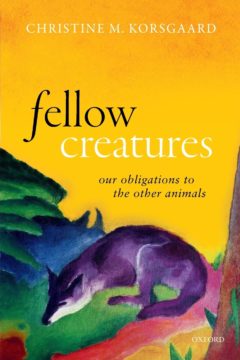 Without really looking into them, I have always felt sceptical of Kantian approaches to animal ethics. I never really trust them to play well with creatures who are different from us. Only recently, I cared to pick up a book to see what such an approach would actually look like in practice: Christine Korsgaard’s Fellow creatures (2018). An exciting and challenging reading experience, that not only made a very good case for Kantianism (of course), but also forced me to come to terms with some rather strange implications of my own views.

 The force of recent attempts to increase minority visibility in the performing arts, principally in the US, by matching the identity of the performer with that of the role—in effect a form of affirmative action—has been diminished by a series of tabloid “scandals”: the casting of Jared Leto as a trans woman in Dallas Buyers Club
  1.
1.