by Mark R. DeLong
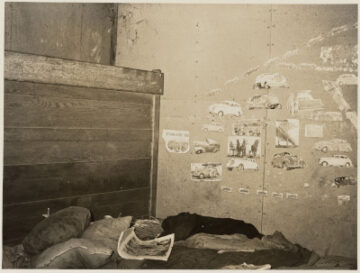
In October 1938, 23-year-old Arthur Rothstein drove the roads on assignment to document the lives of the nation as part of his job in the Farm Security Administration (FSA). This time, his assignment was New Jersey, and in Monmouth County he was interested in where potato-picking migrants slept, usually in shacks near the fields they worked. He took lots of pictures of ramshackle buildings—ones you would easily assess as barely habitable: a leaning frame taped together with tar paper, a “silo shed” that sheltered fourteen migrant workers, a “barracks” with hinged wooden flaps to cover windows—in fact merely unscreened openings, one dangling laundry to dry. Rothstein, like his colleagues at the FSA during Franklin Roosevelt’s New Deal, documented the need for the government programs. Squalid housing matched the dirt and brutal labor of migrants, many of them cast into their situations by the disaster of the Great Depression.
Amidst such architectural photographs, one sticks out. Actually it is one of a pair of photographs, both taken indoors of sleeping quarters—no one would comfortably call them “bedrooms.” One shows a narrow unmade bed near a window shabbily curtained with a frayed and loosely hung blanket. In the other one, more tightly framed, the image draws close enough to reveal a carved headboard, a rumpled newspaper open to a full-page ad for Coca-Cola (“Take the high road to refreshment“) and other papers pushed to the corner of the bed. Neatly cut pictures of luxury cars from newspaper advertisements decorate the flimsy particle board wall that served as meagre insulation.[1]
When I saw the picture with the cars, I noticed a change in visual tone. The image felt hopeful. Read more »

 Jokes about JD Vance’s romantic entanglements with living room furniture have been ubiquitous for about two weeks now. Professional comedians like


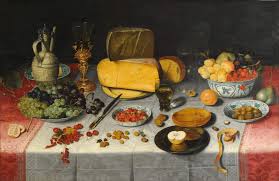 In an age where there is little agreement about anything, there is one assertion almost everyone agrees with—there is no disputing taste. If someone likes simple food instead of complex concoctions, who is to say that’s wrong. If I prefer bodice rippers to 19th Century Russian novels, you might say my tastes are crude and uncultured but hesitate to say one type of literary work is inherently better than the other. Aesthetic judgments are about subjective preference only. This is especially true of food and drink. Our preferences in this domain seem especially subjective. You can’t be wrong if you dislike chocolate ice cream can you?


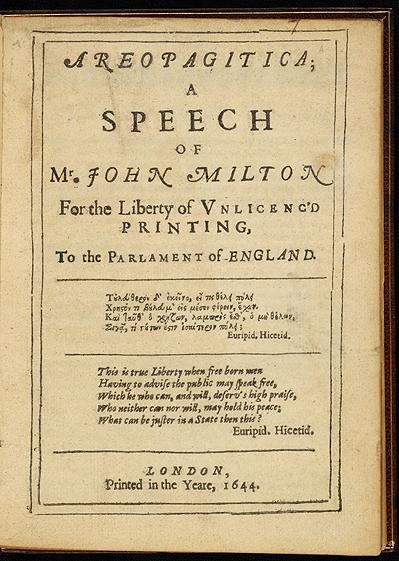 How do we regulate a revolutionary new technology with great potential for harm and good? A 380-year-old polemic provides guidance.
 Firelei Báez. Sans-Souci, (This threshold between a dematerialized and a historicized body), 2015.