by David Winner
 Throughout most of my life, I periodically napped in the back sitting room of my parent’s house in Charlottesville, gazing at an enormous shelf of my father’s books.
Why I am a Jew was an unlikely title to find. Though my father was most certainly a Jew, he was fiercely disconnected from all things Jewish. He claimed that he only learned that he was Jewish after he left his Jewish mother and Irish American stepfather behind in Pasadena to go to a very antisemitic Harvard in the late forties. He hated Woody Allen, Larry David, Bernie Sanders, and all other public Jews, never set foot in a synagogue or at a seder dinner, and was skeptical about the state of Israel.
Perhaps being brought up by such a non-Jewish Jew has influenced my perspective. When the news broke about the Hamas attacks in the fall, Angela, my wife, was cross with me before I even opened my mouth because she was stunned by what had happened and feared what I would say. I’ve had a long history of disparaging Israel.
A few days after the attacks, I came back to my house in Brooklyn to find Angela in conversation with our ultra-orthodox Jewish neighbors. They were in shock. Their seventeen-year-old son told us that Muslims had slated the following day for killing Jews around the world. Only Israel could protect us from the “animals.” The world, as he framed it, was overrun by an evil force out to get him and his community. Rather than confront his racism, I retreated inside. I didn’t think he would ever construct things any differently. Read more »


 According to the anthropologist James Bielo
 This is the first in a series of three articles on literature consider as affective technology, affective because it can transform how we feel, technology because it is an art (tekhnē) and, as such, has a logos. In this first article I present the problem, followed by some informal examples, a poem by Coleridge, a passage from Tom Sawyer that echoes passages from my childhood, and some informal comments about underlying mechanism. In the second article I’ll take a close look at a famous Shakespeare sonnet (129) in terms of a model of the reticular activity system first advanced by Warren McCulloch. I’ll take up the problem of coherence of oneself in the third article.
 Jaffer Kolb. Untitled, June, 2024.

 One longstanding debate in aesthetics concerns the relative virtues of formalism vs. contextualism. This debate, which preoccupied art theorists in the 20th Century, now rages in the culinary world of the 21st Century. Roughly, the controversy is about whether a work of art is best appreciated by attending to its sensory properties and their organization or should we focus on its meaning and the social, historical, or psychological context of its production. The debate is similar in the world of cuisine. How best should we appreciate the food or beverages we consume? Should we focus solely on the flavors and aromas or does authenticity and social context matter?
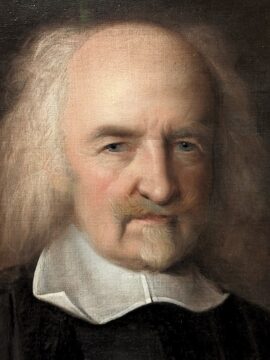 Historians often ask what led to Trump’s landslide victory back in 2024. All those guilty verdicts in the “PornHush” trial certainly helped — the final proof, for many, that the President was an innocent lamb set upon by crooks. And the November exit polls showed that millions of patriotic Americans found democracy a chore anyway, or were actively Fascism-curious, or simply got a buzz out of the fact that, being disempowered in every other meaningful way, they could at least step up and play a part in destroying their own children’s future. But surely the decisive factor was Trump’s inspired choice of running mate — philosopher and controversialist Thomas Hobbes.
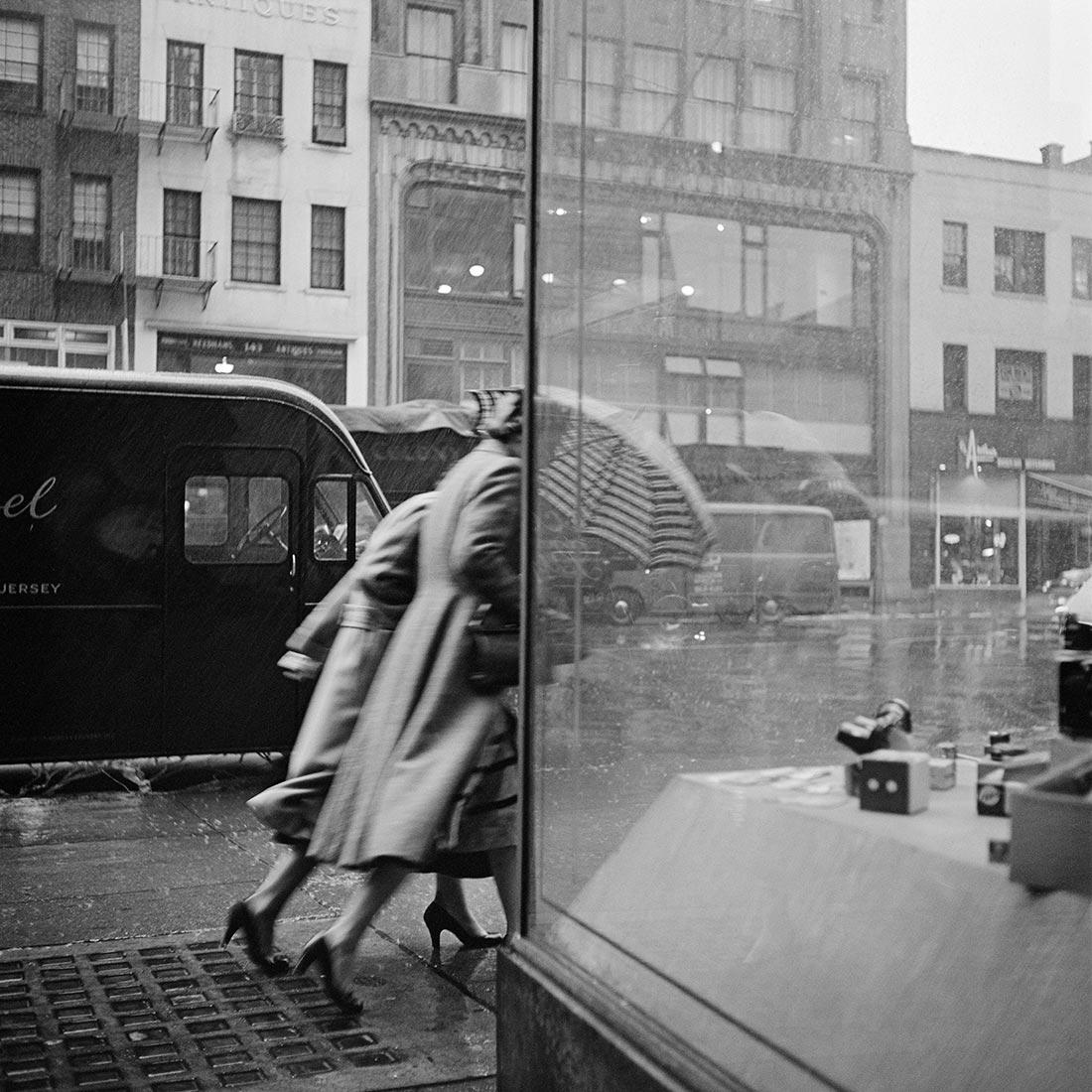 Vivian Maier. October 29, 1953, NY, NY.