
by O. Del Fabbro
Bürgenstock, near lake Lucerne, June 15-16, 2024. Switzerland has organized a peace summit to address the war in Ukraine. Many countries participate, but the aggressor, Russia, was not invited. The main topics of discussion that Switzerland and Ukraine have listed are nuclear and food safety, as well as humanitarian aspects. In regard to the latter, still today, thousands of Ukrainian Prisoners of War (POWs) and civilians are imprisoned in modern Russian concentration camps, thousands of Ukrainian children have been kidnapped and brought to Russian territory. Russia is violating the Geneva Conventions in many ways.
In the shadow of the summit and the high profile visitors from around the world, a group of mostly women has traveled from Ukraine to Lucerne to raise awareness to their issue: the unlawful and unrightful conviction of members of the Azov Brigade, the defenders of Mariupol in the steel plant, Azovstal. These women form one body and together they defend their cause: to bring their loved ones back home. “We are here to tell the whole world what Russia is doing with Ukraine, our husbands and sons,” Anna says.[1]
Anna is the fiancé of a 26 year old POW, Bohdan. For more than 80 days, without any supplies or medical help, Bohdan helped defend Azovstal, until his unit was ordered to surrender to the Russians in May 2022. Ever since, Anna has not heard from Bohdan. In Russia, Ukrainian POWs are deprived of communication with the outside world – a violation of the Geneva Conventions. The only way to get information about their fiancés, husbands, and sons is to scroll endlessly through official Russian Telegram channels. That’s how Anna found out that her husband has been sentenced two times: in November 2023, he was sentenced to 24 years for the destruction of civilian infrastructure, and in March 2024, he was sentenced to 28 years for murdering a civilian. These sentences are a violation of the Geneva Conventions, because Bohdan is a POW, and cannot be put on trial as a civilian. Moreover, Bohdan’s health is deteriorating. While defending Azovstal, his left hand was injured, and ever since being captured, he has not received medical help – yet another violation of the Geneva Conventions. All this is brought to Anna’s attention, because one of Bohdan’s friends was freed in a prisoner exchange in May 2023. The friend told Anna that Bohdan’s hand is still ulcerating and completely dysfunctional. “That’s why it is important to not just talk about POWs in general, but also the unjustly convicted of the Azov Brigade”, Anna concludes. Read more »

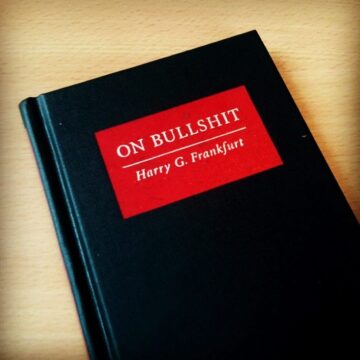 Some things in life are very hard to give up. For me, I hope in a most singular manner, it is bullshit. I have spent nearly twenty years reading whatever literature I can find on what bullshit might be. Since the publication of Professor Harry Frankfurt’s
  In the late 1960’s and early 70’s, my maternal grandmother spent a lot of time in the United States. She would return to Iran, her suitcase filled with presents like candy and fruity bubble gum for her grandchildren, and pretty shirts and dresses for our mom. She also brought back a part of her daily American life: cartons of red Winston cigarettes, Crest toothpaste, hand and face creams with English writings on the bottles, and Dial Soap in that beautiful saffron gold color that was unlike any soap I had seen or smelled before. Our soaps in Iran were usually either flower scented and over perfumed, or green and organic because of the local olive oil used to make them. Everyone valued the green soaps, but I just wanted the American gold soap. I would watch her put the soap back in a plastic container after her shower to keep it from drying and when she was away from her room, I would go open the plastic container and smell the
 With apologies to Charles Dickens, it will be the best of times, it will be the worst of times.



 Sughra Raza. Self Portrait in Early Summer, May 2024.



 In 1762, Jean-Jacques Rousseau prophetically declared that “we badly need someone to teach us the art of learning with difficulty.” Two hundred and fifty years later, Rousseau’s words seem clairvoyant in their relevancy to schooling in the United States. Education has come to the forefront of the array of issues emerging in the post-Covid era. The abandonment of the alphabet soup of standardized tests, student reliance on Chat GPT, and rampant grade inflation all point to a wider problem. And though some politicians see the Ten Commandments as the solution to classroom troubles, universal progress toward a real solution seems far away. Not that some don’t try.