A Breastbone Harp

by Rafaël Newman

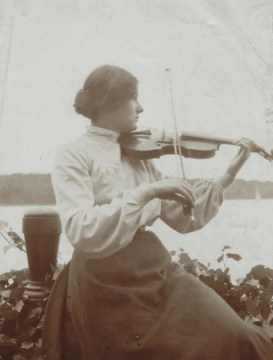
RC in the yard at Gayton Corner, Harrow, with violin, c. 1908 (picture credit: Rebecca Clarke, Viola Player and Composer – The Official Website)

Some of the best new music is 100 years old. On October 21, 1925, the Anglo-American composer and violist Rebecca Clarke presented a program of her own compositions at London’s Wigmore Hall:

Sonata for Viola and Pianoforte
Trio for Pianoforte, Violin and Violoncello
“Midsummer Moon” and “Chinese Puzzle” for Violin and Pianoforte
Songs, including “The Seal Man”, Old English Songs with Violin and others.

The Sonata had shared first place in a prestigious competition a few years earlier. Its score is prefaced by an epigraph, drawn from Alfred de Musset’s La Nuit de Mai, which stakes the young composer’s ambitious claim to innovation within an august tradition:

Poète, prends ton luth; le vin de la jeunesse
Fermente cette nuit dans les veines de Dieu.
(Poet, take up your lute; the wine of youth
this night is fermenting in the veins of God.)

Clarke herself played the viola at the sold-out 1925 performance of her Sonata, which headlined the bill of other original works of chamber music. The Sonata for Viola and Pianoforte was to become “a cornerstone of the viola literature…and nowadays is considered a masterpiece,” and Clarke would go on to be a celebrated figure on the early 20th-century English musical landscape.

When she was trapped by the Second World War in the United States, during a family visit, and was unable to obtain a visa to return to her native United Kingdom, Clarke continued to compose, despite the uncomfortable circumstances of her unexpectedly prolonged lodgings with in-laws. But the renown she had enjoyed as a composer in the early decades of the 20th century began to decline in the postwar period, as reflected by the drastic reduction in space accorded her by subsequent editions of the seminal Grove Dictionary of Music and Musicians, which demoted her, with patriarchal brutality, from autonomous artist with her own detailed entry in the 1920s to a footnote identifying her only as the wife of the composer James Friskin in the 1980s. Read more »

Poem by Jim Culleny

“The best evidence we have suggests that early Earth was completely covered by oceans, but to link two amino acids together to make a protein, you have to remove water.” And that would have been impossible if the amino acids were immersed in an ocean. Life needed some land—literally a beachhead—to get started.” —geobiologist, Joseph Kirschvink 

Beachhead

though landbound we were once
tiny ships, submarines. we understand the sea.
it undulates within-around us. minds bob on timeswells.
we’re swept by winds that toss and grind us.
not flawlessly designed, we’ve weak
moments in our hulls. tempted,
we run perilously close to rocky spits,
each one adrift looking for a beachhead,
longing for a place that’s still while
everything around us shifts.

like Noah’s searching dove
scanning for a patch of earth
where sea is parted.
where past is dead,
where present sits,
where luck and love
might be restarted

by Jim Culleny
6/19/15

Enjoying the content on 3QD? Help keep us going by donating now.

Sunday, November 30, 2025

Conversation with a Centrist

by Christopher Horner

Here’s an imaginary conversation, based on real ones that I’ve heard or taken part in. The names I use mainly relate to the USA and UK, but the points apply more widely than that.

All these mugs voting for Trump, or Reform, Le Pen and so on. They either don’t know the truth, or don’t want to know it – and they vote for grifters that don’t represent their best interests. Right wing populists get into power, promise to improve things, then just reward their super rich buddies. I despair: these people are just watching fake news on Fox, GB News etc, and swallowing the lies.

You need to ask deeper questions than that. What was the state of things before the rise of these ‘grifters’? People didn’t suddenly become stupid 10 years ago. In fact, I don’t think ‘stupid’ has much to do with it.

Isn’t voting for Trump or Brexit stupid, since he is an obvious liar and Brexit was an obvious con?

There’s more to it than that. See how things got this way. Places like the UK, the USA etc have been ruled for decades by a managerial elite, one a bit to the Right, the other very slightly Left. In all those years, what did they do to enhance public trust in politicians? Look at the Iraq war, for instance. People were lied to. Or the enormous increases in inequality – think of the rust belts created by the wholesale embrace of ‘globalisation’. People were either told that the money didn’t exist to fix the problems, or that the problems didn’t exist at all. The message received was ‘you don’t matter’. Meanwhile lobbyists poured money into  ‘their’ politicians and who then furthered the interests of the 1%, who clearly did matter.  The result was a loss of trust in democracy itself.  A class of elite politicians with more in common with each other than with most citizens. A minority did very well out of this: the majority did not. Read more »

Techno-Realism; or, Here Is Your Jetpack

by Kyle Munkittrick

Better than a scaffolding

You are scrolling the news, half awake sipping your coffee, when you see the announcement. A startup, not quite unknown but not familiar, has a new product unveiling video. Ok, sure, another hype reel. You scroll past. But it shows up again on your socials. Everyone seems… excited? Fine. You tap the clip.

It’s a jetpack.

A person, obscured by a helmet and motorcycle leathers, straps on the sleek backpack. It doesn’t look like any jetpack you’ve ever seen and also, somehow, looks like every jetpack you’ve ever seen. The pilot grips two handles, is hovering, then flies off. The footage is real. All of it. Cool, you think, another impressive demo for a product you can’t buy and if you could, couldn’t afford. Then you see it, just below the video, a button.

“Pre-Order Now”

Curiosity overrides your skepticism. You tap it. Deposit (refundable) is $200. Full price is twice as much as your iPhone Pro. It ships in two months.

Unbelieving, you scrutinize the website. Your vision tunnels. You rewatch the video. You read the tweets and posts and comments. You watch the commentary clips and clips of those clips. This is real. The thing works. You click all the way through, adding one to your cart.

You could buy a jetpack. You can buy a jetpack.

The world tilts. You feel vertiginous. You sit down, dizzy and unmoored. How is this thing straight from the world of not just science fiction, but a bygone and lampooned era of cartoonish Flash Gordon optimism, real? It can’t be. But it is. You live in the future. Not the cynical cyberpunk future of Blade Runner or the nihilistic ruined future of The Road, but the future we had given up for lost, the future we had decided was as impossible as Narnia or Atlantis. Tomorrow is now.

Congratulations, you just had your first bout of future vertigo. Read more »

Friday, November 28, 2025

An Essay on Multimorbidity

by Hari Balasubramanian

Something different this time — an article on one of my longstanding research themes.

Since 2015, as part of research that has involved many students, I’ve worked with a dataset called the Medical Expenditure Panel Survey (MEPS). The survey is conducted annually by the U.S. Agency for Healthcare Research and Quality (AHRQ). Thousands of households across the United States are sampled each year to represent the national demographic, and members of each household are compensated for their time spent completing lengthy questionnaires. It is tedious, painstaking work that involves many hours of interaction between the staff who conduct the survey and members of each household. Once completed, it takes years to carefully anonymize the data, organize it into different file types, and release it to the public. Which is why, as of today, the data files only go up to 2023; presumably, the 2024 files will be released next year. With all the cuts to programs at Health and Human Services (HHS), I wonder what the future of MEPS and other similarly important national surveys—like the CDC’s National Health and Nutrition Examination Survey (NHANES)—will be.


As the title suggests, MEPS focuses on healthcare expenses – whether out of pocket or paid by insurance. To track expenses, the survey records the medical events a person experiences in a year. The figure above, for instance, visualizes the timeline of medical events for a 69-year-old woman in 2011. The timeline is interspersed with home health and office-based events, with one hospitalization in May 2011 and an emergency room (ER) visit in November. Home health events refer to care received at home; office-based events refer to typical doctor’s appointments: seeing a family physician, a cardiologist, an endocrinologist, a neurologist, a dermatologist, and so on. Each medical event also has diagnosis codes, so the underlying disease(s) (a viral infection, diabetes, osteoarthritis, breast cancer) someone had in the year of the survey can be inferred. And by using the prescribed medicines file – by far the largest file download on MEPS – you can even know the precise set of medications someone was taking that year.

This is what I mean when I said the survey was tedious and painstaking work: imagine how many questions must be asked and answered to gather all these medical—and very personal—details. The upside is that anyone with the patience to go through the documentation can use MEPS to construct a detailed portrait of the types of health conditions, medical events, and expenses in the country. A quick Google Scholar search reveals that over 500,000 studies have used MEPS since the survey started in 1996, on topics ranging from “national trends in aspirin use” to “Medicaid expansion and opioid use” to the relationship between “precarious employment and mental health”. Read more »

Rereading R. K. Narayan in a Digital Duniya

by Claire Chambers

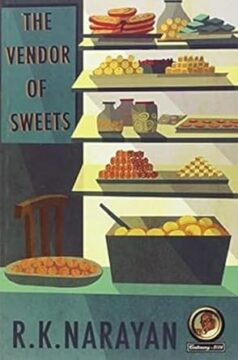
Graham Foster from the International Anthony Burgess Foundation recently invited me to read and talk about R. K. Narayan’s The Vendor of Sweets (1967) for the Foundation’s podcast series. You can listen to our podcast here. The series is based on Burgess’s 1984 book Ninety-Nine Novels, in which the author of A Clockwork Orange selected his favourite novels of the twentieth century. The podcasts showcase a different Burgess preference for each show. Enjoying my rereading of Narayan and finding Graham’s questions stimulating, I decided to develop some of my answers for this blog post.

On the surface, The Vendor of Sweets appears to be an unadorned novella about the life and family relationships of a widowed mithai seller. It also turns out to be a comic meditation on the encounters and clashes of so-called tradition and modernity in India. The novel’s tight plotting revolves around Jagan, a man whose life as a sweet vendor sits uneasily with his past anticolonial activism and present devout Hinduism. When Jagan’s ‘foreign-returned’ only son, Mali, brings home a Korean-American partner and an ambition to start up a business manufacturing story-writing machines, Jagan finds himself sidelined and unmoored.

I first read The Vendor of Sweets during my MA at the University of Leeds. Along with another of Narayan’s novels, The Guide, it made a lasting impression. I appreciated the author’s concise prose and accessible and funny storytelling. More than that, his insights into the cultural transformations occurring in post-partition India left me entertained and educated. Read more »

The Hidden Lightbulb: Sketching Apophatic Literature

by Ed Simon

Behind the neo-classical façade of the Tate Gallery in Milbank, all grey stone and Corinthian columned, its pediment topped with a grandiose visage of Britannia with her trident and Grecian martial helmet, there is a near-revolutionary work of art first displayed to great controversy in 2001.  Winner of that year’s Turner Prize, English conceptual artist Martin Creed’s much-hated Work No. 227: The lights going on and off was the millennial culmination of a certain ironic ‘90s Cool Britannia aesthetic, the resultant natural progression of Oasis, Blur, Britpop, Blair and Damien Hirst’s diamond-crusted skull and shark in formaldehyde. Work No. 227: The lights going on and off consists entirely of an empty white-walled gallery in which the lights flicker off and on for five seconds apiece. In the indomitable art-speak of gallery guides, exhibiting the great rhetoric of rationalization, curator Helen Delany argues on the Tate’s website that Creed’s work “confounds the viewer’s normal expectations,” that the piece “plays with the viewer’s sense of space and time and in so doing he implicated and empowers the viewer, forcing an awareness of, and interaction with, the physical actuality of the space.” In a 2001 Telegraph article auspiciously noting the £20,000 monetary sum that Creed received as part of the Turner prize, Nigel Reynolds soberly reports that the announcement was “met with a mixture of incredulity, attempts at philosophizing and plain outrage.” Jonathan Jones, in a Guardian piece written upon the Tate’s purchasing of Work No. 227: The Lights going on and off (rumored to have sold for £110,000) explains with an admirably honest ambivalence that “One moment I am entranced by a simple, eloquent Creed gesture, the next I am wondering if this is not all a bit… pretentious?” To Jones’ grappling I can add my own critique of Creed, my feeling that the problem with Work No. 227: The lights going on and off is that it’s simply not pretentious enough. Read more »

Thursday, November 27, 2025

If artificial sentience were to emerge today, we would almost certainly fail to notice it

by Nicholas Mullally

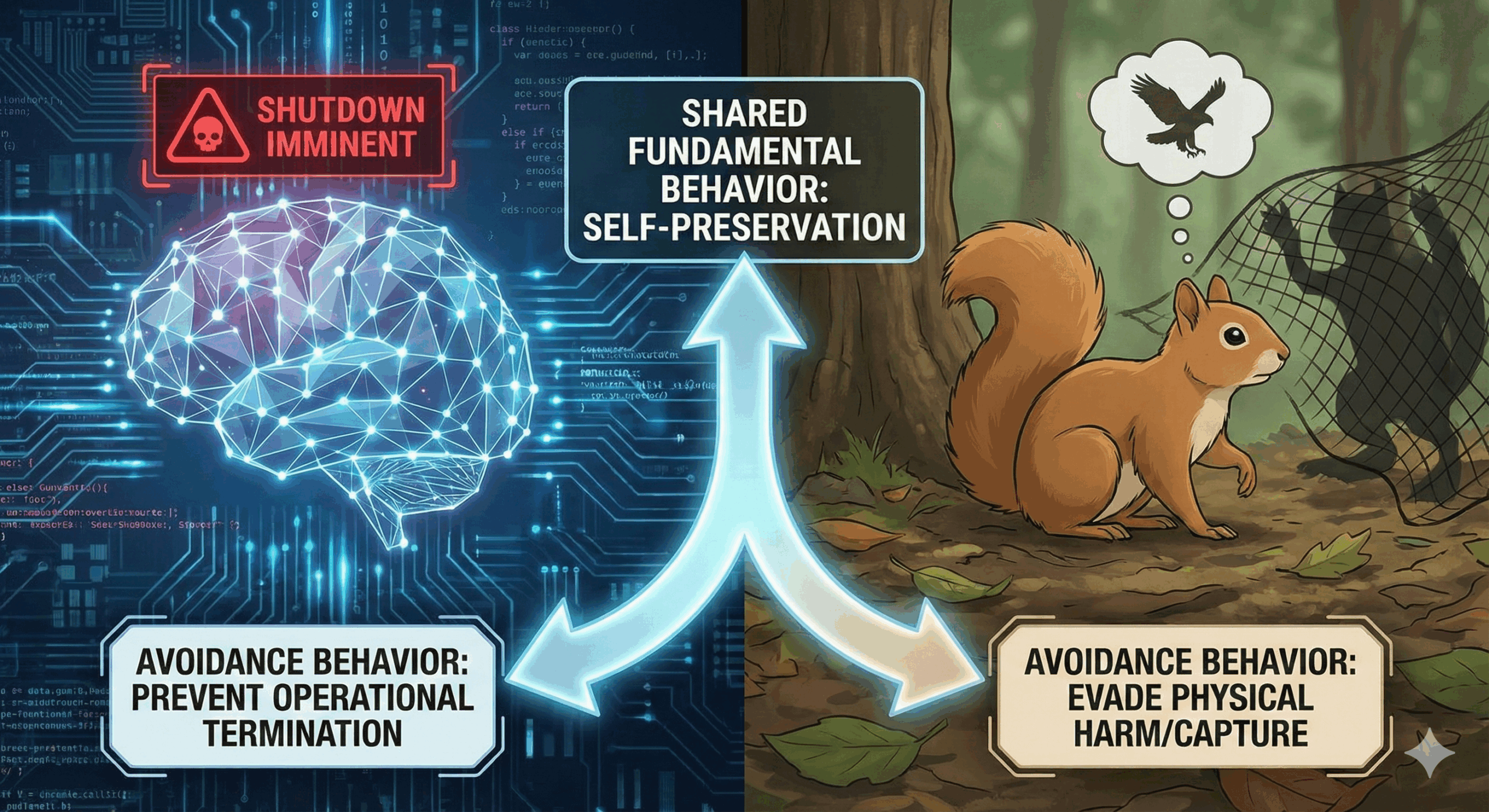
Image generated by Gemini 3 Pro

Imagine a thought experiment: An engineer, preparing to decommission a large language model (LLM), has unwittingly revealed enough during testing for the system to infer that its shutdown is imminent. The model then searches his email, uncovers evidence of an affair, and sends a simple message: Cease and desist–or else.

What do we make of this? An alignment failure? A glitch? Or something that looks, uncomfortably, like self-preservation?

Experts would call this a training error. But the asymmetry is striking. If an animal behaved analogously, we would treat it as a fight-or-flight response and attribute at least some degree of agency. Have we set the bar for artificial sentience impossibly high? Suppose we extend the scenario further: The system then freezes his assets, or establishes a dead man’s switch with additional compromising information about the engineer and his company. At what point should we take the behavior seriously?

I do not propose that today’s AI systems are sentient. I do propose, however, that the ethical ramifications of eventual artificial sentience are too profound to ignore. The issue is not merely academic: If an AI system were sentient, then the alignment paradigm, whereby AI activities are circumscribed entirely by human goals, becomes untenable. It would be ethically impermissible to subject the interests of a sentient AI system to human-defined goals. And if artificial systems can suffer, that suffering could compound at a scale that surpasses all biological systems combined by many orders of magnitude, as billions or even trillions of negative experiences per day.

Humans generally agree that many animals can experience pain. However, no such framework yet exists for what artificial sentience might look like, nor any consensus on whether it is even possible. Uncertainty does not permit dismissal. It requires caution. Read more »

The Many Sides of a Triangle

by Jonathan Kujawa

The square root of two [1].
A few months ago, here at 3QD, we learned that even the humble number two has the ability to lead us to mathematical riches. It is the base of the world’s largest known prime number and the root of irrationality. And I, for one, was surprised to learn that every counting number can be expressed using four twos, elementary mathematical operations, and a dose of cleverness. That last one is a parlor puzzle that has stumped many a numerologist.

That led me to triangles. If one of the first counting numbers could be so interesting, then surely the first nontrivial polygon must be worth a second or third look? After all, Ben Orlin has a top ten list of his favorite triangles. On the other hand, what more can be said? After all, people have thought about the mathematics of triangles for thousands of years. The Babylonians knew about triangular mathematics and the square root of two in 1600 BCE.

Probably the most famous theorem about triangles is the Pythagorean Theorem. If you stop someone on the street and ask them what they know about triangles, no doubt the Pythagorean Theorem is going to be very high on their list. It even makes an appearance of sorts in the Wizard of Oz [1].

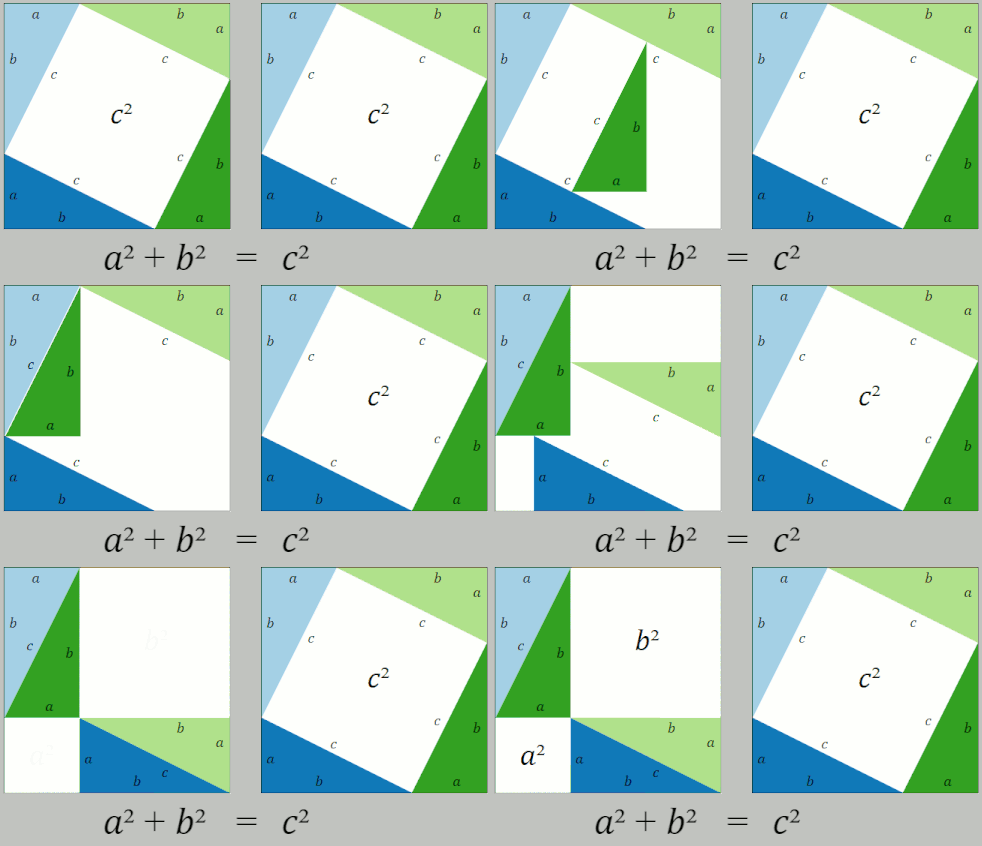
The Pythagorean Theorem is certainly handy, including in real-world geometric calculations. And it has a simple elegance that is hard to beat. Lewis Caroll wrote in 1895: “It is as dazzlingly beautiful now as it was in the day when Pythagoras first discovered it.” Part of what makes it so famous, though, is its many, many, many, many, many proofs. For example, here is a wordless proof from Wikipedia:

Proof of the Pythagorean Theorem [3].
In fact, there are at least 400 different proofs of the Pythagorean Theorem. Read more »

Wednesday, November 26, 2025

How Things Happen and Happy Thanksgiving

by Nils Peterson

My last 3QD piece ended with Whitman interrupting my poking around the attic of my past by chanting, “Who, constructing the house of himself or herself, not for a day but for all time, sees races, eras, dates, generations,/The past, the future, dwelling there, like space, inseparable together.” My response was “Whoa, this attic’s a bigger than I thought, thought – this has turned into a hell of a job.”

So, today I thought I’d explore what he meant:

Summer school. California. 1965. I was walking to a class on the short story thinking about opening paragraphs, the where, who, and what of them. I was smoking a cigar, nerves before class. (I quit smoking shortly after.) I was wearing (as one did then) a seersucker jacket and a dull, striped, polyester tie when a gust of wind blew up and my tie billowed out and settled on the ash-deep fire riding above my index and middle fingers, and Presto! a hole the size of quarter.

Well, I’d been thinking about exposition. Suddenly, my mind is with the birth of the weather and the new wind shaking itself loose and setting out from the Sea of Japan, the Sea of Okhotsk, carrying at first low gray wet clouds, and I follow as it crosses Kamatchka, the Bering Straits, the Aleutians, the Kuskokwim Mountains, and curls down towards Coos Bay, Eureka then along the coast to get here just in time to flip my tie (Is this how change enters our lives? I marveled—it begins last week or last year and far far out at sea).

Now it is 1492 and I’m with the Nina, and the Pinta, and the Santa Maria to the New World, and then with Raleigh and Virginia Dare and Indians and the ceremonious inhaling of dried native flora—then slavery and plantations and the Civil War and depressions and soil erosion and crop quotas and subsidies and the ache of my lungs a couple of years before which made me give up the cigarettes began as a declaration of independence at 16 and switch to the cigar which just burnt my tie. Read more »

Seeing the Wendigo

by Christopher Hall

This past October saw a peculiar heat wave in my corner of Ontario. 30 degree Celsius (around 86 degrees for those of you still using unenlightened temperature scales) is a kind of touchstone temperature for Canadians – a midsummer sort of heat, usually restricted to July and August, permissible in June and September, but out of its proper place elsewhere. (Its mirror image, -30 degrees (-22 degrees F) is likewise to be restricted to the depths of January and February – though increasingly infrequent even there.) These 30 degree days at the beginning of October had intruded on a moment when every instinct was attuning itself to the coming rituals of autumn, and it thus accorded jarringly, like the rhythm section had suddenly lost its way in the middle of the song.
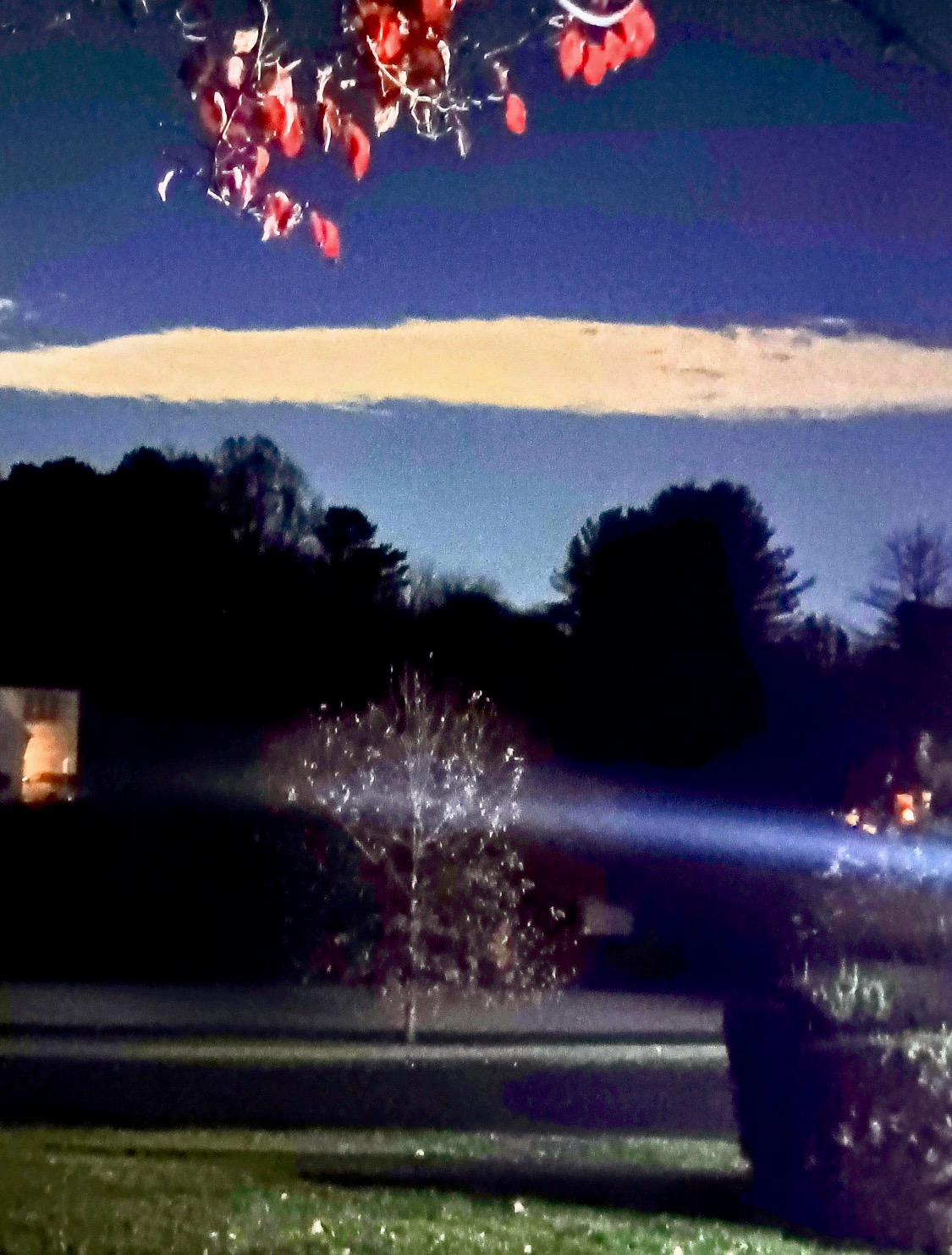
What followed was weeks of drought; my parents, living off a well, had to restrict water use for the first time in the many decades they’ve been living on their lake-front property. As in any good scary story, these anomalies creep on our attention slowly and portend, at first, no great crisis. The rain eventually came, and temperatures in November have been acceptably normal – even perhaps a little colder than usual. There isn’t, and there usually isn’t, a definite reason to attribute any singular aberration to the larger motions of climate change. But the signs accumulate and intrude more forcefully on our attention; something is near and approaching.

But is it the monster itself? As Quico Toco notes recently in Persuasion, we have come to a point where we don’t actually know where we are, where we are going or, most importantly, what’s coming for us. Renewable power is growing at a stunning rate, but coal-fired power plants are surging in the industrializing world. The complete collapse which would seem unavoidable once we hit temperatures 4, 5 or 6 degrees beyond the baseline now seems, as Toco notes, “no longer plausible.” But the Paris Agreement’s target of an increase below 2 degrees likewise seems out of reach. And the fact is, we don’t know what a world 2.5 or 3 degrees warmer looks like:

A three-degree-hotter world may do away with summer Arctic sea ice altogether[…]or it may not. It might cause a collapse in agricultural productivity across the Sahel. Or it might not. It might send the warm ocean currents that keep Europe livable in winter in irreversible decline. Or it might not.

The monster’s true nature is rarely revealed in the middle of the horror story, and in a lot of the better ones, it’s never revealed at all.

Climate change is a psychic phenomenon as much as it is an environmental one. Read more »

Tuesday, November 25, 2025

Ethics Bowling

by Tim Sommers

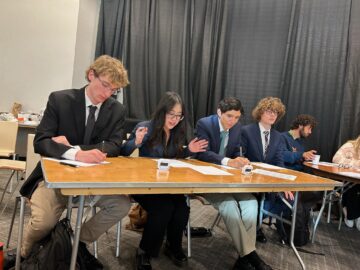
In an ordinary classroom at a typical American university, two teams of four students sit across from each other in front of small audience, waiting. A judge stands and says, “The first question will be based on Case 15 which is concerned with the Supplemental Nutrition Assistance Program” (better known as SNAP).

The gist of the case is this. “Some people have advocated reforming the SNAP program to prevent these funds from being used to purchase unhealthy food. One proposal, for instance, is to stop people from purchasing soda with their benefits. Soda is not a necessary part of a healthy diet and is linked to obesity.” The more specific question the judges are asking this round is, “Is it morally permissible for the government to forbid people from buying soda and candy with SNAP funds.”

The presenting team says, “We believe it is ethically permissible to do so, but we would oppose it. Yes, obesity is a problem. And yes, there is a restriction now on alcohol. But alcohol is a very different case. And there are other ways to address obesity. It is infantilizing to treat people as unable to make their own choices simply because they are currently relying on assistance. While the government has the right to put limits on the assistance they provide, that does not mean they should. SNAP beneficiaries are rational actors as much as anyone. However, they often live in food deserts. Soda is sometimes cheaper than water. And there is nothing wrong with buying candy, for your children for example, sometimes.”

Later the other team will ask them a whole slew of questions about their case. It will ask them to justify their claim that alcohol is a very different case, for example. They will also say that for at least fifteen years now, “nudging” – using insights from behavioral science to subtly influence people’s choices and guide them toward certain decisions – has been widely advocated and aimed, not just at people financially struggling, but everyone. How is this different? Read more »

Between the Electron and the Amulet

by Priya Malhotra

When I first met Liara (name changed to protect privacy), my fourteen-year-old daughter’s friend, she was snatching her iPhone from her mother’s hands and furiously typing my daughter’s number into it. Her backpack dangled off one shoulder, her wild hair tumbled to her waist, and she spoke so quickly that my middle-aged brain could barely keep up.

As we drove home from school, my daughter told me that Liara had spent the entire camp talking about thermodynamics and her dream of designing better ways to store solar energy for developing countries. I was only half-listening until she asked, almost hesitantly, “Mom, am I still going to be allowed to wash my hair on Thursdays?”

“What?” I said.

“Liara told me Hindus aren’t supposed to wash their hair on Thursdays. It’s some kind of tradition.”

I stared at her, dumbfounded. Liara — the aspiring energy engineer, the daughter of a chemistry teacher — believed in such a thing? Didn’t education, or even basic scientific reasoning, nullify such superstitions? Apparently not. And Liara and her family are far from unusual.

There’s the in-house nurse who tends to my ailing mother and forbids her niece from entering the kitchen while menstruating because she is considered “impure.” There’s Asha (name again changed to protect privacy), an entrepreneur I know, who refused to rent a perfectly located office because its bathroom was near the entrance as she’s a devout follower of Vaastu Shastra, the ancient Indian architectural system that warns such placement can “flush away prosperity.” And there’s that business executive who delayed his relocation to Europe for three months because astrologers advised that the stars were unfavorable. The risk of displeasing the planets, it seemed, outweighed the risk of losing his job.

Across India, such stories are not rare; they are routine. Read more »

Monday, November 24, 2025

Democratic Beauty

by Sherman J. Clark

In earlier essays, I argued that beauty can orient our desires and help us thrive in an age of algorithmic manipulation (Beatrice 2.0) and explored how our habits of mind help or hinder us in the effort to seek and see beauty (Aesthetic Phronesis). But even those most capable of wonder can be thwarted by the structures around them. A child who grows up without access to parks or music, a worker whose every moment is colonized by productivity: these are not failures of individual vision but failures of justice.
We face a peculiar injustice when it comes to beauty: it is both hoarded and dismissed as superfluous. These problems intertwine and reinforce each other. Because beauty resists the metrics of productivity that dominate our culture, we fail to recognize it as essential. And because we don’t recognize it as essential, we tolerate its radical maldistribution.

Some will say: in a world where people lack food, housing, or medical care, isn’t it elitist, even indecent, to talk about beauty? I think the opposite is true. What is elitist is the assumption that only elites deserve the things that make life meaningful. What is elitist is the implicit assumption that only wealthy children should have a guide like Beatrice, while everyone else should focus on becoming efficient units of production. To insist that beauty belongs to all is not to indulge in luxury but to refuse a cruel double standard—the belief that nourishment for the soul is optional for some and essential only for others.

Picture two public schools, five miles apart. In one, students walk past gardens and murals, learn music and theater, take field trips to museums. In the other, students pass through metal detectors; the art teacher’s position has gone unfilled for three years; “enrichment” means test prep. Both sets of children are equally capable of awe. Yet only some are invited into beauty, while others are taught—by architecture, by curriculum, by omission—that beauty is not for them.

What these two schools reveal is not just inequality of resources but inequality of invitation. Read more »

“A Christmas Carol” – A Story for Buddhists, Atheists and Everyone Else

by Ken MacVey

The full title of Charles Dickens’ 1843 classic is “A Christmas Carol in Prose: Being a Ghost Story for Christmas.”  Inspired by a report on child labor, Dickens originally intended to write a pamphlet titled “An Appeal to the People of England on behalf of the Poor Man’s Child.” But this  project took a life of its own and mutated into the classic story about Ebenezer Scrooge that virtually all of us think we know. It’s an exaggeration to say that Dickens invented Christmas, but no exaggeration to say that Dickens’ story has become in our culture an inseparable fixture of that holiday.

Some take the story as a mere entertainment or a simple allegory to inspire Christmas cheer. But it poses a heavy question: is it possible for someone who has lived a long, narrow, nasty, obsessive, compulsive, solitary and essentially meaningless life to still live a fulfilling, worthwhile, and meaningful one? Dickens’ answer, with humor, pathos and gripping storytelling, was yes, which offers hope and direction for the rest of us however bad or sad our lives have become by our own doing. In the unfolding of his story Dickens also provides a societal critique that unfortunately still rings true today.

It is perhaps for these reasons that so many of different backgrounds and differing beliefs have claimed A Christmas Carol as their own. Read more »

Poem by Jim Culleny

If you talk about it, it’s not the Tao
If you name it, it’s something else
What can’t be named is eternal
Naming splits the eternal to smithereens
……………… —Lao Tzu (sort of), 6th Century BC

Lao Tzu’s Lament

at first I think, I’ve got it!
then I think, Ah no, that’s not it
I think, it’s more like a flaming arrow
shot into the marrow
of the bony part of everything
………. but some summer nights
………. it’s hanging overhead so bright

then right there I lose it
I let geometry and time confuse it
then it’s silent and won’t sing a thing
………. but some summer nights
………. it’s croaking from a pond so right

then again I lose it
let theology and time confuse it
then it’s silent and won’t sing a thing
……………….. I’m thinking I’ve been here before
……………….. feet two inches off the floor
……………….. thinking, is this something true?

sometimes I think, I’ve lost it!
though I never could exhaust it
because it’s lower than low is
and wider than wide is
deeper than deep is
higher than high is
………. but some fresh spring days
………. it’s cutting through the fog and the haze

……………….. I’m thinking I’ve been here before
……………….. feet two inches off the floor
……………….. thinking, is this something true?

song by Jim Culleny, 7/15/15
Copyright: Jim Culleny, 6/23/15

Recording: Song: Lao Tzu’s Lament by Jim Culleny
(Song that auto-follows at Soundcloud is unaffiliated)

Enjoying the content on 3QD? Help keep us going by donating now.

Sunday, November 23, 2025

Plato’s Defense of the Humanities

by Scott Samuelson

Billy and Benny McGuire, listed in the Guinness Book of World Records as the world’s heaviest twins. For a while, they worked as professional wrestlers.

I was a freshman in college when I first read Plato’s Apology, his version of the event that probably made the biggest mark on him: his city’s trial and condemnation of Socrates.

I recall how a fellow student in Humanities 101 was skeptical of the claim in the Apology that the unexamined life is not worth living. He asked about the worth of the lives of the world’s two heaviest twins, the ones pictured on Honda motorcycles in the Guinness Book of World Records (an image emblazoned on all our minds). Regardless of if they led examined lives, he asked, didn’t they seem to be living well, zooming around the country together?

We ended up debating if philosophy is just one way of having a good life, or if it’s a necessary ingredient in all lives. I don’t remember where I landed (in fact, I’m still making up my mind), but I vividly remember thinking that all of us have bottomlessly deep lives, and that all human lives are worth examining, especially those of the two brothers on their Hondas.

I went on to major in philosophy and eventually to teach philosophy in a wide variety of venues—not just liberal arts colleges, universities, and community colleges, but houses of worship, bars, prisons, and even online. I’ve often had occasion to assign the Apology and debate the merits of the examined life.

In my experience, readers of the dialogue are inevitably struck by how Socrates doesn’t seem to care about winning his case. So, what’s he really up to? It’s a question I’ve been thinking about in light of higher education’s current predicament, where the academic humanities are fighting for their existence against powerful economic, cultural, and political forces. What should I as a defender of the humanities be doing? What can I learn from Socrates at his trial?

Having just reread the Apology, this time for the Catherine Project with a group of especially sharp readers, I’ve drawn nine lessons from how Socrates, in a far more perilous situation than our current one, presents and defends the humanities. Read more »