by Christopher Horner

Here’s an imaginary conversation, based on real ones that I’ve heard or taken part in. The names I use mainly relate to the USA and UK, but the points apply more widely than that.
All these mugs voting for Trump, or Reform, Le Pen and so on. They either don’t know the truth, or don’t want to know it – and they vote for grifters that don’t represent their best interests. Right wing populists get into power, promise to improve things, then just reward their super rich buddies. I despair: these people are just watching fake news on Fox, GB News etc, and swallowing the lies.
You need to ask deeper questions than that. What was the state of things before the rise of these ‘grifters’? People didn’t suddenly become stupid 10 years ago. In fact, I don’t think ‘stupid’ has much to do with it.
Isn’t voting for Trump or Brexit stupid, since he is an obvious liar and Brexit was an obvious con?
There’s more to it than that. See how things got this way. Places like the UK, the USA etc have been ruled for decades by a managerial elite, one a bit to the Right, the other very slightly Left. In all those years, what did they do to enhance public trust in politicians? Look at the Iraq war, for instance. People were lied to. Or the enormous increases in inequality – think of the rust belts created by the wholesale embrace of ‘globalisation’. People were either told that the money didn’t exist to fix the problems, or that the problems didn’t exist at all. The message received was ‘you don’t matter’. Meanwhile lobbyists poured money into ‘their’ politicians and who then furthered the interests of the 1%, who clearly did matter. The result was a loss of trust in democracy itself. A class of elite politicians with more in common with each other than with most citizens. A minority did very well out of this: the majority did not.
If they aren’t stupid (which I don’t concede) weren’t they gullible? What about the lies? If big swathes of the pollution watch Fox news or their equivalents, they will just keep supporting the same crowd of thieves and liars.
They are certainly misinformed, often lied to. But do you really think the problem is just an epistemological one? That if they had better news things would improve?
Well, not if they are as stupid as I think they are.
Telling people they are stupid – or just acting like they are – is a very poor political strategy for winning anyone over. And it’s not true. If you removed Fox News and the like tomorrow, it’d help, but it wouldn’t tackle the causes of the deep disconnect between voters and what they perceive -with justice -as the elites. People have a sense they have been left behind, dumped. So, when they got the chance to vote in a way that might shake that up, they went for Trump, or Brexit or whatever. And yes, they were fed lies about e.g. immigrants being their cause of woe, but the reasons for these aren’t at the level of knowledge. If it were as simple as that, all you’d need (a big task I accept) would be a public education policy. Just tell them why they are wrong. Good luck with that.
It wasn’t just the ‘left behind’. Plenty of better off people were duped: they voted MAGA, Brexit etc.
They did. In some cases, it was because they really thought it would help them in some way. Ultimately though, you need to see that people do not always, perhaps usually, just vote for their ‘best interests’. People vote or act politically for all sorts of reasons. Desire, Emotion – rage, resentment, all play a huge role. And the role of ideology in modern society is to mobilise fantasy in certain ways. Here media does play a role. Collective fantasies about problems with fantasy solutions to fix them. These ‘solutions’ – which often intensify feelings of righteous anger – provide a kind of relief or enjoyment: ‘these [insert scapegoat here] is why things are so crap’ – and a sense of meaning and purpose in a landscape that has none.
So, they are stupid.
No: they are adrift. And you aren’t devoid of fantasy, either: fantasy about common-sense, about getting back to ‘normal’ after Trump goes, and so on. And the working of capitalism, voting repeatedly for centrist parties who do the bidding of the billionaires and not voters, who leave things as they are. Isn’t there a saying about insanity: doing the same thing repeatedly and expecting different results?
All this stuff is theoretical. It doesn’t get us anywhere. We just must vote for the nearest progressive candidate. Nothing else works.
First, there’s nothing wrong with reading a few books and getting to understand what motivates people, or how the economy works. You’re in favour of less ignorance, aren’t you?
All that theory hasn’t got us anywhere.
There’s good and bad theory. But neither is responsible for the mess we are in now. the Left was defeated in the last decades of the 20th century, and we are feeling the effects now. We need action, informed by the best thinking we can do, not despair.
OK, just vote then
But for whom? Voting for a Kamala Harris or a Keir Starmer is just a way of keeping things the same.
They are better than the alternative.
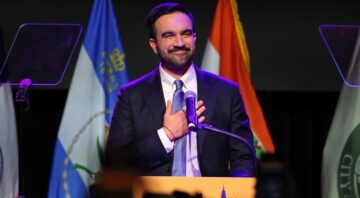
Maybe, but they lead to the alternative at the next election. Too often, ‘centrist’ parties, instead of tackling inequality, start aping right wing pseudo solutions to shore up their fading popularity. But it rarely works. Voters attracted by that kind of thing vote for the full-on racists and bullies, not the paler version of the centre. Others, as I’ve said, will vote for anything that looks like a real alternative. But that alternative need not be the Trumps, Cuomos and Farages of this world. We need, at the very least, to vote for people who represent authentic hope. Zohran Mamdani might be a good example. And we need a mass movement behind people like him.
Well, that’s my point – just vote. Revolutions are off the agenda. And ‘Mass movements’ today just spell trouble. Voting is what counts.
Voting is crucial, but only a part of what counts. Mamdani didn’t succeed just because of his undoubted talents and focus of key affordability issues that affect New Yorkers, vital though that was. He developed a huge army of campaigners – his team mobilised people, he worked with Labour unions. Politics must be about getting people active, and that can be in support of a candidate, or to achieve some other goal. Think of BDS, for instance (Boycott, Divestment and Sanctions) – that had success against apartheid South Africa and is having an effect on the exports of good from the territories occupied by Israel. Theres a long history of successful mass action – for the vote, for civil rights, and much more. Campaigns to tax wealth and not work, to help pay for decent public services, can garner a lot of support. Mamdani got that right, too.
Won’t raising taxes on the richest just lead to them leaving?
That’s a much-cited objection. But how would an under taxed landowner like the Duke of Westminster, who owns a huge part of London’s real estate take that with him? Assets like that aren’t a moveable feast. Still, I do accept that the ‘let’s tax a bit more’ policy isn’t sufficient. And there might be capital flight. Much of the wealth needs to be tackled not after it reaches the pockets of the billionaires but before. Amazon, Walmart, Berkshire Hathaway, etc are huge international organisations. Vampire-like, they have their teeth in value creation across the planet. They suck it up, and avoid tax through multiple dodges and loopholes, many of which were crafted by obedient legislators. Here I’m thinking of the very big corporations not ‘mom and pop’ stores. Assets attract investment because investors expect future profits, which avoid taxation because they aren’t net profit going into individual oligarchs’ bank accounts. We need to be smarter – and more international – in our approach to all this.
That’ll be very difficult.
Agreed – but we must act on this – the grotesque inequality is killing our democracies, and the planet. Ultimately, though, we need to do more than boycott or vote – crucial though that is. We need to get beyond the unjust, damaging and inhumane political and economic system.
Oh, dear – revolutions? I don’t see that coming. That just gets you the Gulag
And Capitalism? – that got you world wars, catastrophic global warming, rocketing inequality. We must get beyond it, and saying all change is impossible because it might lead to something bad is truly a counsel of despair.
It’s more realistic and safer to stick with what we have, with some reforms to make it fairer.
But what we have is collapsing: the centre ground is caving in. There is no ‘normal’ to go back to. It’s quite wrong to assume that realism is on the side of the status quo. Being realistic means seeing the need for radical change before it is too late and then acting: being as radical as reality. The alternative isn’t between “what we have now” and “the Gulag”. That’s a false choice. Systemic change is very difficult -to put it very mildly -but it’s not about ‘Storming the Winter Palace’: the reform and radical change politics I advocate involve people moving beyond the obviously dysfunctional thing we call business as usual to something better.
I’ll believe it when I see it.
It’s either that, ultimately, or catastrophe.