
by Christopher Hall
Comic horror’s fundamental lesson is that the world is not what it looks like. This thought is given particularly sharp expression in John Langan’s The Fisherman:
‘When I look at things – when I look at people – I think, None of it’s real. It’s all just a mask, like those papier-mâché masks we made for one of our school plays when I was a kid…All a mask…and the million-dollar question is, What’s underneath the mask? If I could break through the mask, if I could make a fist and punch a hole in it…what would I find? Just flesh? Or would there be something more…Maybe whoever, or whatever, is running the show isn’t so nice. Maybe he’s evil, or mad, or bored, disinterested. Maybe we’ve got everything completely wrong, everything, and if we could look through the mask, what we’d see would destroy us.
The speaker here is in grief after his entire family was killed in a traffic accident, and there is a sense that only such large dislocations can jar us out of a sense of the reality of the world around us. There is another sense, however, in which this dislocation is a fundamental condition of modernity. A person in the Middle Ages could stand on a still, firm platform and watch the universe revolve around her. It was obvious the platform was solid and still – she wasn’t moving, was she? – and from that fact many other conclusions could proceed. (This is, of course, a vast over-simplification of the medieval worldview, which, for one thing, very much did believe in non-terrestrial realities. But it remains the case that for a large part of human history the route from perception to conclusion was reasonably short.) Now, not only must we accept that we are, in fact, travelling at tremendous speeds in various directions relative to other objects, but we also do so through space that is curved, though time that slows down the faster we go, and, thanks to quantum mechanics, upon a platform where “solidity” does not mean what we expect. The winners of the Nobel Prize for Physics in 2022 won “for experiments with entangled photons, establishing the violation of Bell inequalities and pioneering quantum information science.” The actual meaning of this is beyond most people – it certainly is beyond me – but the net result is that now one may approach the oracle Google, ask whether the universe is “locally real,” and receive the answer, “No.”
When Kamala Harris, in August of 2024, began calling Trump and his base “weird,” it resonated first and foremost through the intricate codes of behaviour MAGA has indulged itself in. “Let’s go Brandon,” wearing diapers and massive ear-bandages, and the bizarre religious fetishism for a man who is in no way Christ-like, all contributed to the idea that Trump’s supporters had become, as was and is commonly said, “disconnected from reality.” Much of this may, in fact, be derived from the online world where a good deal of Trump’s support originates; to be strange is the simplest method by which to weed out the normies. This sort of political coherence is hard to come by; even so, Trump’s response was, as is common with him, reflective in the sense that he merely threw the insult back: “They’re the weird ones. Nobody’s ever called me weird. I’m a lot of things, but weird I’m not.” “I think we’re the opposite of weird, they’re weird.” And, an increasingly long time ago, at the moment of the Sixties counterculture that gave rise to the modern Democratic party, they were weird.
So MAGA is weird, and their cultural and political opponents are weird. Are they weird in the same way? Read more »
 In recent public debates it has been argued that the implementation of Artificial Intelligence in weapons systems is changing the nature of war, or the character of war, or both. In what follows, my intention is to clarify these two concepts of nature of war and character. It will show that AI is a powerful technology, but it is currently neither changing the character nor the nature of war.
 Orwell has surely been safe for ages – through just two famous books, neither of which is Keep the Aspidistra Flying. His essays seem alive too. Ideology plays a role here: he was saying things in Animal Farm and 1984 that influential people wanted disseminated. You couldn’t get through school in Britain without being made to read him. I persist in thinking him overrated. Will he fade without the Cold War? There’s no sign of it yet.

 When I think of New York City, the first image that rises to the surface isn’t its vaunted skyline, those defiant towers scraping at the heavens. It isn’t the classical grandeur of the Metropolitan Museum where civilizations whisper through marble and canvas, nor the razzle-dazzle of Broadway where melodies unfurl amidst a fever of lights and applause. No, of all the things I could remember, the image that lingers most is one of angst—dense, unrelenting and amorphous, like yellowing seepage on the walls of an old house, eating it from the inside out.
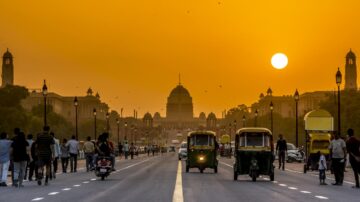 Meanwhile, in New Delhi, the capital city of India to which I’ve just returned, I’ve been startled to find a different rhythm altogether – slower, steadier, and far from the edge of a precipice. Here, the streets hum with chaos, the air is thick with dust and petrol, and the disparities between wealth and poverty gape wide. And yet, amidst this, I see people who seem—dare I say it?—happier. Their circumstances, when measured against any global standard of “quality of life,” are objectively harsher than those of the stressed and striving New Yorkers I left behind. But their faces, their words, their mannerisms suggest something else entirely.


 Sughra Raza. Self Portrait At Home. December 2024.
 After many years as a practicing lawyer, I remain proud of what I do. Putting aside lawyer jokes, stale references to ambulance chasing and analogies with other professions that charge by the hour, I have enjoyed doing what lawyers do and I am unapologetic about it.


 With its pristine rainforest, complex ecosystems and rich wildlife, Ecuador has been home to one of the most biodiverse countries on Earth. For thousands of years indigenous peoples have also lived harmoniously in this rainforest on their ancestral land. All that has now changed. Since the 1960s, oil companies, gold miners, loggers and the enabling infrastructural workers have all played their part in the systematic deforestation and destruction of this complex eco-system. Human rights abuses, health issues, deleterious effects on the people’s cultures and the displacement of people have all become part of the indigenous people’s lives. But wherever and whenever oppression, exploitation and social injustice raises its ugly head, resistance will eventually emerge, and so it is with the indigenous Waorani people of the Ecuadorian rainforest, under the leadership of Nemonte Nenquimo.